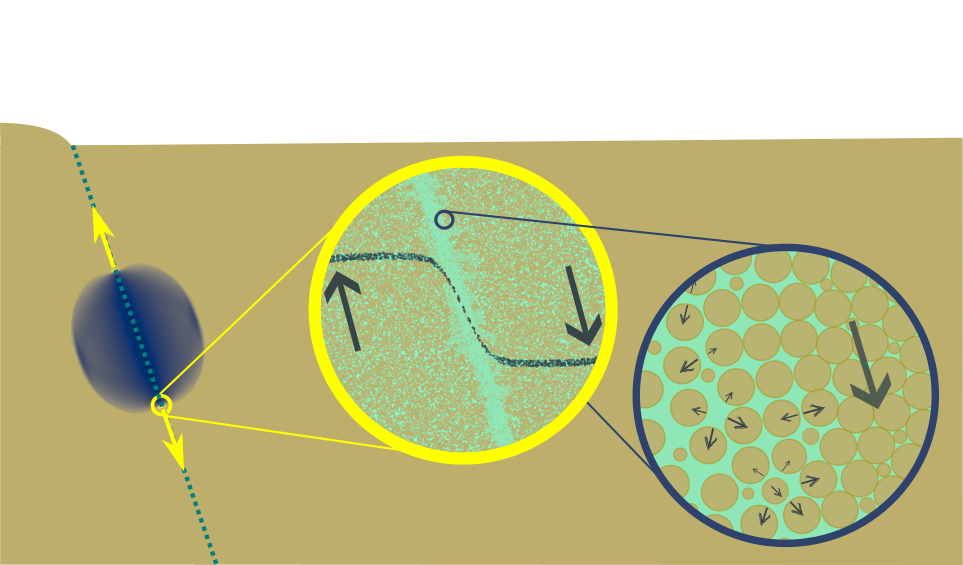
Assessing the stability of debris and sediments perturbed by fluid flow and infiltration is becoming increasingly important in the context of global climate change. At the Earth's surface, infiltration and subsurface flow play a key role in the deformation of shear zones at the base of landslides, rockslides, and glaciers. Most of the time, these layers of unconsolidated debris are not completely at rest but instead deform steadily at extremely slow rates, typically on the order of millimetres to a few centimetres per year. This mechanical regime, known as creep, is sensitive to the content, pressure, and flow of water, as evidenced by the many documented examples of creeping landslides that accelerate in response to increasing rainfall intensity.
In Norway, the most prominent example is the unstable rock mass at Åknes in Stranda kommune, where roughly 50 million cubic metres of rock standing above Sunnylvsfjorden threaten to fail and generate a catastrophic tsunami. Deformation rates on the order of tens of millimetres per year are directly modulated by precipitation. Since 2017, Norges vassdrags- og energidirektorat (NVE) has installed several state-of-the-art monitoring boreholes that continuously record fluid pressure and displacement at different depths and locations within the rockslide.
In this project, the student will use data from this exceptional natural laboratory to develop and run numerical models of subsurface flow in porous shear zones. The aim is to capture the fluid–solid interactions that govern creep deformation and its seasonal accelerations. The project also aims to teach the fundamentals of numerical modelling, including how to work with existing open-source numerical libraries. Depending on the student's interests, potential topics include the modelling of subsurface flow in porous and fractured materials, the mechanics of friction and faulting, and the rheology of saturated granular shear zones.
This Master’s project will be integrated into a cross-disciplinary research team at the Njord Centre, where you will participate in weekly meetings with other researchers from the group working on related topics.
Do not hesitate to contact Fabian (fabian.barras@mn.uio.no) if you need further information on the project.