Motivation
Volcanic eruptions are a significant natural driver of short-term climate variability. Large eruptions inject sulfur dioxide (SO2) into the atmosphere, where it is oxidized to form sulfate aerosols (SO4). These aerosols scatter solar radiation, resulting in a cooling effect on the climate. Evidence of such cooling is consistently found in temperature records, tree rings, and ice cores. For recent eruptions, the source volcano and its emission characteristics are generally well-documented; however, for past events, only the sulfate deposition signature remains in ice cores, with no direct information regarding the volcano’s location, eruption strength, or emission height.
The interpretation of these ice-core signals is complex: deposition patterns vary with eruption location, plume injection height, and seasonal circulation. Synoptic-scale weather conditions determine the transport pathways, thus influencing the geographic imprint of volcanic aerosols in ice cores. To disentangle these factors, we utilize the extensive array of Arctic and Antarctic ice cores that contain sulfate deposition records.
Research Task
The key objective is to link sulfate deposition patterns in polar ice cores with volcanic source characteristics and their climate impacts. By combining observational records with modeling approaches, we aim to answer the following questions:
- How do eruption latitude, injection altitude, and season affect the transport and deposition of volcanic sulfate aerosols?
- Can we distinguish the signatures of different eruptions in the multi-core records and estimate their relative strengths?
- To what extent can ice-core sulfate records be utilized to reconstruct the climate-relevant forcing of past volcanic eruptions?
Methodology
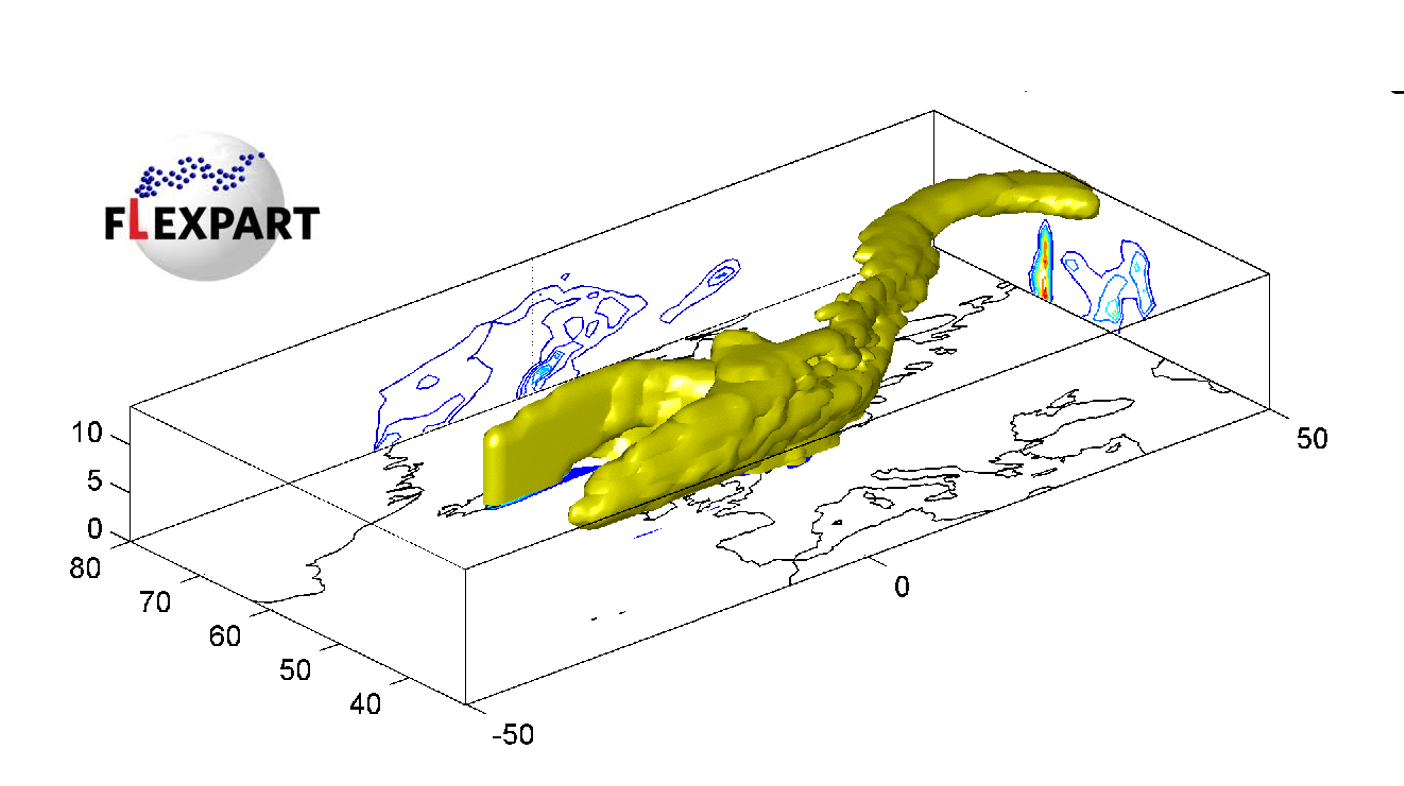
We will employ the Lagrangian particle dispersion model FLEXPART to simulate volcanic eruptions with varying source locations, injection heights, and seasonal emissions. These simulations will be compared with the spatial and temporal patterns of sulfate deposition observed in the polar ice-core array. Additionally, climate model experiments will be conducted to assess the radiative forcing and surface temperature response to different eruption scenarios. By combining transport modeling with ice-core records, we aim to build a bridge between observed sulfate deposition and volcanic climate impacts.
Outcome
This project will enhance our ability to interpret sulfate signals in ice cores and reconstruct the volcanic forcing of climate. Such knowledge is essential for distinguishing natural from anthropogenic drivers of climate variability. Ultimately, the results will contribute to refining past climate reconstructions, improving volcanic parameterizations in climate models, and providing a clearer picture of how volcanic eruptions shape the Earth’s climate system.