Background:
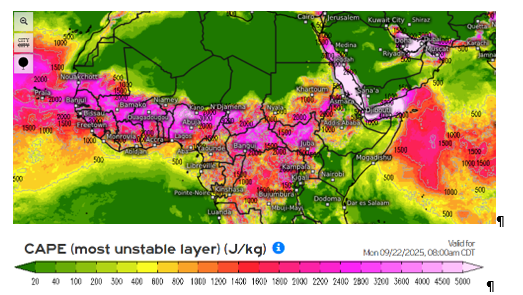
In subtropical areas, the subsiding branch of the Hadley circulation strongly suppresses precipitation due to the formation of a strong capping inversion above the planetary boundary layer (PBL). Observations and models show that the PBL itself can be quite moist due to regional evaporation from ocean areas. This allows for the build-up of Convective Available Potential Energy (CAPE; see Wallace & Hobbs, p. 345) over the Persian Gulf (Figure 2). However, the energy requirements to break through the capping inversion barrier are generally too large to allow for the formation of convective cells and precipitation.
Standard methods (or rather theories) to generate precipitation have focused on seeding clouds with ice nucleation particles to accelerate the precipitation formation process (the BWF process; see Wallace & Hobbs, section 6.6), as shown in Figure 1 (http://www.donaldisme.dk/weather.htm). A very different approach would involve enhancing the energy content of an air parcel in the PBL by warming and adding water vapour, thereby allowing it to break through the energy barrier of the capping inversion.
The Project:
In this project, the student will use the PALM large eddy simulation model (https://palm.muk.uni-hannover.de/trac) to perform high-resolution simulations for selected cases over the Persian Gulf and adjacent land areas. The initial thermodynamic properties of the air in a small number of grid cells located in the PBL will be manipulated in the model to study how much energy is needed to actually break through the capping inversion barrier. The simulations will further illustrate whether this is sufficient to allow for the formation of a deep convective cell and calculate the amount of precipitation that actually forms and eventually reaches the ground (some will evaporate as the raindrops fall through drier air).
The project will build on the method applied in the master's thesis by Ketil Ronold (duo.uio.no, 2024) to study deep convective clouds with the PALM model.
Question: Can we envisage a large floating “frying pan” (cf. Figure 3) with a strong greenhouse effect to generate an air parcel with sufficient heat and moisture to break the capping inversion barrier?
Although the project focuses on a (so far) purely theoretical case, it will provide the student with a solid understanding of how thermodynamics and cloud microphysics are parameterised in a state-of-the-art large eddy simulation model.
The project will also offer practical experience in conducting simulations on a supercomputer and in handling model results while assessing uncertainties in the outcomes.