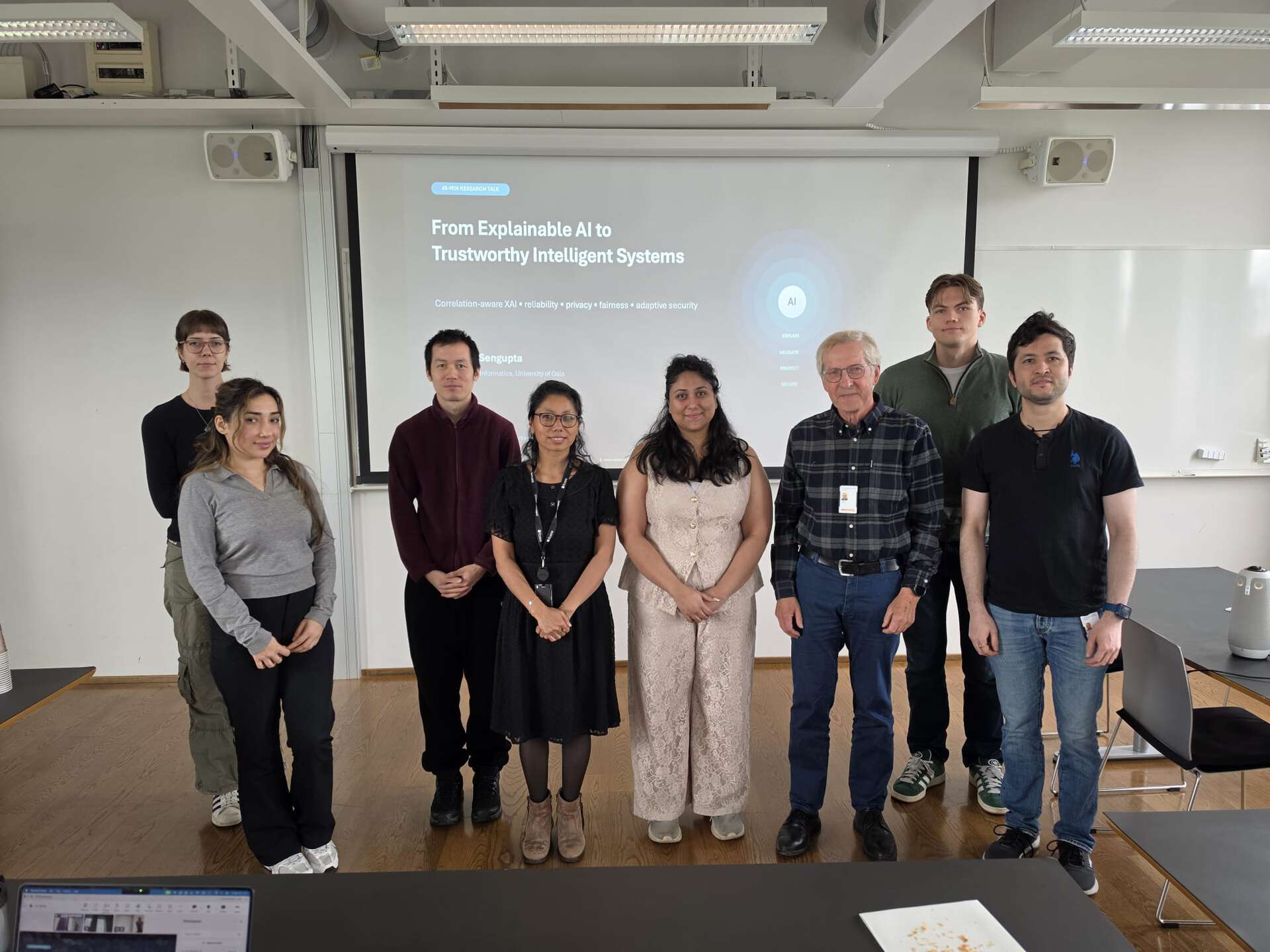
Meeting link: https://teams.microsoft.com/meet/39909295372794?p=MdGMfFwNA9zUEKA2xU
Speaker: Poushali Sengupta from IFI, UiO.
Abstract:
The growing integration of artificial intelligence into communication networks and autonomous systems demands capabilities that extend beyond predictive accuracy. AI-driven systems must provide decisions that are interpretable and reliable while operating under practical constraints related to fairness, privacy, communication, computation, and security. These requirements become particularly important in next-generation networks, where intelligent decisions are increasingly distributed across heterogeneous devices and must adapt to dynamic operating conditions. This work presents a unified perspective on the progression from explainable AI (XAI) toward trustworthy intelligent systems. At the explanation level, correlation-aware approaches such as Explainable AI with Correlation-Impact Ratio (ExCIR) and its extensions focus on balancing predictive accuracy and explainability, while explicitly accounting for dependencies among input features. Building on this, MCIR-M extends correlation-aware explanation to multivariate and nonlinear dependencies among features, enabling more expressive modeling of complex feature interactions that may not be captured by linear or pairwise relationships alone. Together, these approaches aim to produce feature attributions that remain informative and reliable without compromising predictive effectiveness. Systematic benchmarking further examines the trade-offs among explanation quality, robustness, consistency, and model performance across different data characteristics and model classes, reinforcing a central requirement for trustworthy AI: explanations should not only be available, but should remain reliable across complex dependency structures while the underlying predictive system continues to perform accurately. At the system level, hierarchical XAI (HXAI) extends explainability to distributed and resource-constrained environments, balancing privacy and explainability by controlling how information and explanations are shared across different levels of the system. This direction is further extended through X-NeGoBoX, which incorporates negotiation-based mechanisms to balance competing requirements such as explainability, privacy, fairness, and system utility in networked AI systems. Security introduces an additional dimension for future intelligent networks, where context-aware adaptation and explainability work together to establish trust. Adaptive post-quantum cryptographic mechanisms adjust security according to the current threat, mobility, latency, and resource conditions, while XAI provides a trust layer by explaining and justifying why a particular context-aware security decision was made. This makes adaptive security not only efficient and responsive, but also transparent and trustworthy for future vehicular and 6G systems. Together, these directions move from explaining AI decisions to designing trustworthy intelligent systems, integrating reliability, fairness, privacy, efficiency, and security under practical deployment constraints.