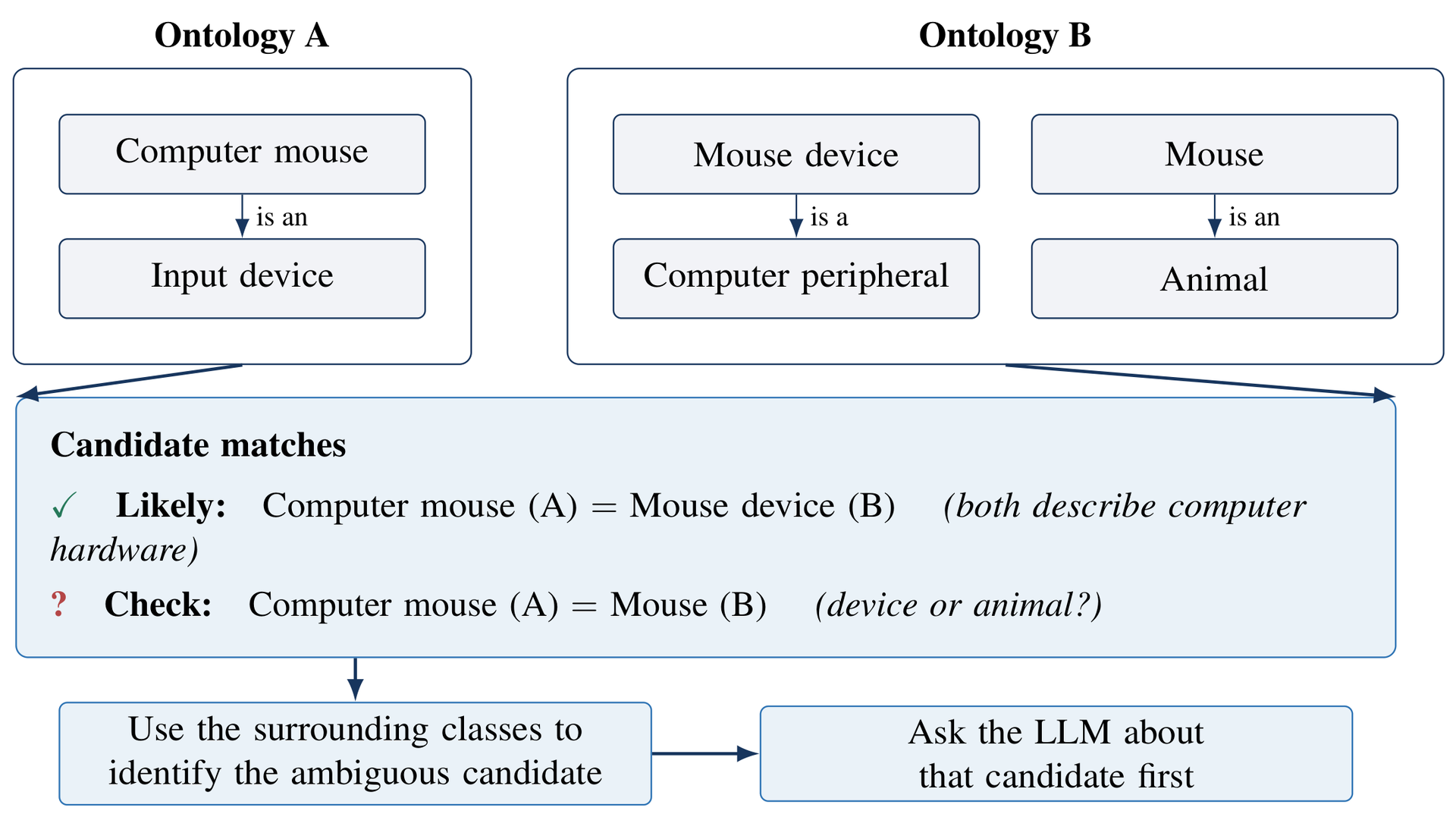
An ontology is a machine-readable description of the concepts in a domain and the relationships between them. For example, two medical databases may both describe organs and diseases, but use different names and organise the concepts differently. One ontology may contain Heart, while another uses Cardiac organ. To exchange data correctly, a computer must discover that these concepts refer to the same thing.
Finding such connections is called ontology matching or ontology alignment. Existing tools can compare names, descriptions and the surrounding structure of the ontologies. For large ontologies, they may need to consider a very large number of possible matches, and some suggestions may be uncertain. Wrong matches can also have a large effect. After the ontologies are combined, they may create logical conflicts, meaning that some classes can no longer have any possible examples.
Large language models (LLMs) can help because they can work with ordinary descriptions of concepts. However, LLM calls require time and computing resources, and an LLM can also make mistakes. This thesis therefore focuses on a question: if only a limited number of uncertain matches can be checked, which match should be checked first?
In this project, you will build a program that looks at candidate matches and ranks them using simple clues. One clue is how certain the matching tool is about a suggested match. Another is the possible logical effect of accepting it. For example, a match that could create several logical conflicts may be more useful to check than a harmless match in an isolated part of the ontology.
The Ontology Alignment Evaluation Initiative (OAEI) provides public datasets for testing ontology matching systems. The Anatomy and Conference datasets include manually curated reference matches. You can use these as an automatic answer key when testing the ranking strategies, before asking an LLM.
Main question
If only a limited number of candidate matches can be checked, can logical warning signs help us choose better questions for an LLM than random selection or the matching tool’s estimates alone?
Main tasks
No previous knowledge of ontologies is required. The project begins with the basic ideas and a small public dataset. You will:
• Read introductory material about ontologies, ontology matching and the use of reasoning tools to detect logical conflicts.
• Run an established matching system, such as LogMap, on the OAEI Anatomy and Conference datasets.
• Build a program that collects uncertain candidate matches and decides which ones to check first.
• Implement and compare three simple strategies: random order, an order based on the matching tool’s estimates, and an order that also uses logical warning signs.
• First evaluate the ranking strategies using the reference matches, so that candidates can be checked automatically without calling an LLM. Then send a smaller set of difficult candidates to one or two LLMs and compare their answers with the references.
• Compare the strategies under different limits, for example after 25, 50, 100 or 250 checks.
• Measure match quality, logical conflicts, LLM calls, runtime and token use.
• Create a visual explanation of interesting cases, such as a small interface that shows why a candidate was selected and what changed after it was accepted or rejected.
The expected result is a reusable component that helps a matching system decide where an LLM is most valuable. Matching more complex relationships or testing a larger biomedical dataset can be treated as optional extensions.