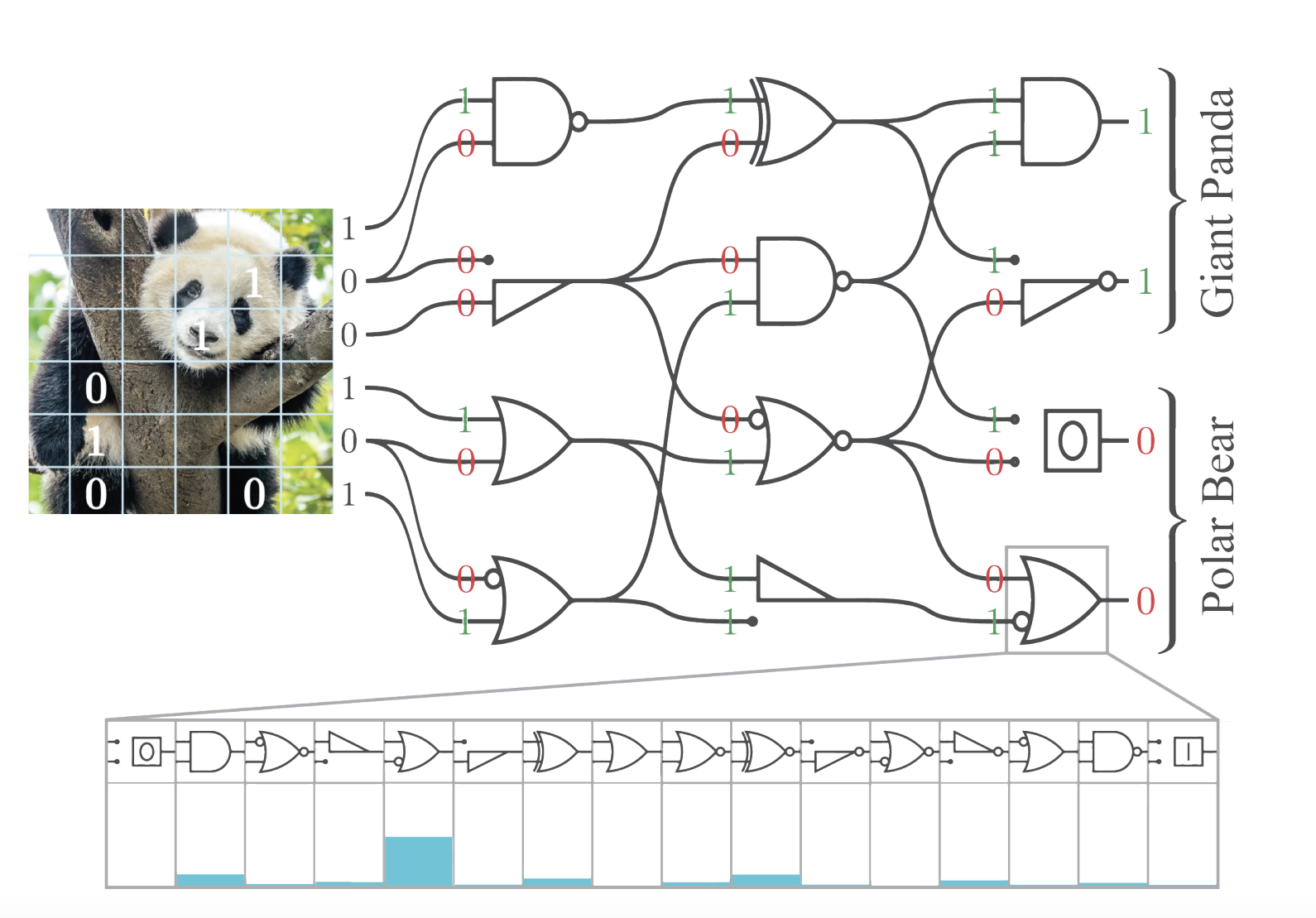
Blending symbolic reasoning with end-to-end differentiable models, the project advances computer vision architectures that think in compact logical steps while training with standard gradient methods. Differentiable logical components—learned gate structures, logical pooling, and clause-style heads—are embedded within convolutional or transformer backbones so that features are selected, composed, and justified through interpretable rule-like pathways. The agenda targets domains where traceable decisions and small compute budgets are essential, such as medical imaging, scene understanding, and autonomous perception under tight latency constraints.
Central questions include how logic-aware layers should be arranged to balance accuracy, sparsity, and robustness; whether learned gates capture stable visual primitives that survive distribution shifts; and how clause-based logic learners compare when integrated as distillation targets or hybrid heads. Empirical work centers on MNIST and CIFAR families for rapid iteration, extending to stress tests on corruptions and calibration to probe reliability. Alongside standard accuracy, the study emphasizes energy surrogates (FLOPs, memory, “gate-ops”), explanation faithfulness, and rule stability over training and pruning. The anticipated result is a trustworthy, compact vision pipeline that remains competitive in accuracy while offering crisp, human-readable reasoning—a step toward safety-critical, interpretable AI.
References:
[1] Petersen, Felix, et al. "Convolutional differentiable logic gate networks." Advances in Neural Information Processing Systems 37 (2024): 121185-121203.
[2] Belaid, M. B., Sharma, J., Jiao, L., Granmo, O. C., Andersen, P. A., & Yazidi, A. (2025, April). Generalized Convergence Analysis of Tsetlin Automaton Based Algorithms: A Probabilistic Approach to Concept Learning. In Proceedings of the AAAI Conference on Artificial Intelligence (Vol. 39, No. 15, pp. 15524-15531).