Background
We're interested in tackling these research problems both using physics-based models and approaches and using data-driven machine-learning based approaches. We have promising results already using both these families of methods and are open to candidates interested in either both of one of these aspects. In the last couple of years, we have had 4 MSc students working on projects in this domain and all have achieved an A or B as their final grade. New students in this domain will benefit from the results achieved by the previous students as well as from other recently published results.
Projects
1) Probing the atmospheric properties
Previous works have shown that continuous microbarom measurements provide insights on atmospheric properties. The detection or non-detection of microbaroms at an infrasound station is determined by the strength and direction of the stratospheric winds and temperature. Sudden Stratospheric Warming events can be characterized using infrasound as the temperature increases by up to 50 degrees in the upper stratosphere and the polar eastward jet is slowed or reversed, and this is a key mechanism which can couple down to the surface to cause prolonged winter cold spells in Europe and densely populated parts of North America.
You will hence work on the enhancement methods to allow for a continuous monitoring of the stratosphere, and maybe you will even be able to predict the prospects of greater snowfall and better skiing conditions based on an infrasound-based continuous monitoring of the stratospheric circulation?
For this line of research, there are two main opportunities available. 1A) is on using data-driven approaches (and often machine-learning based) to map between global infrasound datasets and the state of the upper atmosphere. 1B) is on exploring advanced signal processing approaches to sift out more relevant information about the actual wavefields recorded at one or several of the stations.
Line 1A) You will base your work on three model datasets. First, for the state of the atmosphere we'll use the best available models from the European Centre for Medium-Range Weather Forecasts (ECMWF). Second, for the microbarom source modelling of the oceans, we'll use an openly available model data called
AtmospheRic inFRasound by Ocean Waves (ARROW). Third, for the globally recorded infrasound wavefield, we'll use a publicly available data product published by colleagues at the Federal Institute for Geosciences and Natural Resources (BGR) in Germany.
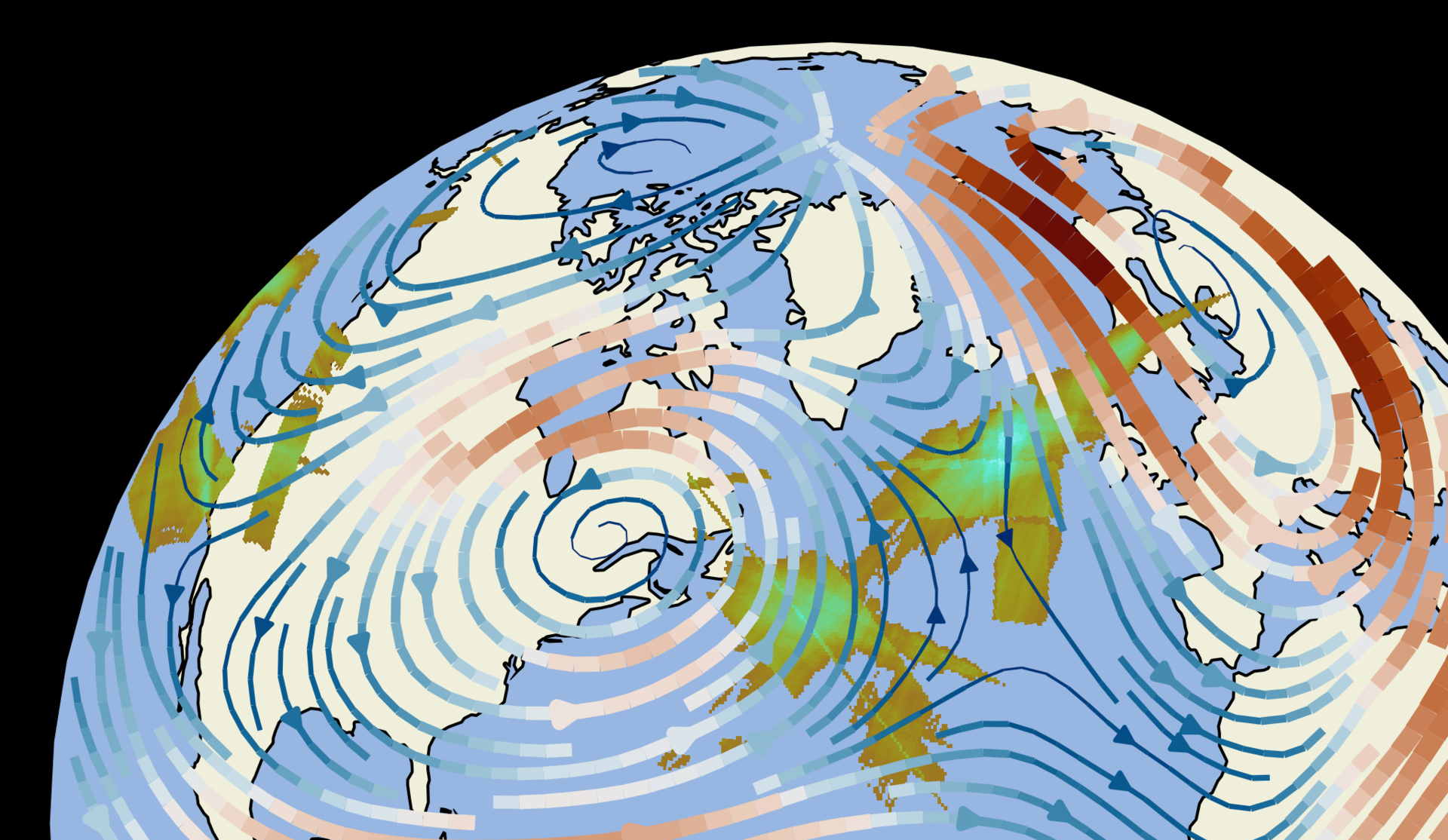
Line 1B) You will work with array data recorded at an infrasound station in Bardufoss, northern Norway. This is one of the world's largest infrasound arrays with 10 elements distributed over an aperture of almost 2 km. Many standard infrasound array signal processing recipes and pipelines are tailored for analysis of transient explosion-like signals. However, the continuous-wave nature of microbarom signals, see below, has sparked the application of array signal processing approaches that provide enhanced characterization. You will explore parameter tuning possibilities for conventional delay-and-sum beamformers and inter-element correlation-based beamformers, as well as adaptive and more advanced beamformers based on for example Capon’s method, CLEAN and MUSIC.
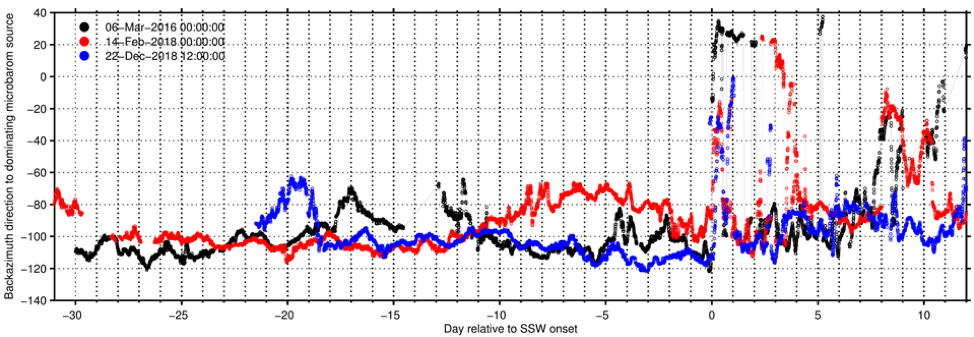
The below figure provides an analysis of the direction towards the dominating mircrobarom wavefront arrival at the station in Bardufoss before and after three different Sudden Stratospheric Warming events:
2) Probing the solid Earth
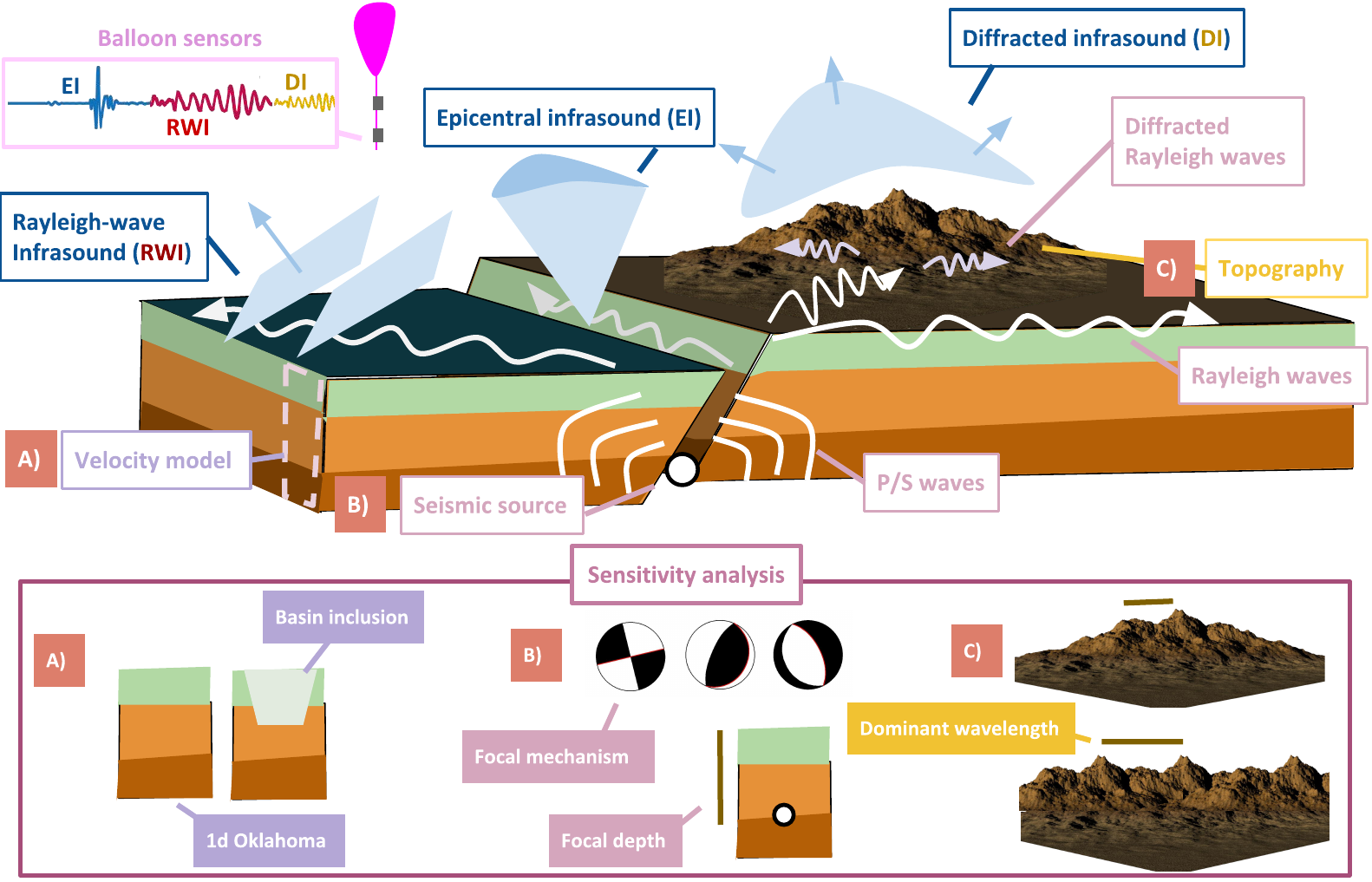
Balloon pressure sensors provide a unique alternative to ground stations in the absence of sufficient station coverage such as Earth's polar regions and other planets, such as Venus.
You will have the opportunity to work in a team to develop novel algorithms to invert for subsurface velocities and for characteristics of seismic events using acoustic waveforms recorded at the balloon.
Necessary experience:
-
For project option 1A) Appropriate coursework on ML and practical ML frameworks
-
For project option 1B) IN5450 - Array signal processing, or similar coursework related to signal processing
-
For project option 2) Wave propagation knowledge
-
Solid skills in Python or Matlab scientific programming
-
Solid data analysis skills
Additional beneficial competence:
-
Acoustical or seismic wave propagation
-
Digital signal processing
-
The ObsPy Python package
-
Atmospheric dynamics and meteorology