
Research directories: Multiple research directions are available, and interested MSc students are encouraged to reach out to discuss their background and interests in order to define a tailored project proposal.
The focus is on simulating wave propagation, a phenomenon central to many areas of science and engineering. Traditional numerical approaches are often computationally intensive and limit large-scale applications. In recent years, deep neural architectures known as neural operators, such as DeepONet [1] and the Fourier Neural Operator (FNO) [2], along with their variants, have emerged as powerful alternatives.
Below are a few potential themes:
1) Neural Operators for Fluid–Structure Interaction (FSI)
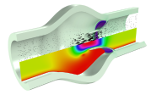
Fluid-Structure Interaction (FSI) problems are classic examples of multiphysics systems, where fluid flow interacts with deformable or elastic structures. Neural operators offer promising tools to accelerate simulations and enable real-time or large-scale applications.
Possible applications:
- Cardiovascular modelling: Coupled flow-tissue models to simulate deformation during the cardiac cycle.
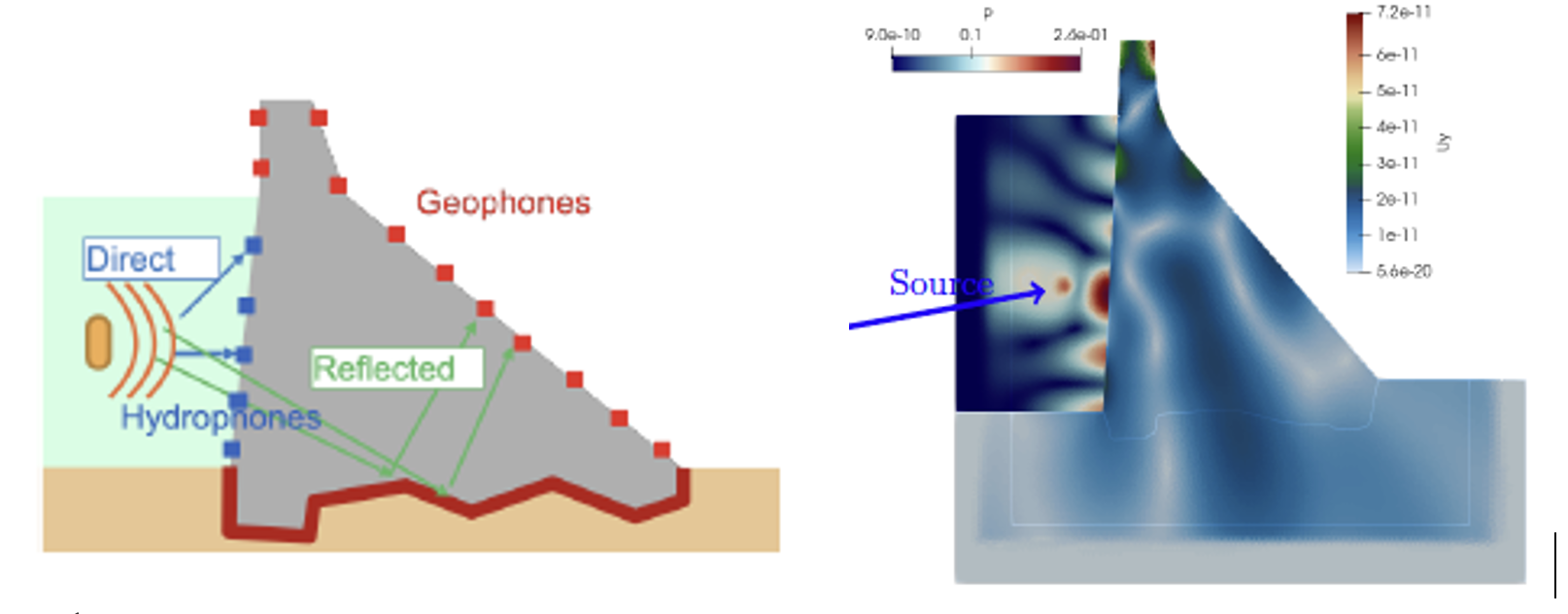
- Water dam simulation: Studying the interaction between water pressure and dam wall deformation under various loading scenarios is important for stability investigation.
|
|
|---|
Recent developments in neural operator frameworks have introduced novel methods for efficiently capturing complex fluid dynamics and structural responses. However, there remains a gap in effectively modeling coupled dynamics in deforming and moving environments, particularly at the fluid–solid interface. [3] proposed a hybrid solver for vesicle dynamics, employing a Fourier Neural Operator (FNO)-based model for the fluid while retaining a traditional solver for the solid structure. While this demonstrates promise, the coupling is only partially learned and lacks explicit interface physics. A recent paper [4], proposed a Physics-Informed Neural Networks (PINNs) framework to learn fluid-structure interaction dynamics coupled with immersed boundary conditions.
A compelling research direction is to develop a fully FNO architecture for the coupled fluid-structure system, enabling end-to-end learning of the interaction dynamics with improved speed and flexibility.
2) Neural Operator in Ultrasound Elastography
Ultrasound elastography is used to estimate tissue stiffness by measuring wave propagation through soft tissues. Neural operators can accelerate the forward simulation of wave fields in heterogeneous, viscoelastic media and enable fast inverse recovery of biomechanical properties.
Potential research topics:
- Developing operator surrogates for time-harmonic elastography models.
- Integrating physics-informed neural operator models into inverse problems for shear wave speed reconstruction.
- Investigating uncertainty quantification and robustness in neural-operator-based inversion pipelines.
- Exploring 2D and 3D datasets for abdominal tissue characterization.
3) Neural operators in atmospheric sound propagation and the solid Earth
Acoustic wave propagation is guided by same set of equations across different media including atmospheric and seismic media. There are several numerically challenging wave propagation modelling problems in atmospheric and seismic real-world problems. We have previously worked on end-to-end neural networks for acoustic wave propagation [5], but we see great potential for even further enhancements using neural operator approaches to incorporate into the wave equation modelling itself.
In addition, a model pretrained over an extensive set of medium and source characteristics could therefore serve as a foundational model that could be then fine-tuned for several applications such as ultrasound imaging, seismic exploration, or acoustic wave propagation. This transfer learning procedure would reduce the computational cost of building training data for future applications.
[1] L. Lu, P. Jin, and GE Karniadakis, “DeepONet: Learning nonlinear operators for identifying differential equations based on the universal approximation theorem of operators,” Nat Mach Intell, vol. 3, no. 3, pp. 218–229, Mar. 2021, doi: 10.1038/s42256-021-00302-5.
[2] Z. Li et al., “Fourier Neural Operator for Parametric Partial Differential Equations,” May 17, 2021, arXiv: arXiv:2010.08895. doi: 10.48550/arXiv.2010.08895.
[3] W. Xiao, T. Gao, K. Liu, J. Duan, and M. Zhao, “Fourier neural operator based fluid-structure interaction for predicting the vesicle dynamics,” Jan. 04, 2024, arXiv: arXiv:2401.02311. doi: 10.48550/arXiv.2401.02311.
[4] A. Farea, S. Khan, R. Daryani, EC Ersan, and MS Celebi, “Learning Fluid-Structure Interaction Dynamics with Physics-Informed Neural Networks and Immersed Boundary Methods,” Aug. 04, 2025, arXiv: arXiv:2505.18565. doi: 10.48550/arXiv.2505.18565.
[5] Brissaud, Q., Näsholm, S. P., Turquet, A., & Le Pichon, A. (2023). Predicting infrasound transmission loss using deep learning. Geophysical Journal International, 232(1), 274-286.
Necessary experience:
- Solid theoretical and practical understanding of neural network frameworks
- Wave propagation knowledge
- Solid skills in Python or Matlab scientific programming
- Solid data analysis skills
Additional beneficial competence:
- Acoustical or seismic wave propagation
- Familiarity with finite element methods
- Basic understanding of physics laws