Leveraging Machine Learning to Understand the Dynamics of Arctic Atlantification
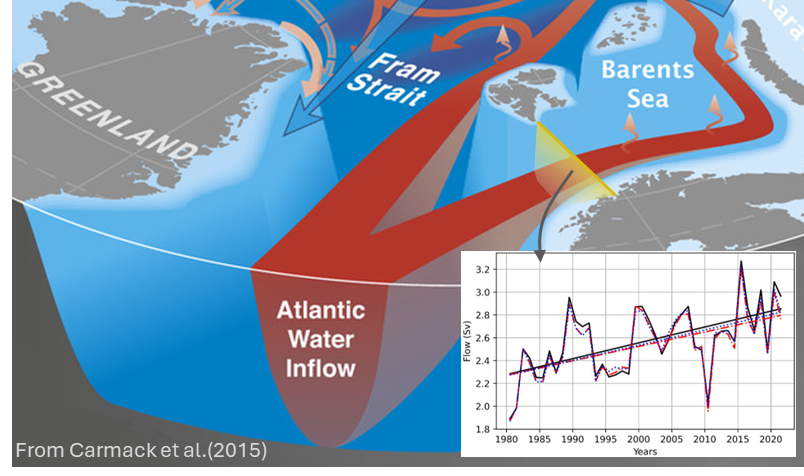
The Arctic Ocean is among the most vulnerable regions on Earth, undergoing rapid and unprecedented change. To understand the dynamics of climate change, the scientific community has launched coordinated international observations and modeling efforts focused on the Arctic climate system. A key concern is Atlantification (the increasing influence of warm Atlantic waters on the Arctic Ocean), driving dramatic shifts such as accelerated sea‑ice loss, altered weather patterns, and profound ecosystem disruptions. A major contributor to Arctic Atlantification is the increasing ocean transport from the Nordic Seas to the Barents Sea. In this project, you will develop neural operators as surrogate models to predict Barents Sea Opening (BSO) flow by mapping from forcing variables (e.g., preceding ocean state, atmospheric forcing, and possibly ocean temperature and salinity) to BSO inflow characteristics. By doing so, the model enables fast and efficient sensitivity analysis to identify the dominant contributors to BSO flow. During this impactful research, you will engage in state‑of‑the‑art scientific machine learning for spatiotemporal tasks, operator learning, and sensitivity analysis to validate the model and explore plausible scenarios.
Learning Data Assimilation Operators to Update Ocean Forecasts from Sparse Observations
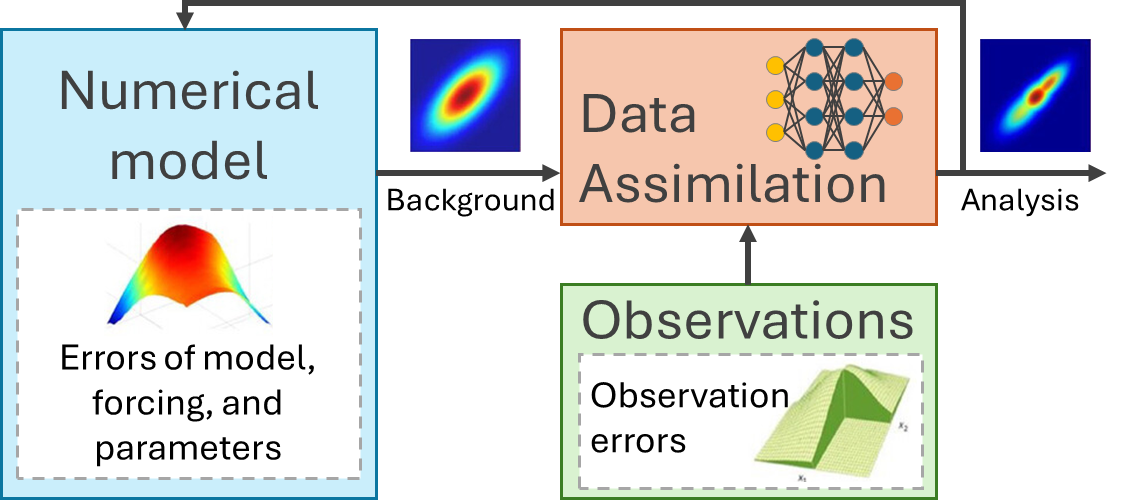
In this project, you’ll explore a cutting-edge paradigm in oceanography: learning data assimilation operators, surrogate models that intelligently combine simulation outputs with intermittent observations to iteratively correct and update ocean forecasts. Drawing on neural operator frameworks, your objective is to train a model that ingests both the most recent forecast and sparse observational data (e.g., sea surface height, temperature, or in-situ profiles) and produces an assimilated ocean state that closely approximates the truth. Unlike conventional data assimilation schemes (such as optimal interpolation or ensemble Kalman filters, which often struggle with high computational expense or complex parameter tuning), this approach offers a data-driven, computationally efficient, and potentially real-time alternative. This research focuses on a regional ocean, but the methodology can be applied to other regional ocean modeling domains. During this project, you will engage in operator learning, optimization under sparse supervision, ocean dynamics, satellite and in-situ observational data, and generalization across regions and modalities. This project not only impactful in real-world forecasting, but also innovative at the frontier of ocean–AI integration.
Leveraging Neural Operator Surrogates for Seasonal Sea Ice Formation and Melting Prediction
The Arctic is one of the fastest-changing regions on Earth, with shrinking sea ice having profound effects on global weather, ecosystems, and human activity. Hence, predicting how sea ice forms and evolves in areas like the Barents-Kara Seas is crucial. Sea ice models, especially when run at climate-relevant spatial and temporal scales, are computationally intensive, limiting the number of ensemble members or forecast frequency. In addition, key sub-grid processes are parameterized in current models, often leading to biases. Neural Operators (e.g., Fourier Neural Operators) offer a promising route to reduce this computational burden while preserving physical fidelity and enabling zero-shot super-resolution forecasting. By leveraging recent advances in remote sensing and high-resolution simulations, this study will seek to offer fast, accurate, and physically consistent predictions, particularly in regions like the Barents-Kara Seas where model uncertainties are highest. The model will emulate key sea ice dynamics at a fraction of the computational cost, enabling the generation of large ensembles to study internal climate variability.
Useful references:
Dörr, J., Årthun, M., Docquier, D., Li, C., & Eldevik, T. (2024). Causal links between sea‐ice variability in the Barents‐Kara Seas and oceanic and atmospheric drivers. Geophysical Research Letters, 51(7), e2024GL108195.
Durand, C., Finn, T. S., Farchi, A., Bocquet, M., Boutin, G., & Ólason, E. (2024). Data-driven surrogate modeling of high-resolution sea-ice thickness in the Arctic. The Cryosphere, 18(4), 1791-1815.
Kovachki, N., Li, Z., Liu, B., Azizzadenesheli, K., Bhattacharya, K., Stuart, A., & Anandkumar, A. (2023). Neural operator: Learning maps between function spaces with applications to pdes. Journal of Machine Learning Research, 24(89), 1-97.