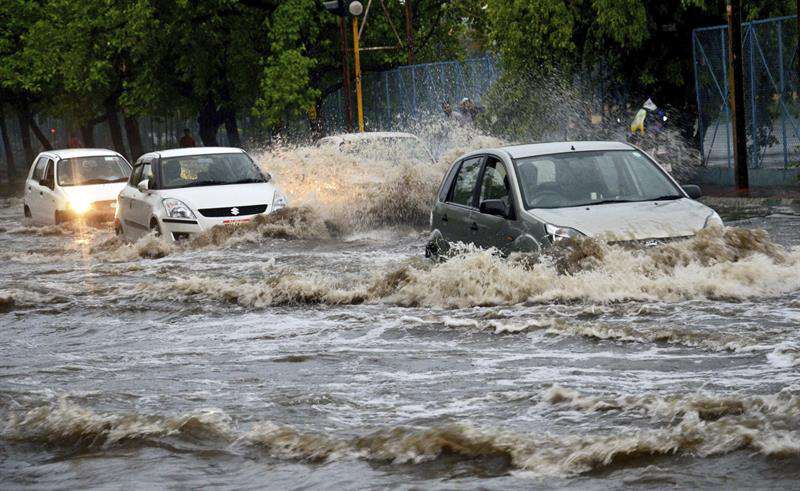
The likelihood of urban flooding is expected to continue increasing. Improved prediction of where, when, and how severely flooding may occur is therefore important for flood preparedness, emergency management, and communication with authorities and the public. One important approach is to carry out numerous computer simulations of various foreseeable scenarios. However, such simulations are very time consuming. To save time, this master project will investigate the use of physics-informed machine learning to create more efficient surrogate models of urban flooding.
Background: Traditionally, physics-based numerical models have been widely used to simulate urban flooding. High-resolution two-dimensional (2D) hydraulic models or a hybrid 1D-2D model can reproduce flood depth, extent, velocity, pressure and inundation areas by numerically solving the governing hydraulic equations. However, such simulations may require substantial computational resources and processing time, particularly when high-resolution terrain data and many rainfall or flood scenarios are considered.
Objective: The main objective of this master project is to investigate the potential of physics-informed machine learning for accelerating urban flood simulations while maintaining an acceptable level of prediction accuracy.
Methods: A real-world study area will be selected based on available data. Relevant datasets include terrain or elevation model, river cross-sections, hydraulic information, rainfall or inflow data, and other information required for flood modelling.
The open-source HEC-RAS modelling framework will be first used to create a 2D or coupled 1D–2D hydraulic model, following a standard procedure.
Machine learning (ML) will then be investigated for accelerating flood prediction. In particular, physics- informed machine learning (PIML) combines data-driven learning with physical knowledge or physical constraints. Such approaches may provide faster approximations of computationally demanding hydraulic simulations while retaining important characteristics of the underlying physical processes. Through a concrete case study, the student will use some real-world data to set up and improve the hydraulic models and test the PIML or other new solutions. At the same time, the student will study both the efficiency gain and the extent of accuracy loss, so that the benefits and limitations of ML for this particular application are investigated.
Anticipated outcomes:
- a functional or improved HEC-RAS 2D or 1D–2D flood model for the selected study area
- a set of hydraulic simulations representing selected flood scenarios
- development and testing of one or more PIML approaches for rapid flood prediction
- a quantitative comparison of hydraulic modelling and ML prediction in terms of accuracy and computational efficiency
- improved understanding of the opportunities and limitations of physics-informed ML for urban flood-risk assessment and emergency applications
Needed background of the student:
- Basic knowledge about C programming;
- Basic knowledge about machine learning;
- Courage of tackling challenging problems in the intersection of hydraulic modelling and machine learning.
References:
- Guangzhao Chen, Jingming Hou, Yuan Liu, Shuhong Xue, Hao Wu, Tian Wang, Jiahao Lv, Jing Jing, Shaoxiong Yang. Urban inundation rapid prediction method based on multi-machine learning algorithm and rain pattern analysis. Journal of Hydrology, Volume 633, 2024.
- HEC-RES software framework.
- Luo, X., Yuan, S., Tang, H., et al. (2024). Enhanced physics-informed neural networks for efficient modelling of hydrodynamics in river networks. Hydrological Processes, 38(4), e15143.
- United Nation (2026). Water Facts.