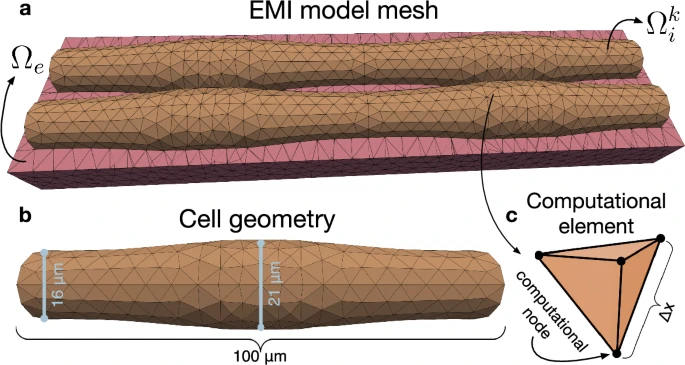
The latest modeling paradigm of cardiac electrophysiology is cell-based. That is, the individual cells are fully resolved, each with its subcellular details. These cells are mathematically termed the intra-cellular subdomains. Also, the gap between the cardiac cells is also resolved, mathematically called the extra-cellular subdomain. The interface between the intra- and extra-cellular subdomains is the cell membrane. These physiological details were not resolved in traditional models, thus cell-based modeling now provides the potential of discovering new knowledge. However, at the same time, the computing requirement of cell-based modeling is extremely high.
One possibility of reducing the computational cost is to use physics-informed machine learning (ML). This possibility is particularly appealing for the extracellular subdomain, where a substantial amount of computation takes place. Mathematically, a 3D Laplace equation is valid in the extra-cellular subdomain, where the solution depends on the shape of the subdomain, a prescribed conductivity field over the subdomain, and some boundary conditions that are applicable on the membrane (the boundary enclosing the extra-cellular subdomain). The reason for the solution inside the extra-cellular subdomain being time dependent is because the boundary conditions on the membrane change with time (due to dynamic behaviour of the intra-cellular subdomains).
An entire cell-based simulation can have thousands or even millions of time steps. The idea is to train a neural network using a relatively small number of time steps, with the various boundary conditions as input, for the purpose of later being able to inference the time-dependent numerical solution in the extra-cellular subdomain. It is noted that the trained neural network doesn't need to change if the geometry and the conductivity field remain the same.
The master project can be carried out in the following phases:
- Phase 1 (semester 1 at the same as taking courses): Familiarise with the current literature on solving elliptic partial differential equations using physics-informed neural networks (see e.g. [4]). Implement proof-of-concept neural networks that have the goal of inferring the solution of a Laplace equation inside a given domain, based on boundary conditions alone. For training the neural networks, manufactured solutions and matching boundary conditions (on domains of simple geometries) can be used. Thereafter, study the accuracy, stability and computational efficiency of the trained neural networks.
- Phase 2 (semester 2): Learn to use an existing cell-based simulator of cardiac electrophysiology. (Some details can be found in [1].) Thereafter, study the existing literature on physics-informed ML for cardiac modeling, such as [2] and [3], with the purpose of designing a suitable neural network that suits the extra-cellular subdomain, while also using experience obtained in Phase 1. Implement the designed neural network and couple it with the existing cell-based simulator.
- Phase 3 (semester 3): Carry out numerical experiments for studying the computational cost and accuracy of the trained neural network, as well as the potential of saving computing time when the trained network replaces a traditional Laplace equation solver, with the 3D domain being of a realistic shape. The developed software code will be made open source. Complete the master-degree thesis.
Requirements of the master student:
- Good programming skills;
- Good knowledge of numerical methods;
- Basic knowledge of ML;
- Ambition of combining cutting-edge ML with supercomputing.
References:
[1] Jæger, K.H., Trotter, J.D., Cai, X., Arevalo, H. and Tveito, A., "Evaluating computational efforts and physiological resolution of mathematical models of cardiac tissue," Scientific Reports, Volume 14, 2024.
[2] Jianxin Xie and Bing Yao, "Physics-constrained deep active learning for spatiotemporal modeling of cardiac electrodynamics," Computers in Biology and Medicine, Volume 146, 2022.
[3] Herrero Martin C, Oved A, Chowdhury RA, Ullmann E, Peters NS, Bharath AA, Varela M., "EP-PINNs: Cardiac Electrophysiology Characterisation Using Physics-Informed Neural Networks," Front Cardiovasc Med. 2022.
[4] Sirignano, J and Spiliopoulos, K, "DGM: A deep learning algorithm for solving partial differential equations", JOURNAL OF COMPUTATIONAL PHYSICS, Volume 375, Page 1339-1364, 2018. DOI: 10.1016/j.jcp.2018.08.029