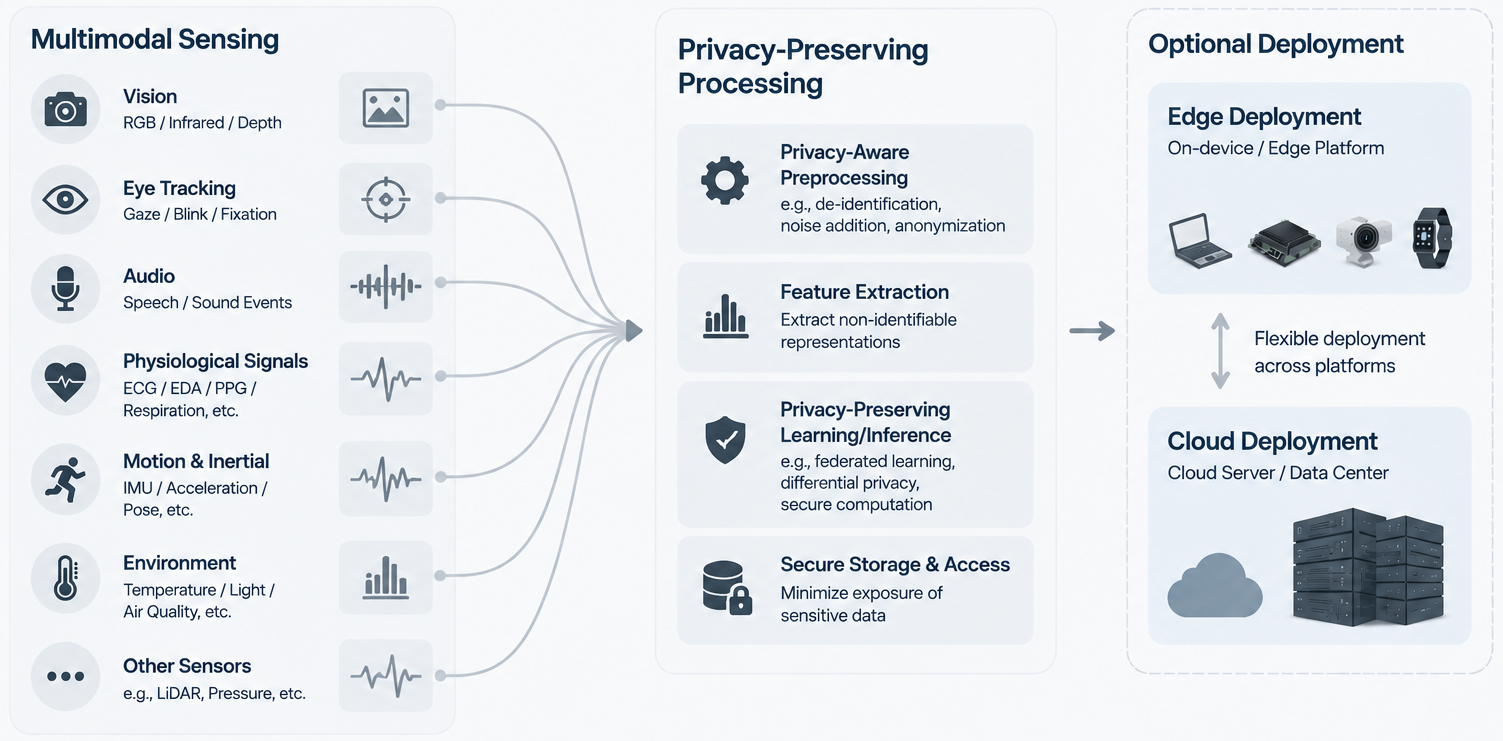
Artificial intelligence (AI), computer vision, and sensing technologies are enabling new possibilities for understanding human behavior and interactions. Many emerging applications, such as smart environments, healthcare systems, human-computer interaction, and assistive technologies, require systems that can analyze human states in real time. However, collecting and processing human-related data introduces significant privacy challenges, especially when dealing with sensitive information such as facial expressions, body movements, and personal behaviors.
This project explores how human sensing systems can be designed to understand human states while protecting sensitive personal information. Instead of directly storing or transmitting raw data, the system will investigate privacy-aware approaches that extract meaningful information while minimizing exposure of identifiable details.
Students will investigate methods for analyzing human characteristics such as facial micro-expressions, movement patterns, motion intensity, behavioral changes, or other non-verbal signals. The project will explore how sensing, machine learning, and privacy-preserving techniques can be combined to build intelligent systems that are both effective and responsible.
The goal of this project is to design and evaluate a privacy-preserving human sensing system that can recognize relevant human states while reducing privacy risks. Depending on the project direction, students may work on areas such as privacy-aware computer vision, human behavior analysis, feature extraction, machine learning models, or system design.
A typical project may include the following steps:
- Review related work in human sensing, computer vision, machine learning, and privacy-preserving AI.
- Collect and process human-related data from different sensing sources, such as images, videos, or motion data.
- Develop methods to extract meaningful human features while reducing sensitive information exposure.
- Train or adapt machine learning models for analyzing human states or behaviors.
- Evaluate the system based on recognition performance, privacy protection, and practical usability.
The final system could, for example, demonstrate privacy-aware facial expression analysis, a system that estimates human engagement based on motion patterns, or an intelligent sensing platform that analyzes human states without requiring storage of raw personal data.
Learning Outcome
By the end of the project, students are expected to:
- Gain an understanding of privacy-preserving AI systems, human sensing technologies, and computer vision-based human analysis.
- Develop practical skills in designing AI pipelines that extract meaningful information from human-related data while considering privacy requirements.
- Understand the challenges and trade-offs between AI performance, data privacy, and system usability.
- Learn how machine learning models can be applied to analyze human states using different types of behavioral signals.
- Gain experience in developing and evaluating AI systems in an interdisciplinary research environment.
Requirements for the Student
We are looking for highly motivated master students who are interested in tackling challenging problems in AI, human sensing, computer vision, machine learning, and privacy-preserving technologies. Building such a system requires students who are comfortable working across different technical areas and are motivated to develop solutions for complex engineering and research challenges.
The master thesis will be conducted in a collaboration of IFE and ND. ND has adopted a model where master students take 60 credits worth of courses in the first year of the master studies, and work full-time on the master thesis in the second year. We ask you to plan accordingly. The following are some relevant courses for this thesis topic:
- IN5050, IN5060, IN5020, and IN4260MCT provide relevant background.
Students are expected to have a strong technical background and experience in some of the following areas:
- Programming skills: Experience with Python, alternatively MATLAB. Students should be comfortable developing, debugging, and integrating software components for AI-based sensing systems.
- Machine Learning and Computer Vision: Basic knowledge of machine learning, deep learning, and computer vision concepts is expected.
- Human Sensing and Data Analysis: Interest or experience in analyzing human-related data, such as images, videos, motion signals, or behavioral patterns.
- Privacy-Aware System Design: Interest in understanding how AI systems can be designed to balance information extraction, privacy protection, and practical deployment requirements.
The project is designed for students who enjoy solving difficult technical problems and are motivated to work at the intersection of AI, human understanding, and responsible technology development. Students should be prepared to work independently, explore new technologies, and contribute actively to the development of privacy-preserving human sensing systems.
At the same time, this project is a collaboration between IFI and IFE. Thus, students will have access to dedicated technical guidance, research expertise, facilities, experimental equipment, and computing resources. Through this collaboration, students will gain hands-on experience in developing systems within a professional research environment while contributing their own ideas and solutions. In addition, students are expected to spend one day per week onsite at IFE facility in Halden during the implementation.