Project description
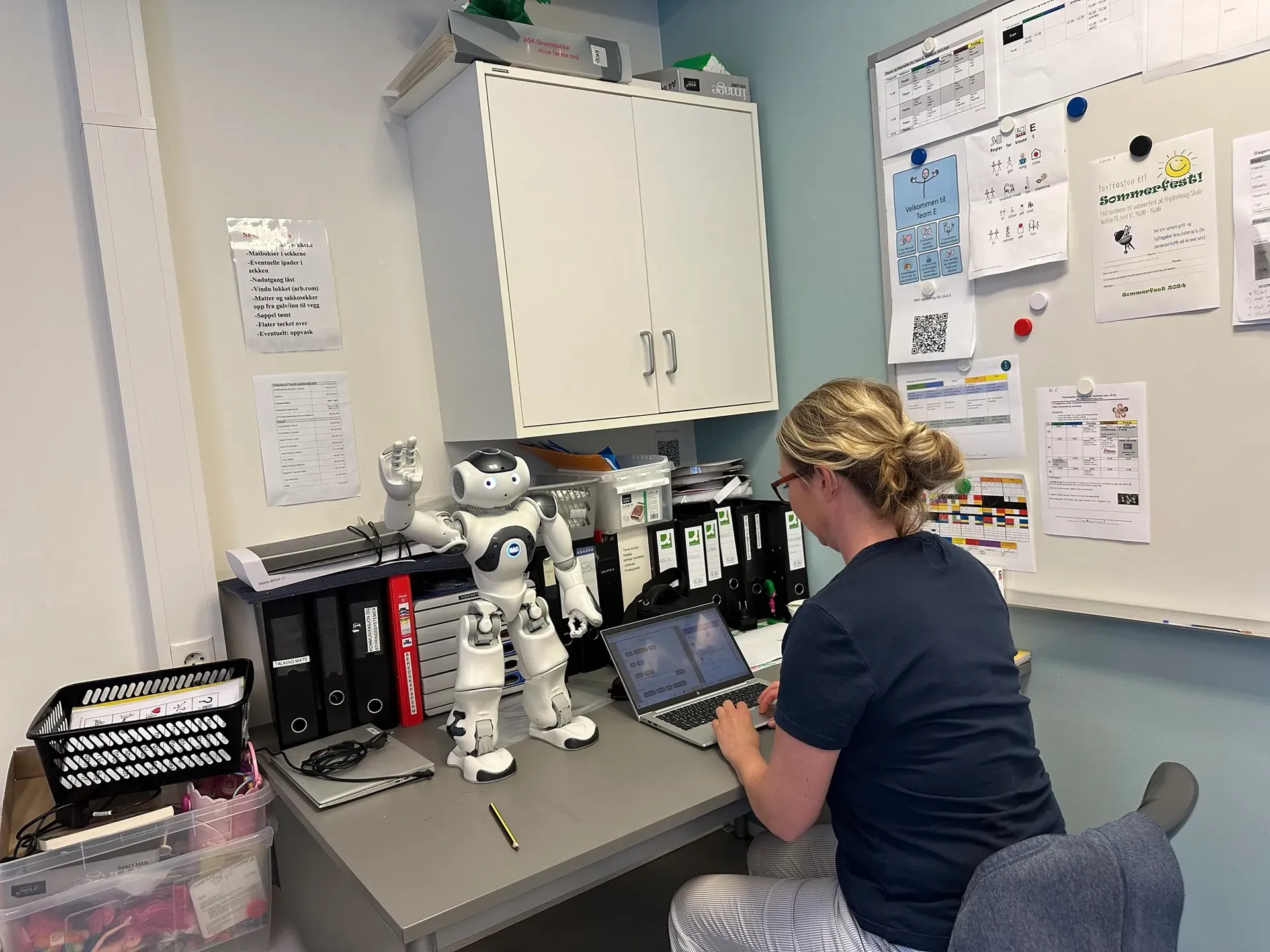
In the ROSA project, we have created a remote control that is used by teachers at a special school to help children with autism or other mental disabilities with their communication skills. The remote is working and is actively in use at the school, but could use additional work to make it more functional and easier to use. Some possible things that could be done:
- Structure code so that it can run on Nao 5 and Nao 6 robots (currently in separate branches)
- Restructure the code so that it works with multiple kinds robots using ZTL (https://gitlab.com/robothouse/rh-user/ztl). A previous master student made a working prototype, but this has not been integrated into the main code.
- Make it easier to add actions to the remote, so that teachers could add actions themselves
- Quality of life improvements such as saving commonly using phrases, a conversation history, or other things that make it easier to communicate with pupils.
- Add the ability to translate the user interface and robot actions, so that the robot can be used with other languages than Norwegian.
- Other ideas that can make the remote control a better tool for the teachers at the school.
- Better documentation so that others can use the remote control.
Project tasks
The majority of the tasks will require some coding work and some requirements gathering and possible testing out the solution with other people who will be using the remote. This may include testing with the teachers at the school depending on how far along the solutions become. A possible setup could look like:
- Gather requirements from teachers
- Code up prototypes
- Evaluate with teachers
- Repeat for an additional iteration
Starting point for references
T. Schulz and K. Skeide Fuglerud, “Creating a Robot-Supported Education Solution for Children with Autism Spectrum Disorder,” in Computers Helping People with Special Needs, K. Miesenberger, G. Kouroupetroglou, K. Mavrou, R. Manduchi, M. Covarrubias Rodriguez, and P. Penáz, Eds., in Lecture Notes in Computer Science. Cham: Springer International Publishing, 2022, pp. 211–218. doi: 10.1007/978-3-031-08645-825
J. C. Torrado et al., “Lessons learned from two pilots using social robots with children with autism in a Special education school in Norway,” presented at the HCI International 2025, in Lecture Notes in Computer Science. Gothenburg, Sweden: Springer, 2025.
C. A. Badescu, “Teach Me How To Dance: An exploration of motion translation methods using the ZTL framework for use with children with autism in educational settings,” Master thesis, 2024. Available: https://www.duo.uio.no/handle/10852/112628. [Accessed: Jan. 02, 2025]
T. Halbach, T. Schulz, W. Leister, and I. Solheim, “Robot-Enhanced Language Learning for Children in Norwegian Day-Care Centers,” MTI, vol. 5, no. 12, p. 74, Nov. 2021, doi: 10.3390/mti5120074
Course background
IN4140 Introduction to robot technology or good familiarity with ROS will be necessary to work with the robots.
IN4050 Introduction to artificial intelligence and machine learning can be useful for implementing or understanding algorithms
IN5490 Advanced Topics in Artificial Intelligence for Intelligent Systems can be helpful for understanding how to read articles and write your master’s.