Project Description
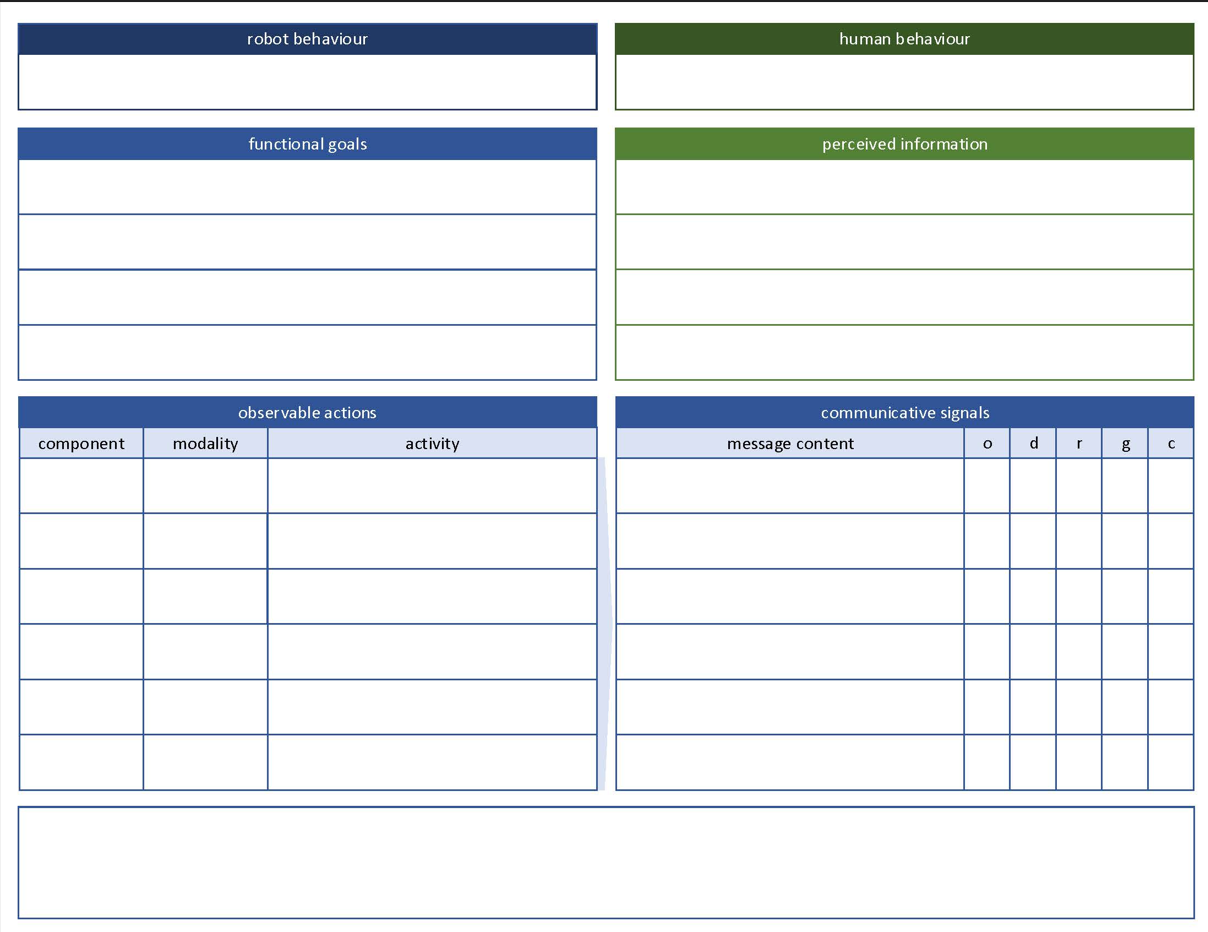
We published a paper, Communicative Robot Signals: Presenting a New Typology for Human-Robot Interaction that classified signals from robots (lights, movements, sounds, etc.) in the context of communication and interaction with humans. The resulting typology created 5 properties (origin, deliberateness, reference, genuineness, and clarity) and a worksheet that could be used to describe the signals as a robot completes a goal. We used this typology to describe discuss several interactions in other articles.
So, from the article we know the typology works descriptively, but is it prescriptive? That is, can we use the typology to create new interactions and be able to roughly guess how it will be interpreted by the people viewing or interacting with the robot?
Project tasks
Students would be expected to design interactions with a robot and a study on how people perceived these interactions.
Starting point for references
- P. Holthaus, T. Schulz, G. Lakatos, and R. Soma, “Communicative Robot Signals: Presenting a New Typology for Human-Robot Interaction,” in Proceedings of the 2023 ACM/IEEE International Conference on Human-Robot Interaction, Stockholm Sweden: ACM, Mar. 2023, pp. 132–141. doi: 10.1145/3568162.3578631. Available: https://dl.acm.org/doi/10.1145/3568162.3578631. [Accessed: Mar. 14, 2023]
- T. Schulz, R. Soma, and P. Holthaus, “Movement acts in breakdown situations: How a robot’s recovery procedure affects participants’ opinions,” Paladyn, Journal of Behavioral Robotics, vol. 12, no. 1, pp. 336–355, Aug. 2021, doi: 10.1515/pjbr-2021-0027
- T. Schulz, J. Torresen, and J. Herstad, “Animation Techniques in Human-Robot Interaction User Studies: a Systematic Literature Review,” ACM Trans. Hum.-Robot Interact., vol. 8, no. 2, Jun. 2019, doi: 10.1145/3317325
- F. Hegel, S. Gieselmann, A. Peters, P. Holthaus, and B. Wrede, “Towards a typology of meaningful signals and cues in social robotics,” in 2011 20th IEEE International Symposium on Robot and Human Interactive Communication (RO-MAN), IEEE, 2011, pp. 72–78. doi: 10.1109/ROMAN.2011.6005246
Courses
IN4140 Introduction to robot technology or good familiarity with ROS will be necessary to work with the robots.
IN4050 Introduction to artificial intelligence and machine learning can be useful for implementing or understanding algorithms
IN5590 Rapid Prototyping of Robotic Systems may be useful if you want to add to a robot
IN5490 Advanced Topics in Artificial Intelligence for Intelligent Systems can be helpful for understanding how to read articles and write your master’s.