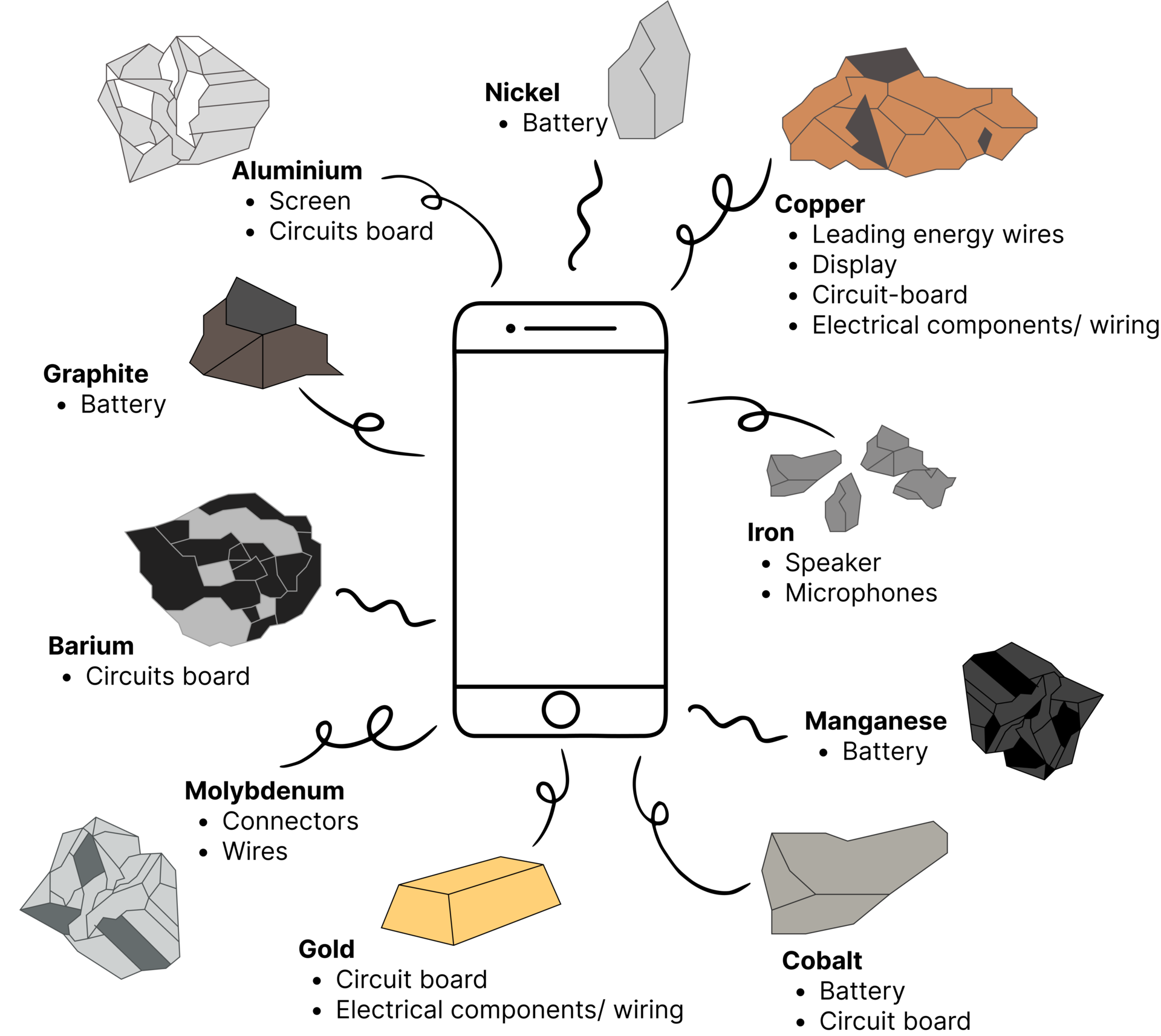
Mining is a global driver of environmental change by polluting water and soil, affecting biodiversity, deforestation, climate change, and more. Mining is also connected with conflict and war, resulting in human rights abuses, such as forced displacement, forced labour, and child labour.
The UN Environment Programme writes: “Without urgent and concerted action to change the way resources are used, material resource extraction could increase by almost 60 per cent from 2020 levels by 2060, from 100 to 160 billion tonnes, far exceeding what is required to meet essential human needs for all in line with the SDGs”.
In Designing Is Mining: Historicizing Material Ecologies of Design, UiO professor Kjetil Fallan argues that “designers are natural born miners. Designing entails crucial decisions on which and how much materials to mine, blast, drill, excavate, or fell”.
Fallan describes a historical process from exploitation via efficiency to elimination through three questions that he briefly addresses in his paper:
1. In what way was the exploitation of extractive materials designed into the material culture of the “mined modernity” of the late nineteenth century?
2. What strategies and methods for more efficient use of extractive materials did designers develop in response to the issue of resource scarcity raised by the environmental movement in the 1960s and 1970s?
3. What kind of design practices and design cultures today are working to reduce or eliminate our dependency on extractive materials, and what are the main obstacles they face in these endeavours?
In this master’s thesis project, you will dive into the 3rd question, identifying, describing, and evaluating the many different design approaches that propose to reduce or eliminate our dependency on extractive materials. The project can be based on documents, but can also include interviews with experts in materials, designers of new materials, designers working with non-extractive materials, and/or an exploration of non-extractive materials and technologies.
On the 6th floor, we have a Materials Library of Stones, which includes most of the mined minerals currently used to design our digital products and infrastructure, such as AI and data centres, as well as minerals needed for the transition to non-fossil energy, such as wind turbines and solar panels. With students, we also designed an interactive mining map of Norway: https://kumu.io/sustainabilitylab/mining-for-twin-transition
You can do this project alone or with a fellow student.
Supervision
We regard the social aspect of doing a master's thesis as important as the academic aspect. As supervisors, we will offer you an engaged and inspiring environment in the Sustainable Futures Lab as well as access to experts when needed.
Courses:
IN5190 – Design for Sustainability (Fall, 2026, Fall 2027)
IN5010 – Design, Technology, Society (Spring, 2027)
Resources
Fallan, K. (2025). Designing is Mining: Historicizing Material Ecologies of Design. Design Issues, (41)1. Online: https://doi.org/10.1162/desi_a_00789
Fry, T. (2005). Elimination by Design. Design Philosophy Papers, 3:2, p.145-147. Online: https://www.thestudioattheedgeoftheworld.com/uploads/4/7/4/0/47403357/09fryelimination_by_design.pdf
Giljum, S. et al. (2025). Metal mining is a global driver of environmental change. Online: https://doi-org.ezproxy.universitetetioslo.no/10.1038/s43017-025-00683-w
United Nations Environment Programme. (2024). Global Resources Outlook 2024: Bend the Trend – Pathways to a liveable planet as resource use spikes (p. 181). International Resource Panel. Online: https://www.resourcepanel.org/sites/default/files/documents/document/media/gro24_full_report_29feb_final_for_web.pdf
Wilson, R.J. (2022). Listening as Non-Extractive Technology. Online: https://fiber.medium.com/listening-as-non-extractive-technology-d024b90b41ec
