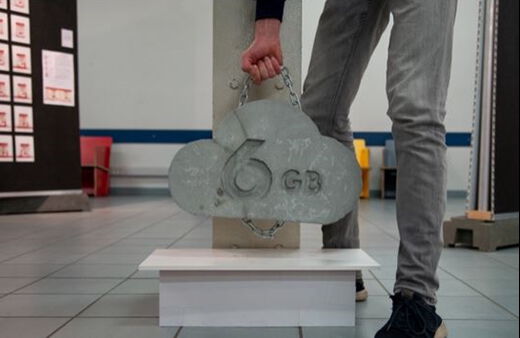
Data centres form the backbone of our digital world. They are central to what we call the cloud. They store our software, algorithms, data, and documents, facilitate the training and use of AI, enable global networking, and much more. Data centres are not as airy as real clouds. They are built with stones, steel, and cement and house large amounts of servers made of minerals, metals, and plastics. To operate a data centre, huge amounts of electricity are needed. The servers generate so much heat that large cooling systems are in place, often utilising water.
The materiality of the cloud is invisible and intangible to us, but at the same time, this materiality has effects on people and the planet. In this master’s thesis project, we ask you to create a critical design intervention to make the cloud tangible.
Critical design is a design methodology that challenges existing assumptions about things that play a role in our lives. Critical design provokes and creates debates. It brings out the hidden values and agendas in a design and sometimes shows alternative, more ethical or sustainable, design alternatives.
Courses:
IN5190 – Design for Sustainability (Fall, 2025)
IN5010 – Design, Technology, Society (Spring, 2026)
IN5120 – Tangible Interaction (Spring, 2026)
Resources:
Bardzell, Jeffrey & Bardzell, Shaowen (2013). What is "critical" about critical design? Online: https://doi.org/10.1145/2470654.2466451
Johannessen, Leon Karlsen (n.d.). The Young Designer’s Guide to Speculative and Critical Design. Online:
https://www.ntnu.edu/documents/139799/1279149990/16+TPD4505.leon.johannessen.pdf/1c9221a2-2f1b-42fe-ba1f-24bb681be0cd