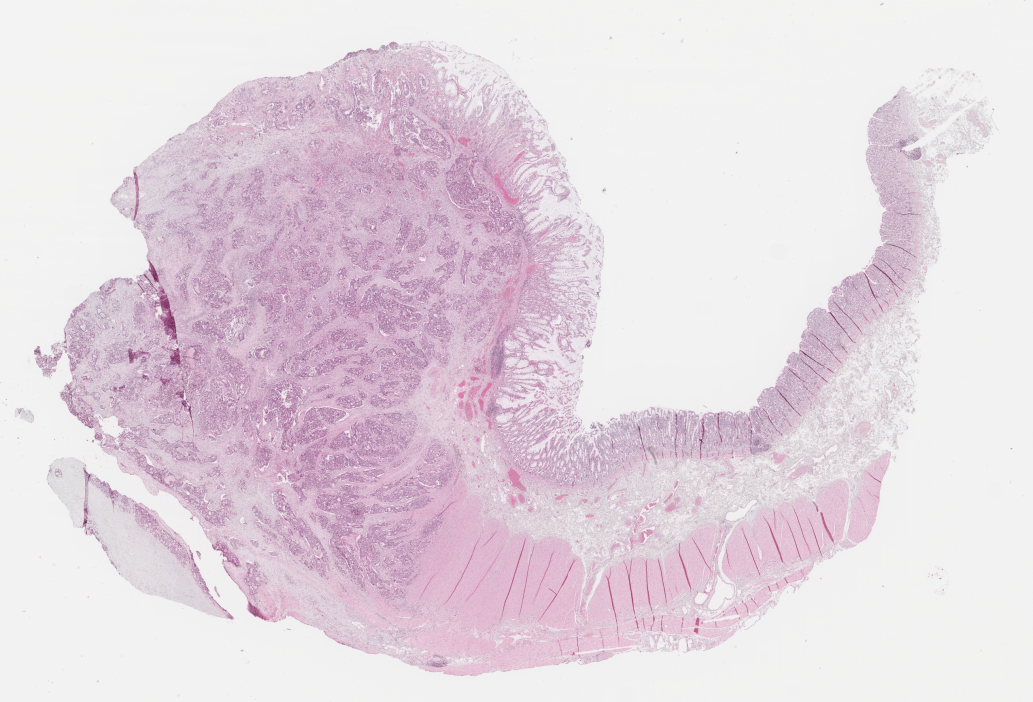
Histopathology is the study of diseases using microscopic examination of slides of tissues. These tissues of the patients often come from biopsy or surgery. For more than a century, specialised medical doctors have performed these evaluations to detect and characterise different diseases such as cancer. It is still considered the gold standard for defining many diseases and provides a range of additional data that affects the treatment of the patients.
Over the past few years, much progress has been made in using artificial neural networks for histopathology. Thousands of academic publications are being published each year. The anticipated impact on clinical practice and patient health has also made the field into a billion dollar industry with many startup companies and active research contributions from companies like Microsoft and Google.
The DSB group has been collaborating with the Institute of Cancer Genetics and Informatics at Oslo University Hospital for more than 30 years on applied machine learning in histopathology, resulting in many substantial contributions to the field. Currently, we are working on a range of different vision tasks for classification and segmentation in histopathology, including prediction of recognised histomorphological features as well as outcomes such as patient survival where the correlations with features of the histopathological images are only partially known. Different technical approaches are regularly being tested, including different network architectures and different training setups with respect to e.g. loss functions, data argumentations and end-to-end training or use of foundation models for histopathology. We test and improve state-out-of-the-art approaches, with a special focus on developing models that can enhance current clinical practice.
Instead of formulating concrete proposals for MSc projects, we encourage interested students to reach out so that we can have an informal chat about your interests and current possibilities – see contact e-mail under the Supervisor(s) headline. Then we can together define a project of mutual interest. Regardless of the particular project, it will generally require you to:
- Familiarise yourself with deep learning and frameworks like PyTorch.
- Read and understand theorical and/or applied machine learning literature relevant for your project.
- Implement and run experiments.
- Describe the experiments and your findings.
References:
[1] Skrede, O.-J. et al. Deep learning for prediction of colorectal cancer outcome: a discovery and validation study. Lancet 395, 350-360 (2020). https://doi.org:10.1016/S0140-6736(19)32998-8
[2] Kleppe, A. et al. Designing deep learning studies in cancer diagnostics. Nat. Rev. Cancer 21, 199-211 (2021). https://doi.org:10.1038/s41568-020-00327-9
[3] Shmatko, A., Ghaffari Laleh, N., Gerstung, M. & Kather, J. N. Artificial intelligence in histopathology: enhancing cancer research and clinical oncology. Nat. Cancer 3, 1026-1038 (2022). https://doi.org:10.1038/s43018-022-00436-4
[4] Tomar, D., Binder, A. & Kleppe, A. in Adv. Neural Inf. Process. Syst. Vol. 37 (eds A. Globerson et al.) 43499-43532 (Curran Associates, Inc., 2024). https://proceedings.neurips.cc/paper_files/paper/2024/file/4cc4cc789849230a4f495a2060b45c87-Paper-Conference.pdf