Research
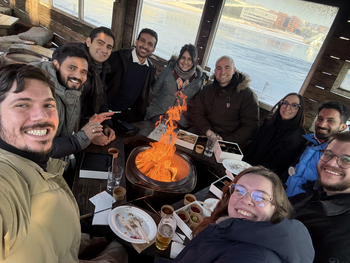
The work in Prof. Sabrina Sartori's research group broadly encompasses materials and devices with a particular focus on energy technologies. Her group´s work includes synthesis, characterisation and scale-up of hydrogen-based materials for vehicular and large-scale applications; batteries; modeling of components and hybrid storage systems.
Projects

Main ongoing Projects:
- AtLAST2 (HORIZON-INFRA)
- HyCO2 (HORIZON-JU-RIA)
- DSTrain (Co-funded by EU)
- FME SOLAR
- FAIR, sustainability project
- FME HYDROGENi
- CH-CYCLE
- CoRE-RE
- HySchool
- INNOVH2up, Towards upscaling sustainable green hydrogen production
- RAPIDO
Recent past projects: AtLAST (Horizon 2020); Hydrogen production from offshore wind, industrial project; INNOVENAT, The sustainable pursuit of energy storage for transformational telescopes; 2D MXenes based anode materials for all-solid-state Li-ion batteries
Contact
Current fellows
PhD candidates: Muhammad Salman; Nikolas Recke; Leandro H. Formigoni Aggio; Gabriela Chimello Mayer;
Postdocs/Researchers: Bruno Hessel Silva; Bilal Babar; Guillermo Valenzuela; Yogesh Kumar Yadav; Waqas Zulfiqar; Julien Fadonougbo; Paola Velasco Herrejón; Andreas Link;
Master students: Utsav Shakya and Timm Ruwen Stahlhut
Cooperation
Our main current collaboration partners have been/are:
National: the Departments of Chemistry, Physics, Informatics, and Institute of Theoretical Astrophysics at University of Oslo (UiO); Institute for Energy technology (IFE); Norwegian Institute for Sustainability Research (NORSUS)
International (examples): Université du Québec à Trois-Rivières, University of Catania, Helmholtz-Zentrum Geesthact, University of Pavia, Adama Science and Technology University; University of Campinas; Federal University of São Carlos
Master Thesis
Our students conduct research in collaboration with academic and industrial partners on projects towards practical applications. Example of completed thesis, by topic:
Hydrogen: PEM fuel cell stack and system modeling (link); The role of the air supply system for proton exchange membrane fuel cells at high elevations; Hydrogen from offshore wind - The role of life cycle assessment in the optimal infrastructure design (link); Combined Hydrogen and Offshore Wind Production - Design and Market Value (link); Proton Exchange Membrane Water Electrolyzer Modeling (link); Modelling and validation of a Fuel Cell Electric Bus (link); Ti1.1CrMn and its hydrides for the application in thermal hydrogen compression (link)
Batteries: Cycle Life prediction of Lithium-ion Batteries Using Machine Learning (link); Safety issues of Li-ion batteries (link); Prediction of Battery Materials Properties with Machine Learning (link); Advanced Modelling of NiMH Batteries (link); In situ operando SAXS and WAXS characterization of the anode materials (a-P/C and FeSb2) for rechargeable sodium ion batteries (link)
Other topics: Antimony selenide based solar cells (link); Building-integrated photovoltaics in Norway, challenges and standards (link); Wind-Driven Clouds - Utilizing wind energy in data centers (link); How will different politics affect the energy system? (link); Conductivity and Defects in Al-doped Li7La3Zr2O12 - A solid-state Li-ion conductor (link)
Our research in the news (selection)
How to transport electricity from wind turbines far out to sea in a cheap way? Titan (2023); Verdensrommet utforskes med diselaggregater, Titan (2023); Smart energilagring bidrar til å berge klimaet, Titan (2020); Astronomy sets new records with revolutionary telescope, Titan (2020); Slik kan Norge gjøre mer for det globale klimaet, Titan (2019); UiO-forsker samarbeider med nobelprisvinneren i kjemi, Titan (2019); UiO researchers have a goal: More solar and wind energy in the electricity grid, Apollon (2017); Nye batterier er en "game changer", Titan (2016)