Background
Machine learning and activity recognition technologies have significantly advanced the monitoring of Activities of Daily Living (ADL) through wearable devices. These innovations have provided valuable insights into general physical activity patterns. However, their application in the domain of strength training exercises remains limited. Accurate recognition and analysis of exercises such as squats, bench presses, deadlifts are crucial for optimizing athletic performance and designing effective rehabilitation programs. By leveraging artificial intelligence (AI) and advanced sensor data, there is an opportunity to enhance exercise monitoring, provide detailed feedback, and improve training outcomes.
Problem Statement
Existing wearable technologies and activity recognition systems often fall short in accurately identifying specific strength training exercises and providing in-depth analysis of performance metrics. They typically do not offer real-time feedback on muscle exertion, fatigue levels, or the dynamics of movement phases (eccentric and concentric). This gap limits athletes and individuals undergoing rehabilitation from accessing comprehensive data necessary for refining techniques, preventing injuries, and accelerating recovery or simply to more accurately and effortlessly track their training activities.
Objective and Methodology
Objective: Develop an AI-driven system that automatically recognizes specific strength training exercises, counts repetitions, and measures exertion levels by analyzing muscle fatigue and movement dynamics. The system aims to enhance both athletic training and rehabilitation programs by providing detailed, real-time feedback.
Methodology:
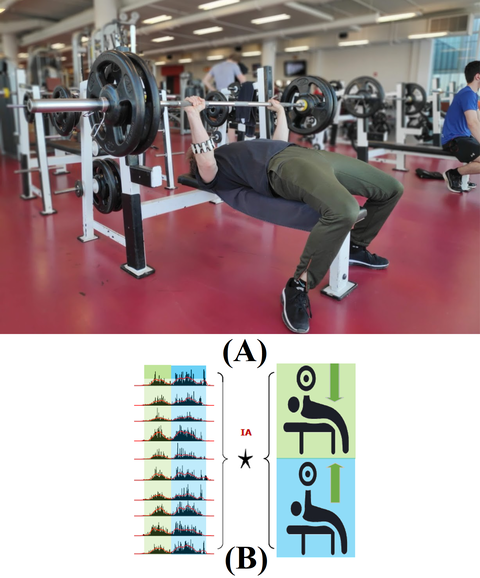
The project will involve recruiting participants to collect a comprehensive dataset. A wearable device equipped with sensors—including heart rate monitors, accelerometers, gyroscopes, and electromyography (EMG) sensors—will capture physiological and movement data as participants perform selected strength training exercises.
Data preprocessing will involve applying filtering techniques to reduce noise and standardizing the data to account for individual differences. Feature extraction will focus on deriving meaningful attributes from the raw data, such as signal amplitudes, frequencies, temporal patterns, and differentiating between eccentric and concentric movement phases.
Machine learning models will be deployed to classify exercises and count repetitions based on the extracted features.
For exertion and fatigue analysis, methods will be developed to quantify muscle fatigue by analyzing EMG signal patterns. Performance metrics will be calculated to assess measures of explosiveness and control during movements.
Data Validation and Significance
Validation will involve statistical analysis of the system's accuracy in exercise recognition, repetition counting, and exertion measurement. By comparing the system's outputs with expert assessments and established benchmarks, we can ensure reliability and effectiveness. The project's significance lies in its potential towards athletic training and rehabilitation by:
- Providing monitoring and personalized feedback of different exercises automatically
- Monitoring muscle fatigue and movement dynamics to help injuries.
- Assisting therapists in tracking patient progress during rehabilitation.
Expected Outcomes
- Innovative AI Models: Creation of robust machine learning models capable of accurately recognizing strength training exercises and analyzing key performance indicators.
- Validated System Prototype: Development of a functional prototype tested and validated in real-world conditions.