Background
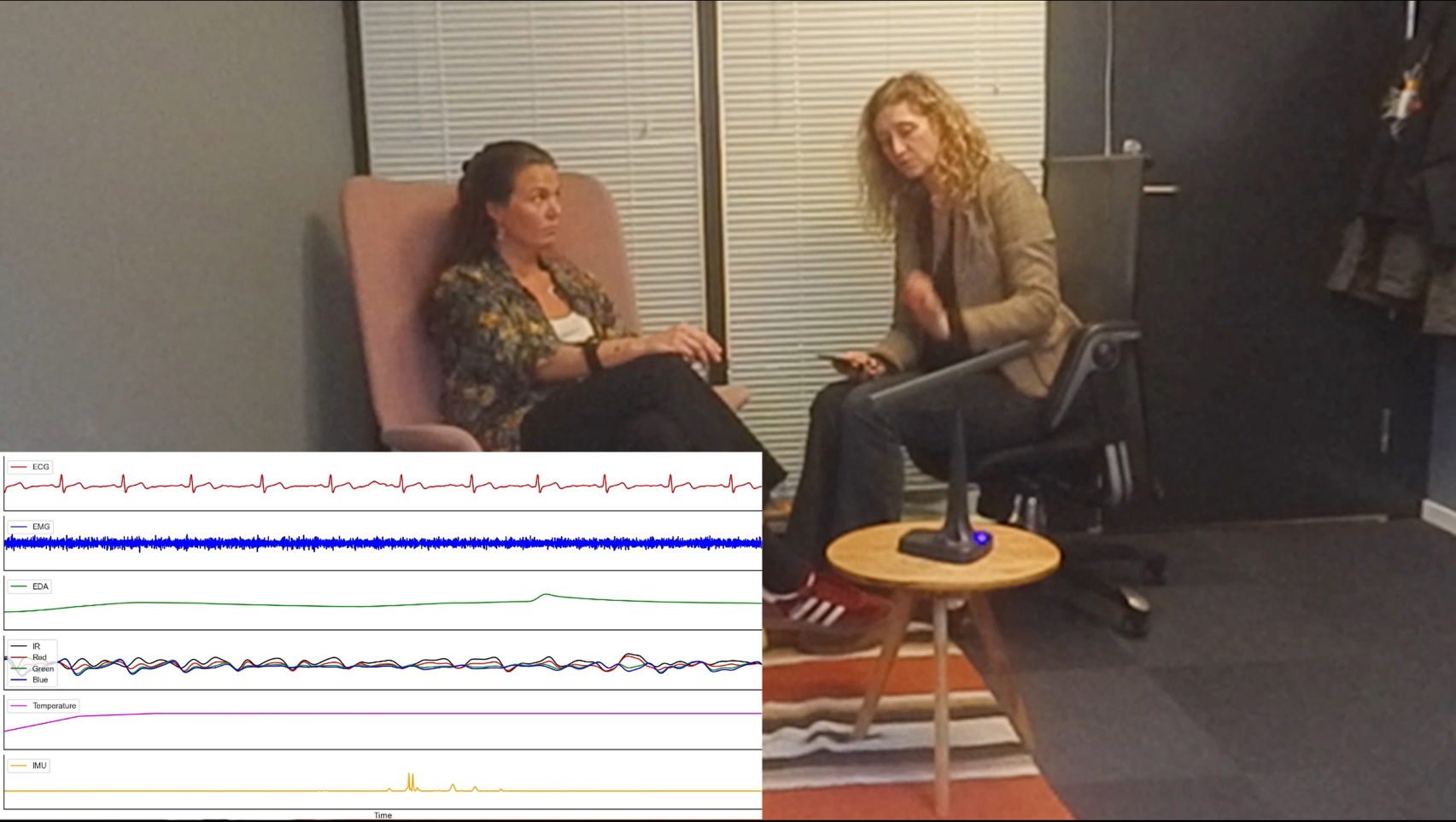
Eye Movement Desensitization and Reprocessing (EMDR) involves recalling distressing memories while receiving bilateral stimulation, commonly through guided eye movements. Preliminary research has identified changes in heart rate and heart rate variability during EMDR sessions Sack et al., 2008. These findings motivate a practical question: can a small, unobtrusive wearable collect signals of sufficient quality to track these responses?
The challenge goes beyond recording a heart rate. A useful system needs to distinguish physiological changes from movement artefacts, align recordings with events during the session, and understand potential physiological patterns from the raw biosignals. By developing and evaluating this workflow, you will help establish whether wearable sensing can provide useful information about activation and recovery during EMDR procedures.
Working with researchers in wearable sensing and clinical psychology, you will contribute to a feasibility study supporting the KIT programme (KIT trial information), an ongoing randomized control trial of EMDR therapy for trauma in psychosis. Your work will help determine what can be measured reliably and how future clinical studies should collect and analyse these signals. The longer-term ambition is to investigate whether physiological responses can help explain differences in treatment outcomes and support more individualized care.
Objective and Methodology
In collaboration with researchers at Oslo University Hospital, Helse Bergen HF, Helgeland Hospital HF, and the University of Oslo, you will develop and evaluate a reproducible workflow for recording, processing, and analysing wearable physiological signals during EMDR procedures. The goal is to assess whether these recordings can reliably capture changes in physiological activity and provide useful information alongside participants’ reports of distress. The project will address three questions:
• Can the biosensor collect usable recordings throughout the session with acceptable participant comfort and limited disruption?
• What physiological changes can be observed between baseline, calming, and desensitization periods, and across repeated stimulation sets?
• How do these changes relate to participants’ reported distress?
The proposed study uses a within-participant feasibility design with adult volunteers recruited through university channels. Sessions will last approximately 60–90 minutes and will be led by the clinical research team. Participants will complete an initial baseline recording and a guided calming exercise, followed by an EMDR procedure focused on a recent stressful situation. The study is intended to examine measurement feasibility in volunteers rather than treatment outcomes in patients.
The student will begin with a literature review covering physiological responses during EMDR, wearable sensing, and methods for analysing changes in autonomic activity. In collaboration with the supervisors, the student will then establish the recording workflow, including sensor setup, signal export, and synchronization with session events.
The technical work will focus on developing a signal-processing pipeline for quality assessment, artefact detection, segmentation, and feature extraction. Session annotations will identify the different phases, stimulation sets, and participant ratings, enabling physiological changes to be examined in their temporal context.
Data collection will proceed under an approved protocol covering informed consent, participant support, and secure handling of research data. The clinical team will oversee screening and the EMDR procedures, while the student’s contribution will centre on sensing, processing, and analysis.
Expected Outcomes
By the end of the project, you will have developed a documented recording procedure and a reproducible analysis pipeline, and evaluated how reliably the biosensor captures physiological signals during EMDR procedures. Your analysis will explore how physiological activity changes throughout a session and how these changes relate to participants’ reported distress.
Your work will help the KIT research team decide how to use wearable sensors in future clinical studies, informing sensor selection, recording procedures, and the choice of physiological measures. This will lay the groundwork for investigating whether these signals can help explain differences in treatment response and, ultimately, support more individualized care. You will gain practical experience in biomedical signal processing, wearable sensing, and interdisciplinary research with clinical partners.