Mathematics for quantum computation and many-body theory (QOMBINE)
A cross-disciplinary project between mathematics, chemistry, and physics
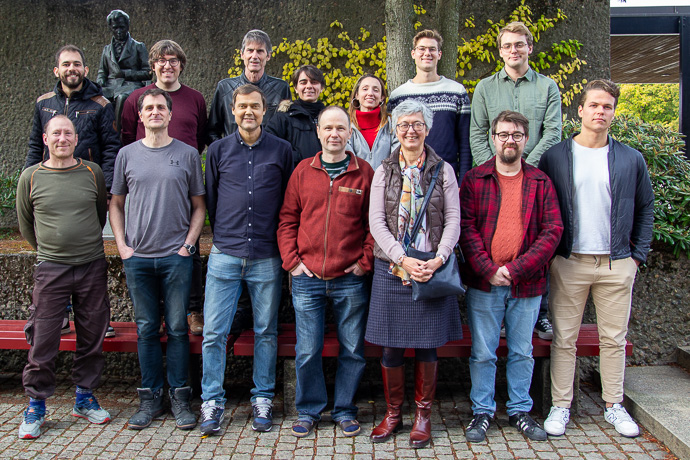
Qombine group members as of October 2023 (Makoto Yamashita not on photo). (Photo: Elisabeth Seland, Department of Mathematics, UiO.)
About the project
Modern computers and their ever improving computing power have defined the technological advancements of our times. Their performance will eventually reach its limits and a new computational paradigm is currently being developed to enable future advances: Quantum computing aims to exploit the features of quantum mechanics in order to solve computational tasks faster than it would be possible on classical computers.
Developing this technology and understanding its capabilities is a massive and quickly evolving endeavor. A collective effort of the scientific community drawing on expertise across various disciplines is key to deliver sound and long lasting progress. Our team of mathematicians, physicists and quantum chemists will concentrate on theoretical questions central to noise-resistant quantum computation and its application to many-body theory and information processing. Answering these questions requires novel tools anchored across our different disciplines. QOMBINE brings together a unique team of experts in Norway to develop these tools. This will lay the foundations for a new and rich cross-fertilization of research in Mathematics, Physics and Chemistry in Norway.
Financing
This project is funded by the Reseach Council of Norway . Funding ID: 324944. Total budget approx. 25 million NOK.
More group photos
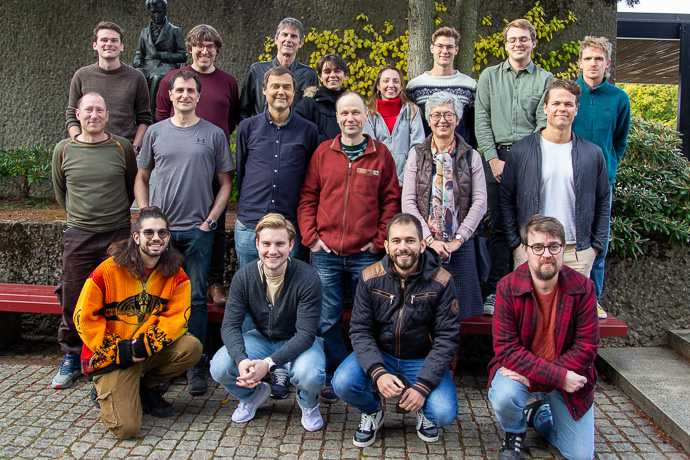
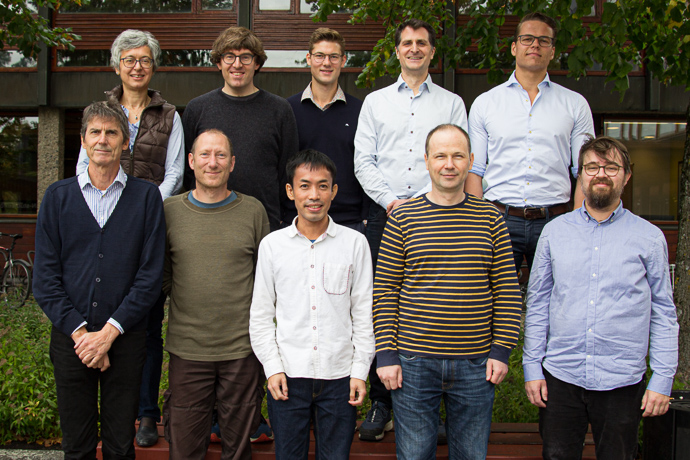
Qombine+ (group members and close collaborators), October 2023. (Photo: Elisabeth Seland, Department of Mathematics, UiO.)Group members as of September 2022. (Photo: Department of Mathematics, UiO.)
We consider the tube algebra of a spherical semisimple multitensor category X, and construct a braided monoidal structure with twist for its representations. We further show that this category is braided tensor equivalent with the Drinfeld center of the ind-category of X, extending the well-known linear equivalence.
Linear maps between finite-dimensional ordered vector spaces with orders induced by proper cones CA and CB are called entanglement breaking if their partial application sends the maximal tensor product K⊗maxCA into the minimal tensor product K⊗minCB for any proper cone K. We study the larger class of Lorentz-entanglement breaking maps where K is restricted to be a Lorentz cone of any dimension, i.e., any cone over a Euclidean ball. This class of maps appeared recently in the study of asymptotic entanglement annihilation and it is dual to the linear maps factoring through Lorentz cones. Our main results establish connections between these classes of maps and operator ideals studied in the theory of Banach spaces. For operators u:X→Y between finite-dimensional normed spaces X and Y we consider so-called central maps which are positive with respect to the cones CA=CX and CB=CY. We show how to characterize when such a map factors through a Lorentz cone and when it is Lorentz-entanglement breaking by using the Hilbert-space factorization norm γ2 and its dual γ2⁎. We also study the class of Lorentz-entanglement annihilating maps whose local application sends the Lorentzian tensor product CA⊗LCA into the minimal tensor product CB⊗minCB. When CA is a cone over a finite-dimensional normed space and CB is a Lorentz cone itself, the central maps of this kind can be characterized by the 2-summing norm π2. Finally, we prove interesting connections between these classes of maps for general cones, and we identify examples with particular properties, e.g., cones with an analogue of the 2-summing property.
Jaklitsch, David Alexander & Yadav, Harshit
(2026).
⊗-Frobenius Functors and Exact Module Categories.
International Mathematics Research Notices (IMRN).
ISSN 1073-7928.
2026(8).
doi: 10.1093/imrn/rnag065.
Full text in Research Archive
Austad, Are; Ortega, Eduard & Palmstrøm, Mathias Sperre
(2026).
K-theory invariance of $L^{p}$-operator algebras associated with étale groupoids of strong subexponential growth.
Documenta Mathematica.
ISSN 1431-0635.
doi: 10.4171/dm/1066.
Full text in Research ArchiveShow summary
We introduce the notion of (strong) subexponential growth for étale groupoids and study its basic properties. In particular, we show that the K-groups of the associated reduced groupoid L^{p} -operator algebras are independent of p\in [1,\infty) whenever the groupoid has strong subexponential growth. Several examples are discussed. Most significantly, we apply classical tools from analytic number theory to exhibit an example of an étale groupoid associated with a shift of infinite type which has strong subexponential growth, but not polynomial.
We use deformation sequences of (Hopf) algebras, extending the results of Negron and Pevtsova, to show that bosonizations of some suitable braided Hopf algebras by some suitable finite-dimensional Hopf algebras have finitely generated cohomology. In fact, our results are shown in more generality for smash products. As applications, we prove the bosonizations of some Nichols algebras (such as Nichols algebras of diagonal type, the restricted Jordan plane, Nichols algebras of direct sums of Jordan blocks plus points labeled with 1), by some suitable finite-dimensional Hopf algebras, have finitely generated cohomology, recovering some known results as well as providing new examples.
Austad, Are & Raum, Sven
(2025).
DETECTING IDEALS IN REDUCED CROSSED PRODUCT C*-ALGEBRAS OF TOPOLOGICAL DYNAMICAL SYSTEMS.
Journal of the Institute of Mathematics of Jussieu.
ISSN 1474-7480.p. 25–25.
doi: 10.1017/s147474802510145x.
Full text in Research ArchiveShow summary
We introduce the ℓ1-ideal intersection property for crossed product C∗-algebras. It is implied by C∗-simplicity as well as C∗-uniqueness. We show that topological dynamical systems of arbitrary lattices in connected Lie groups, arbitrary linear groups over the integers in a number field and arbitrary virtually polycyclic groups have the ℓ1-ideal intersection property. On the way, we extend previous results on C∗-uniqueness of L1-groupoid algebras to the general twisted setting.
We study the quantum metric structure arising from length functions on quantum groups and show that for coamenable quantum groups of Kac type, the quantum metric information is captured by the algebra of central functions. Using this, we provide the first examples of length functions on (genuine) quantum groups which give rise to compact quantum metric spaces.
Given an operator φ : X → Y between Banach spaces, we consider its tensor powers φ⊗k as operators from the k-fold injective tensor product of X to the k-fold projective tensor product of Y . We show that after taking the kth root, the operator norm of φ⊗k converges to the 2-dominated norm γ∗2 (φ), one of the standard operator ideal norms.
Fuchs, Jürgen; Galindo, César; Jaklitsch, David Alexander & Schweigert, Christoph
(2025).
A manifestly Morita-invariant construction of Turaev-Viro invariants.
Quantum Topology.
ISSN 1663-487X.
doi: 10.4171/qt/234.
Full text in Research Archive
We say that an inclusion of an algebra A into a C*-algebra B has the ideal separation property if closed ideals in B can be recovered by their intersection with A. Such inclusions have attractive properties from the point of view of harmonic analysis and noncommutative geometry. We establish several permanence properties of locally compact groups for which L1(G) ⊆ C*red(G) has the ideal separation property.
Kvaal, Simen; Fredheim, Håkon Richard; Højlund, Mads Greisen & Pedersen, Thomas Bondo
(2025).
Time-dependent Bivariational Principle: Theoretical Foundation for Real-Time Propagation Methods of Coupled-Cluster Type.
Journal of Physical Chemistry A.
ISSN 1089-5639.
129(15),
p. 3508–3521.
doi: 10.1021/acs.jpca.4c07417.
Full text in Research ArchiveShow summary
Real-time propagation methods for chemistry and physics are invariably formulated using variational techniques. The time-dependent bivariational principle (TD-BIVP) is known to be the proper framework for coupled-cluster type methods, and is here studied from a differential geometric point of view. It is demonstrated how two distinct classical Hamilton’s equations of motion arise from considering the real and imaginary parts of the action integral. This in turn leads to two distinct bivariational principles for real bivariational approximation submanifolds. Conservation laws and Poisson brackets are introduced, completing the analogy with classical mechanics. Furthermore, the time-dependent univariational principles (the time-dependent variational principle, the McLachlan principle, and the Dirac–Frenkel principle) are reconstructed using the TD-BIVP and a bivariational submanifold on product form. An overview of established real-time propagation methods is given in the context of our formulation of the TD-BIVP, namely time-dependent traditional coupled-cluster theory, orbital-adaptive coupled-cluster theory, time-dependent orthogonal optimized coupled-cluster theory, Brueckner coupled-cluster theory, and equation-of-motion coupled cluster theory.
We provide an explicit expression for the modular hamiltonian of the von Neumann algebras associated to the unit double cone for the (fermionic) quantum field theories of the 2-component Weyl (helicity 1/2) field, and of the 4-component massless Dirac and Majorana fields. To this end, we represent the one particle spaces of these theories in terms of solutions of the corresponding wave equations, and obtain the action of the modular group on them. As an application, we compute the relative entropy between the vacuum of the massless Majorana field and one particle states associated to waves with Cauchy data localized in the spatial unit ball.
Aubrun, Guillaume; Hermes, Alexander Mueller- & Plavala, Martin
(2024).
Monogamy of entanglement between cones.
Mathematische Annalen.
ISSN 0025-5831.
391,
p. 1591–1609.
doi: 10.1007/s00208-024-02935-4.
Full text in Research Archive
Belzig, Paula; Christandl, Matthias & Hermes, Alexander Mueller-
(2024).
Fault-Tolerant Coding for Entanglement-Assisted Communication.
IEEE Transactions on Information Theory.
ISSN 0018-9448.
70(4),
p. 2655–2673.
doi: 10.1109/TIT.2024.3354319.
Full text in Research ArchiveShow summary
Channel capacities quantify the optimal rates of sending information reliably over noisy channels. Usually, the study of capacities assumes that the circuits which the sender and receiver use for encoding and decoding consist of perfectly noiseless gates. In the case of communication over quantum channels, however, this assumption is widely believed to be unrealistic, even in the long-term, due to the fragility of quantum information, which is affected by the process of decoherence. Christandl and Müller-Hermes have therefore initiated the study of fault-tolerant channel coding for quantum channels, i.e. coding schemes where encoder and decoder circuits are affected by noise, and have used techniques from fault-tolerant quantum computing to establish coding theorems for sending classical and quantum information in this scenario. Here, we extend these methods to the case of entanglement-assisted communication, in particular proving that the fault-tolerant capacity approaches the usual capacity when the gate error approaches zero. A main tool, which might be of independent interest, is the introduction of fault-tolerant entanglement distillation. We furthermore focus on the modularity of the techniques used, so that they can be easily adopted in other fault-tolerant communication scenarios.
We present a novel formalism to both understand and construct mixers that preserve a given subspace. The method connects and utilizes the stabilizer formalism that is used in error correcting codes. This can be useful in the setting when the quantum approximate optimization algorithm (QAOA), a popular meta-heuristic for solving combinatorial optimization problems, is applied in the setting where the constraints of the problem lead to a feasible subspace that is large but easy to specify. The proposed method gives a systematic way to construct mixers that are resource efficient in the number of controlled not gates and can be understood as a generalization of the well-known X and XY mixers and a relaxation of the Grover mixer: Given a basis of any subspace, a resource efficient mixer can be constructed that preserves the subspace. The numerical examples provided show a dramatic reduction of CX gates when compared to previous results. We call our approach logical X-Mixer or logical X QAOA (LX-QAOA), since it can be understood as dividing the subspace into code spaces of stabilizers S and consecutively applying logical rotational X gates associated with these code spaces. Overall, we hope that this new perspective can lead to further insight into the development of quantum algorithms.
Martres, Delphine; Fuchs, Franz Georg & Pariente, Ruben
(2026).
Performance of random reservoir unitaries for quantum extreme learning machines using a fault-tolerant construction.
Full text in Research ArchiveShow summary
Quantum extreme learning machines (QELM) is a framework for quantum machine learning which aims to leverage the high dimensionality
of the Hilbert space of a quantum reservoir to construct a rich feature map of classical data inputs. There are promising results mostly
obtained on ideal simulators, but it is known that the inherent noise in quantum devices makes the state quickly converge to a specific mixed state
independent of the input, making the QELM input-agnostic and thus useless[1]. As a step towards practical application of QELM before fully
fault-tolerant hardware is realized, we propose an analysis of the performance of random reservoir unitaries with a controlled T count, which
can be easily constructed fault-tolerantly for CSS codes, compared to the widely used chaotic Ising model reservoir in terms of Fourier richness of
the outputs, and study their impact on the state convergence phenomenon when implemented fault-tolerantly for a small system.
Austad, Are
(2026).
A new characterization of discrete groups yielding compact quantum metric spaces.
Full text in Research Archive
Kvaal, Simen; Bergan, Snorre; Fredheim, Håkon Richard; Larsen, Nadia S. & Neshveyev, Sergey
(2025).
A mathematical approach to CC theory.
Full text in Research ArchiveShow summary
In this talk, I will outline work being carried out in an interdisciplinary project with the Operator Algebra group at Department of Mathematics, UiO. We have done a complete reformulation of coupled-cluster methods from the point of view of the bivariational principle, which gives a more “geometric” view. We have formulated general strategies for a posteriori and a priori error estimation using a nonlinear inf-sup theorem. Several results and proofs are simplified compared to those found in the literature. We are able to place all the analyses presently in the literature in this framework, in particular the seminal works by Rohwedder—Schneider, and Hassan—Maday—Wang
Müller-Hermes, Alexander
(2025).
Limit formulas for norms of tensor power operators and entanglement annihilating maps.
Full text in Research Archive
A tensor functor between tensor categories can have isomorphic adjoint functors. We define a notion of Frobenius functors that accounts for the extra structure of bimodule categories. This condition will allow for the transport of unimodular and pivotal structures of module categories, thereby producing examples of Frobenius algebras. The purpose of the talk is to present this procedure in the context of Hopf algebras and pivotal co-module algebras.
Quantum synchronization is often studied using a master equation, typically the Lindblad equation. This gives the time evolution of the density matrix. If we study the response to a periodic external signal, synchronization is detected by a steady state density matrix that is in phase with the external signal. However, the system will normally only partially synchronize with the degree of synchronization being hard to quantify. This is to some extent similar to the synchronization of a classical system in the presence of external noise, but in that case we can measure the degree of synchronization by the average frequency of the system as compared to the frequency of the external signal. For a quantum system, we apply the quantum trajectory approach, which gives a stochastic trajectory, and measures the average frequency of such trajectories. In this way, we can study the synchronization process in more detail than when using the master equation. We illustrate this by studying the synchronization of a two-level system to an external signal, and the mutual synchronization of two two-level systems.
Floquet engineering is a well-known technique for the control of quantum systems using periodic driving, and has been used for many years in the field of solid state physics to induce and study exotic states of matter. However, in recent years there is an interest in using Floquet engineering in QEC, specifically for the preparation of codestates, by driving the system into a target Hamiltonian whose ground state is a codestate of a desired code. Since in general designing a driving potential for a specific target effective Hamiltonian is a difficult problem, these applications usually rely on intuition to design an appropriate drive. In this talk, after a short introduction to Floquet theory, I will review some of the recent litterature that has applied it to QEC codestate preparation, as well as papers that introduce ways to systematically design appropriate driving potentials for bosonic systems. I will then sketch the idea of an analogous method for interacting spin systems, building upon the intuition developed in one of the applications exposed earlier. Finally I will conclude with some outlooks on the ideas that we plan to explore in future work.
Decoherence is the main obstacle to constructing reliable quantum computers. Therefore, it
is important to understand the physical mechanisms of decoherence. In superconducting
quantum devices, it is observed that the noise spectrum of the environment often is dominated
by low frequencies, the so-called 1/f noise. I will describe how we can model 1/f noise by
random telegraph processes. In this context, there appears a sudden change in behavior as the
parameters of the model are changed, which can be understood in terms of an exceptional
point of a non-Hermitian matrix. I will explain what this means and how this concept can appear
in other contexts.
Bergli, Joakim
(2024).
Quantum Computers: Why would we like to build one and how can we do it? Full text in Research Archive
Fuchs, Franz Georg & Bassa, Ruben Pariente
(2024).
Logical X Operations for Constrained Problems.
Full text in Research Archive
Austad, Are
(2024).
Quantum metrics on crossed products with groups of polynomial growth.
Full text in Research Archive
Fredheim, Håkon Richard
(2024).
Quantum Technology: Recent developments, future challenges and risks, and what this implies for NBIM.
Full text in Research Archive
Fuchs, Franz Georg; Lenssen, Jerome; Martres, Delphine & Myneni, Hemanadhan
(2024).
Quantum Error correction - theory and hands-on.
Full text in Research Archive
Tensor networks (TN) have important applications in mathematics, chemistry, physics, and machine learning. They can for instance be used to describe quantum many-body systems, simulate quantum circuits, or compress neural networks. In this talk I will give a gentle introduction to the mathematical framework of TNs. After introducing the basic concepts and notation, I well go through some well-known algorithms/methods for sampling, calculating inner products, and time evolution.
Austad, Are
(2024).
The ideal separation property for dense inclusions of ∗-algebras in C* -algebras.
Full text in Research Archive
Martres, Delphine & Lind-Olsen, Jesper
(2024).
Quantum Error Correction and the Surface Code.
Full text in Research Archive
Larsen, Nadia S. & Fuchs, Franz Georg
(2024).
Quantum information and computing within mathematics departments at UiO and SINTEF: current perspectives.
Full text in Research Archive
En vanlig misforståelse er at kvantedatamaskiner vil bli superraske erstatninger for dagens maskiner. Faktisk er kvantedatamaskiner tregere på grunnleggende operasjoner, men de tilbyr radikalt nye måter å løse spesifikke problemer på. Hvordan sikrer vi at Norge har kunnskapen vi trenger for å ta i bruk kvanteteknologien når den er moden?
Fredheim, Håkon Richard
(2023).
Quantum Technology: Current research perspectives and recent developments.
Full text in Research Archive
Quantum error mitigation (QEM) aims to reduce the errors that occur on quantum chips when a quantum algorithm is executed. In this talk I will give an introduction to two popular methods for QEM. The first one is based on extrapolation techniques, and the second on quasiprobabilistic decompositions. I will also highlight differences and similarities of QEM and quantum error correction.