News about research and 'In media' articles where PHAB people have participated. The list is not exhaustive, and articles can be in Norwegian or English.
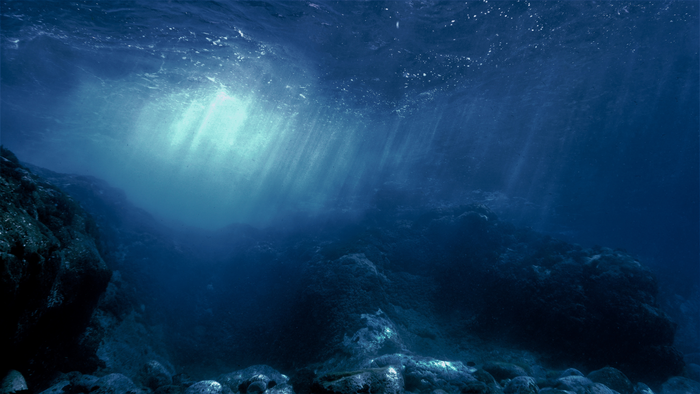
In the deep ocean, there is a myriad of large and small mountains. Researchers at the University of Oslo have now discovered a connection between two deep structures in Earth’s deep interior and the formation of seamounts.
Torgeir Andersen, professor emeritus at PHAB, recently appeared on the Geology Bites podcast to discuss the remarkable geological history recorded in western Norway’s eclogites. He explains how the discovery of coesite revealed that these rocks were buried to depths of around 100 km during the collision of Baltica and Laurentia some 400 million years ago, before returning to the surface, and discusses why rare diamond-bearing rocks may reflect local overpressure rather than even greater burial depths.
You can listen to the episode here, or wherever you get your podcasts.
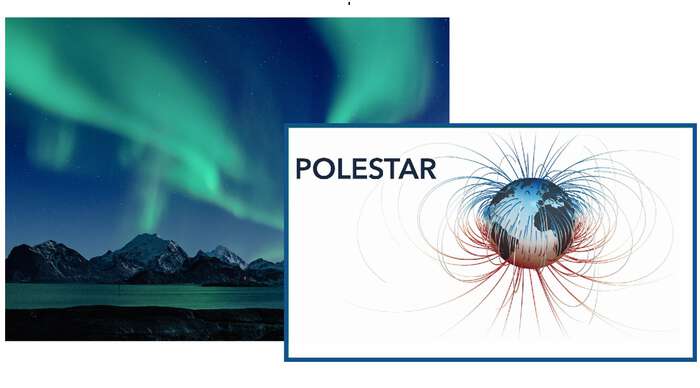
Researcher Leandro Gallo at the Centre for Planetary Habitability (PHAB), Department of Geosciences, University of Oslo, has received funding from the Research Council of Norway for an early-career project. The Polestar project will explore Earth’s magnetic field and how it has evolved over geological time.
Research led by the British Geological Survey with contributions from the University of Oslo, including Professor Trond H. Torsvik from PHAB, has attracted international media attention following the discovery of evidence for a 454-million-year-old “supervolcano” buried beneath eastern England.
The project, 'DEFORM - Deflection of the Core-Mantle Boundary Reorganizes Mantle Flow', commenced at PHAB on August 1, 2026. It is lead by Björn Heyn and will for the first time implement actual deformation of the core-mantle boundary in numerical models.
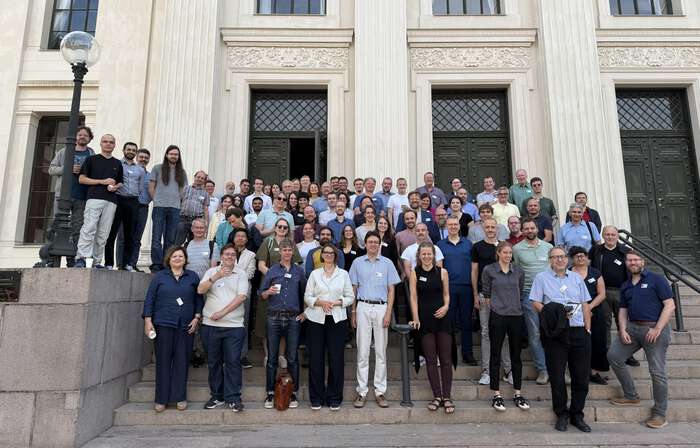
In 2027, ESA will launch the space telescope PLATO, with Norway contributing both technology and research efforts. At the end of July, the PHAB research centre at the University of Oslo hosted the PLATO consortium during PLATO Week #18.
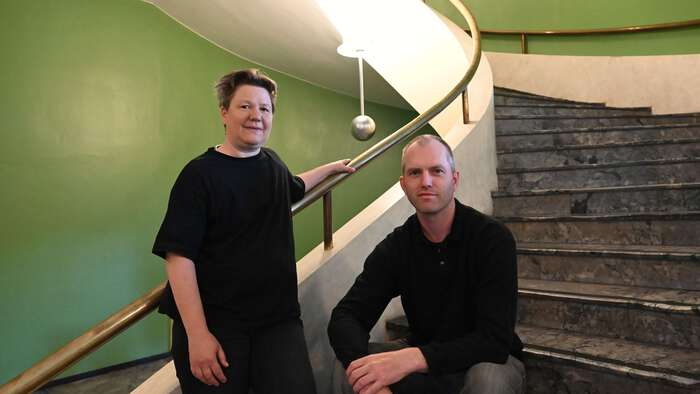
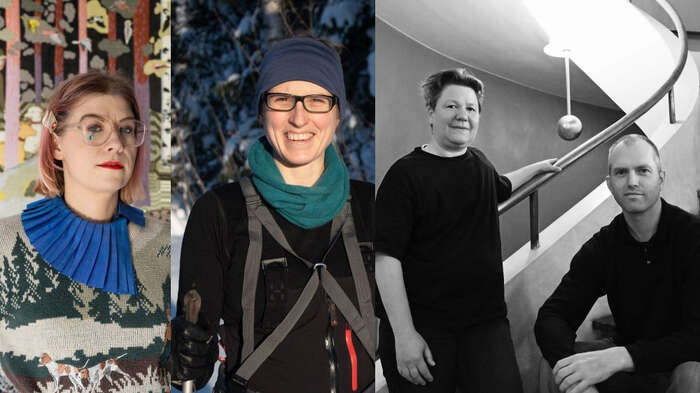
Gjestekunstnere høsten 2026 - våren 2027 gjennom REAL kunst er Emilia Bergmark og Marius Mathisrud, i samarbeid med Désirée Treichler og Stephanie Werner. Vi gratulerer!
The Royal Astronomical Society in the United Kingdom awards the 2025 Keith Runcorn Thesis Prize for the Best Thesis in Geophysics and Planetary Science to Dr. Hannah Sanderson, now a postdoctoral fellow at Centre for Planetary Habitability (PHAB) at University of Oslo.
A research article written by PHAB staff Yi Xue, Mat Domeier, Petter Silkoset, Leandro Gallo, Justin Tonti-Filippini as well as Harald Walderhaug, has received a spotlight feature article in EOS - Magazine of science news published by AGU.
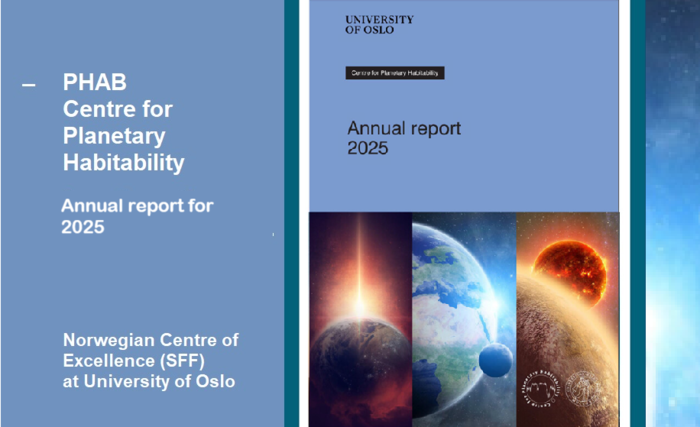
The primary research objective of the Centre for Planetary Habitability is to identify and characterize the essential conditions that render a planet habitable. PHAB commenced operations in the summer of 2023, and you may now read our 2025 Annual Report online.
On 6 February, the PHAB research centre at the University of Oslo hosted a memorial symposium dedicated to the Viljoen twins, Richard and Morris, and their work on komatiites — rare ultramafic volcanic rocks derived from the mantle. The event, which can be watched here, honoured their scientific contributions and brought together colleagues to discuss recent advances in petrology and early Earth history.
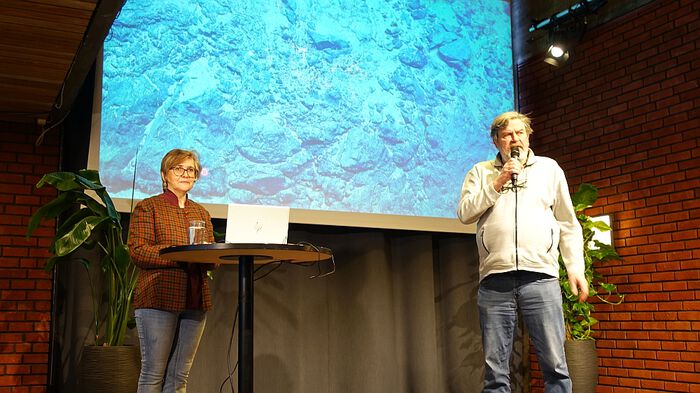
The lecture "The Secret World of Seamounts" was held on 4th of February 2026 by Professor Carmen Gaina, who is a marine geoscientist with the Department of Geosciences and part of PHAB centre of excellence.
The Else-Ragnhild Neumann Award 2025 was presented by Stephanie Werner, Director of PHAB to the award winner Gabrielle Kleber, at a seminar in the Science Library at University of Oslo on the 5 of February.
PHAB researcher Agata Krzesinska has been invited to work with IMEWG, as part of the sub-working group 'Mars Science Scope Prior to the Arrival of Humans'.
The Else-Ragnhild Neumann Award for Women in Geosciences, which recognises outstanding contributions to the geosciences by women, has been awarded for 2025 to Gabrielle Kleber of UiT The Arctic University of Norway.
GoNorth has released a short film featuring interviews and insights from GoNorth’s research expedition in the Arctic Ocean (27 November–17 December 2025). Among those interviewed is Professor Carmen Gaina (University of Oslo, UiO/GEO/PHAB). The film was produced by NORCE and is available on Vimeo.