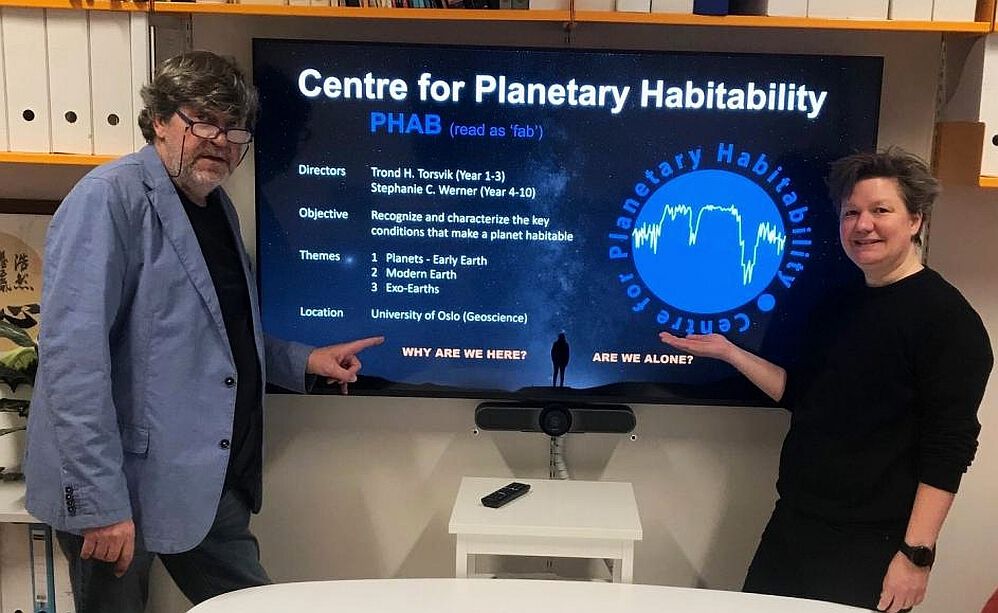
Stephanie Werner took over as director of Centre for Planetary Habitability (PHAB) on July 1. She succeeds Professor Trond Helge Torsvik, who has led the centre since its inception in 2023 and has been a key figure since the application for support in the SFF/CoE-scheme and during the startup phase. His efforts have contributed to strengthening the center's position and building it up.
PHAB is one of University of Oslo's 11 centres for excellence in research. PHAB has a duration of 10 years (2023 to 2033) and aims to explore what the most important conditions for the emergence of life are, as well as what characteristics planets in other solar systems may have that could make them habitable.
Continuity in leadership, up from deputy
Stephanie Werner is not new to the leadership team, as she has been the deputy leader from the start until now, so the transition is unlikely to be significant. Werner also brings with her experience as director (2016-2024) of the Norwegian Research School for Dynamics and Evolution of Earth and Planets (DEEP).
Werner was also a key figure in the SFF/CeE centre Centre for Earth Evolution and Dynamics, another CoE centre, which concluded in 2023. Stephanie Werner became a professor at the Department of Geosciences, University of Oslo in 2017, specializing in planetary science.
Continuing as a researcher and new research project
Torsvik, for his part, recently received project funding for a new major research project titled "The Great Oxygenation Event and Planetary Habitability" from the Norwegian Research Council's scheme for groundbreaking research, FRIPRO.
He thus has a clear plan moving forward and will continue as a researcher at the center and the Department of Geosciences, with a new research project that is relevant to PHAB's research.