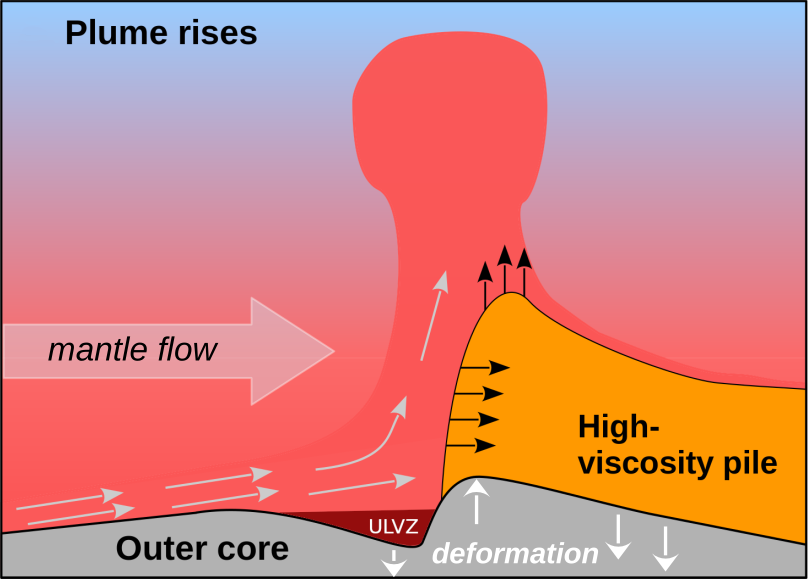
Both plate tectonics and deep-rooted upwellings in the Earth's mantle (so-called mantle plumes) have significant impact on how our planet evolved over time. However, in numerical simulations we need to chose the correct respective boundary conditions to properly reproduce and understand these processes. For example, Earth-like single-sided subduction can only be modeled if the surface boundary can deform. Similarly, if we allow for realistic deformation of the core-mantle boundary, will it change plume formation in our models? Will this deformation also modify mantle convection patterns, the lateral movement and distribution of heterogeneities, or the Earth's magnetic field?

DEFORM will look at how the topographic fingerprints of subducted slabs and thermal or (thermo-)chemical heterogeneities (e.g. the continent-sized Large Low Shear Velocity Provinces, LLSVPs) affect mantle convection and plume formation for various conditions. In addition, the project will compare predicted topography to observations from seismology to get better constraints on lower mantle viscosity and density distributions. Finally, it will compare predicted times of strong changes in core-mantle boundary topography to periods of unusual paleomagnetic data. This may enable the research team to identify possible links between mantle processes and the Earth's magnetic field. While the project will focus on Earth, the method developed in this project can be applied to exoplanets and other stellar objects as well.
The DEFORM group will be composed of PI Björn Holger Heyn as well as one researcher, to be employed. The project group will also collaborate extensively with the rest of PHAB.