
Leading the effort
Nicolas Poirier, a Postdoctoral Fellow at RoCS – Rosseland Centre for Solar Physics, UiO, is leading a vital effort: coordinating, observing, and reporting the findings of this major solar observation. The collaboration, which ran from October 9-16, involves data from the Solar Orbiter spacecraft (a joint NASA/ESA mission) and the Swedish Solar Telescope (SST) located on La Palma.

Collaborating teams
We spoke to Nicolas to learn more about this exciting work and the scientific papers that will soon emerge, including one in collaboration with the Institute for Solar Physics (ISP) in Stockholm.
Goals and expectations
Initial challenges and key objectives
- The first joint observation was conducted last October. What key challenges do you address in your first paper?
- Our first paper, which will be published soon, presents a method to combine SST and Solar Orbiter data to study coronal loop oscillations. We tested a few datasets, and the results look promising. We’ll expand on this with the second observation campaign for a more in-depth analysis.
Primary objectives during the second observation period
- What were the primary objectives during this second observation period?
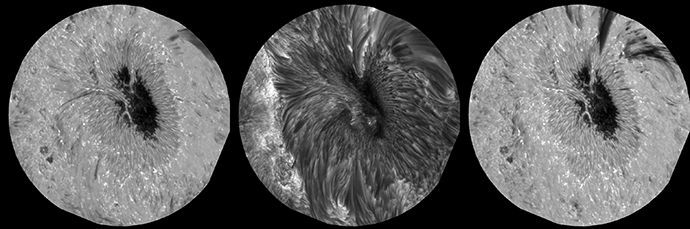
- Our main role as SST observers was to support Solar Orbiter’s observing plan. But we also turned our attention to other interesting solar phenomena, particularly the frequent and strong solar flares caused by the current solar maximum. The overarching goal was to monitor the long-term evolution of an active region over two weeks, involving not only ground-based telescopes like GREGOR and DKIST, but also space missions like Solar Orbiter, IRIS and Hinode.

A closer look at coronal rain
Focusing on specific phenomena
- Were there specific phenomena or targets you focused on during this campaign?
- Yes, we are especially interested in studying coronal rain, which forms in the loops of the Sun's corona.
Coronal rain consists of cold plasma that clumps together and flows down along these loops. With the extensive dataset we gathered, we’ll be able to explore various scientific questions, including plasma composition and coronal heating.
Technical upgrades and methodological changes
- Have there been any technical upgrades or changes in methodology since the last observation?
- Definitely. The most significant change was our decision to focus on the same active region target throughout the campaign. This allowed us to study both short-term and long-term evolution. We also extended the coordination period to mitigate potential disruptions from poor weather.
Lessons learned
- What lessons from the first observation informed this campaign?
- Last time, coordinating between the different teams and instruments was challenging due to varying operational needs. We learned a lot from that experience and improved our processes to ensure smoother coordination this time around.
Overcoming challenges
Main challenges and solutions
- What were the main challenges during this campaign, and how did you address them?
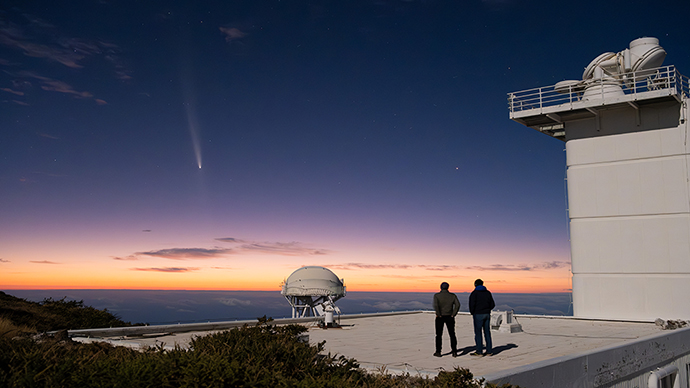
- Good communication between all the teams was crucial. We spent a lot of time preparing to ensure everything ran smoothly. Weather is always an unpredictable factor — last year, a calima (Saharan dust storm) disrupted our observations. Luckily, conditions were better this year. And yes, we sometimes even perform good-luck dances atop the SST tower to hope for good weather!
Collaborative efforts and roles
- How does the collaboration between SST and Solar Orbiter work?
- Coordination for Solar Orbiter observations starts at least 1.5 years in advance. The scientific goals are divided among the team members, and around 6 to 12 months before observations, we coordinate with SST to ensure we can meet the needs of the solar physics community.
Roles of different teams
- What roles do the different teams play in this collaboration?
- The Solar Orbiter team sets the scientific objectives and selects observation targets. The SST team advises on what SST can observe and helps process the data. We also contribute to scientific analysis, working closely with Solar Orbiter’s scientists.
Broader impact on solar research
Importance of coordinated observations
- How do these coordinated observations contribute to solar research and our understanding of solar phenomena?
- We’re in a golden age of solar exploration. Coordinated observations allow us to study different aspects of solar physics in greater detail than ever before. These collaborations lead to breakthrough discoveries and foster international cooperation within the scientific community.
Impact on earth and technology
Our goal is to deepen our understanding of active regions, which are the origins of solar eruptions and coronal mass ejections. These phenomena can have significant effects on Earth's near-space environment, influencing technology, electrical grids, and even astronaut missions.
Sharing the findings
Disseminating results
- When and how will you share the results with the scientific community and the public?
- The first campaign's results will be published in several scientific papers soon, and the second campaign looks even more promising. Data retrieval and calibration will take 3 to 6 months, and given the collaborative nature of the analysis, we expect the first publications to appear about a year after the observations.
Future publications and conferences
- Are there any anticipated publications, conferences, or workshops where you’ll discuss the findings?
- Yes, we’ve already shared some preliminary results at several conferences and workshops. These events are a great opportunity to get feedback from international experts, which helps us refine our research and improve the final results.
Acknowledgments and collaboration
Professor Luc Rouppe van der Voort at RoCS has been instrumental in coordinating and planning for SST, while Nicolas Poirier has focused on the Solar Orbiter component. Sanja Danilovic from ISP (Stockholm) significantly contributed to the coordination last year, particularly by taking data at the SST. Elias Roland Udnæs, Doctoral Research Fellow, was also involved in the observations this year.