
Katia Becheker spent for a month of intense, focused scientific immersion and returned with new skills — plus a lifelong memory: seeing the Northern Lights in Oslo in September.
A multilingual researcher
Originally from the Kabylie region of Algeria, Katia completed her bachelor’s and master’s degrees in physics at Abderrahmane Mira University, graduating top of her master’s class. Since March 2022 she has been pursuing a PhD in solar physics at the same university, with a thesis entitled “Cross-Analysis of Direct and Indirect Indicators of Solar Activity and Its Oscillations” under Dr. Mohamed Réda Bekli at the Laboratory of Theoretical Physics.
A multilingual researcher — courses in Arabic and French, research and collaborations often in English — Katia highlights the cultural and linguistic richness of her region and how it has supported her international outlook.
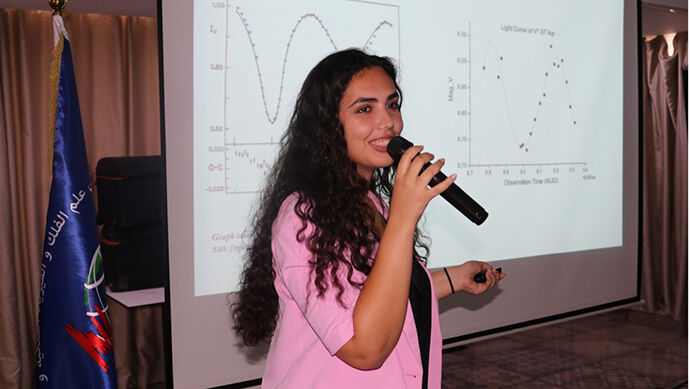
Bridging space weather and space climate
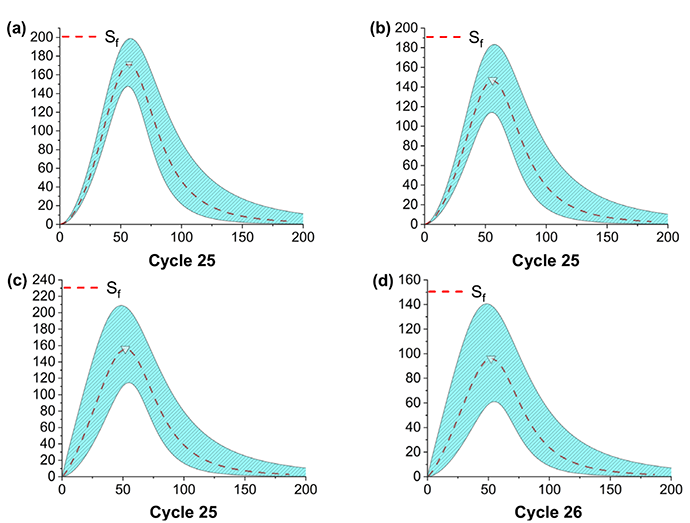
Katia’s work spans both short-term forecasting (space weather) and long-term reconstruction (space climate) of solar activity. Her multidisciplinary training and international experience have shaped a research profile centered on solar activity, sunspots and the solar dynamo.
She predicts and reconstructs solar activity using both direct and indirect indicators, and investigates sunspot dynamics and the mechanisms of the solar dynamo. Her interests extend upward from the photosphere toward chromospheric diagnostics and coronal heating problems; during her visit to RoCS she studied chromospheric signatures of nanoflares.
Looking forward, she aims to propose new research directions that bridge short- and long-term solar variability and to contribute modelling insights and novel small-scale models that advance our understanding of solar processes.
Tools, methods and challenges
Katia emphasizes that much of her work is theoretical and driven by data analysis. Her main tools are a personal workstation for numerical computations, data analysis and modelling, complemented by pen-and-paper for analytical work.
During her visit to RoCS she gained access to a dedicated workstation and local clusters, resources that greatly aided her research.
She also highlights major challenges she faces — limited funding, scarce access to observational facilities, and constrained local resources — which have motivated her to seek collaborations and research opportunities abroad.
International exposure
Katia credits internships and international schools for shaping her career: a CERN summer student internship, participation in ESIPAP (France), MPFuS (Tunisia), IAU ISYA (Algeria), Arab astrophysics schools and conferences, and this recent research visit to RoCS. These experiences broadened her skills, opened collaborative opportunities and created lasting friendships.
Katia came to the Institute of Theoretical Astrophysics to experience a leading centre in solar physics and to explore different research axes.
RoCS turned out to be a very inspiring environment where everyone focuses on the Sun — an intensive scientific immersion.
Work hard, play hard
Katia plans to continue in solar physics after her PhD, but is keeping options open between staying in Algeria or pursuing a postdoctoral position abroad. She hopes her work will improve models and propose new interpretations in solar physics. With the addition of strengthening scientific communities across the MENA and African regions, and encouraging more women into physics and astronomy.
Work hard, be curious, seize every opportunity.
For her it has been a game changer to seek international experience, surrounding herself with motivated peers.
Don't fear challenges. they are where growth happens. And remember: enjoy the journey.
Maintaining balance during a PhD is hard, she says. Katia follows routines: early starts, focused study blocks, planning and progress tracking. She also sets aside time for hobbies like tennis and spending time with family and friends.
Outside of work, she fell in love with Oslo, spending her free time exploring the city’s landscapes, museums, and meeting new people. The highlight of her stay was witnessing the Northern Lights for the first time in September — a childhood dream finally fulfilled.