ReCon²
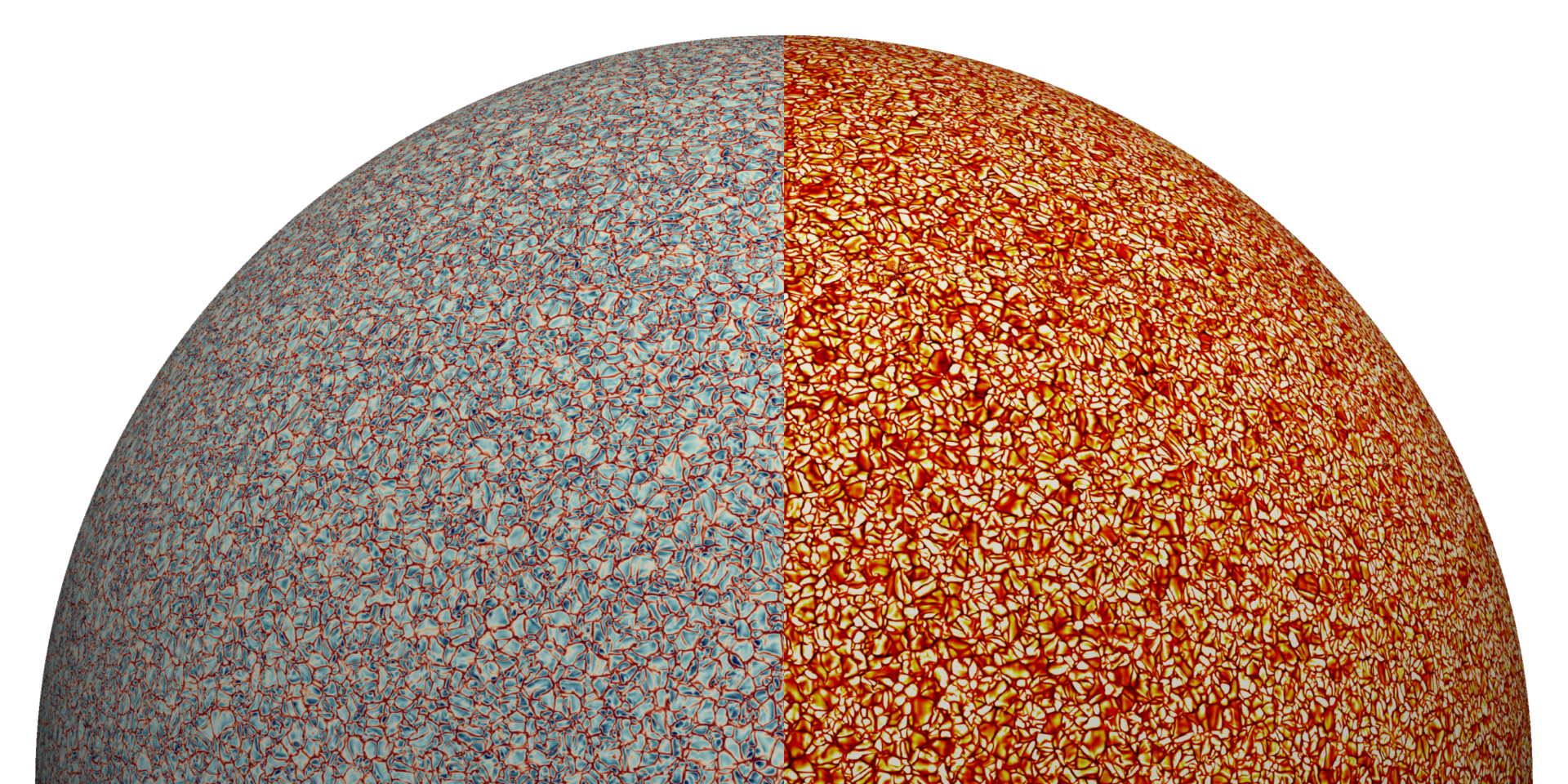
ReCon2 aims to demonstrate that the long-standing mismatch between simulated and observed solar convection is not a fundamental problem in solar physics — but a consequence of insufficient realism in existing models. By combining surface cooling driven convection, compressible MHD, and high-resolution local and global simulations, if successfull, this project will finally put the convective conundrum to rest.
Project is funded by the Research Council of Norway via the Researcher Projects for Young Scientists (FRIPRO), project number 359643. I am the PI of the project. More information can be found here
Other projects
I am currently working on resolving the solar convective conundrum. That requires large scale simulations of the entire solar convection zone. We use the publicly available DISPATCH framework and the 'volleyball' mesh decomposition. We were awarded 165 million CPU hours from the EuroHPC Extreme Scale Access to run the simulations on LUMI supercomputer. I continue to work on improving the simulations and hope that soon we will be able to share some fantastic results with the scientific community.


Academic interests
Solar physics, stellar and planetary atmospheres, magnetohydrodynamics, planet formation, radiative heat transport, plasma physics, statistical quantum mechanics
Background
I have obtained both my M.Sc. (thesis titled "Stellar model atmospheres of late spectral type stars") and Ph.D. (thesis titled "Planet formation. The roles of pebble accretion, radiative and convective energy transport") in the Niels Bohr Institute, University of Copenhagen in Denmark. Apart of computational astrophysics, in my "free time", I like doing observational astronomy, I have participated in the MiNDSTEp collaboration, searching for exoplanets using the gravitational microlensing technique with the Danish 1.54m telescope in La Silla, Chile.