Join the disputation
The PhD defence and trial lecture will be 100% in-person. The room opens for participation just before the disputation starts, and closes for new participants approximately 15 minutes after the defence has begun.
-
Zoom
Join the trial lecture - 29th of November at 10:15 (Aud. 209, Svein Rosselands Hus)
"The Formation and Evolution of Galaxies in the Context of the Large-Scale Structure of the Universe"
Conferral summary
Stretching out throughout the cosmic web, between the bright galaxy clusters and filaments, are vast areas almost completely devoid of matter: cosmic voids. Though they are empty, these dark regions of space can provide answers about the complicated physics of dark energy, and even the nature of gravity itself, if we just know where to look.
Main research findings
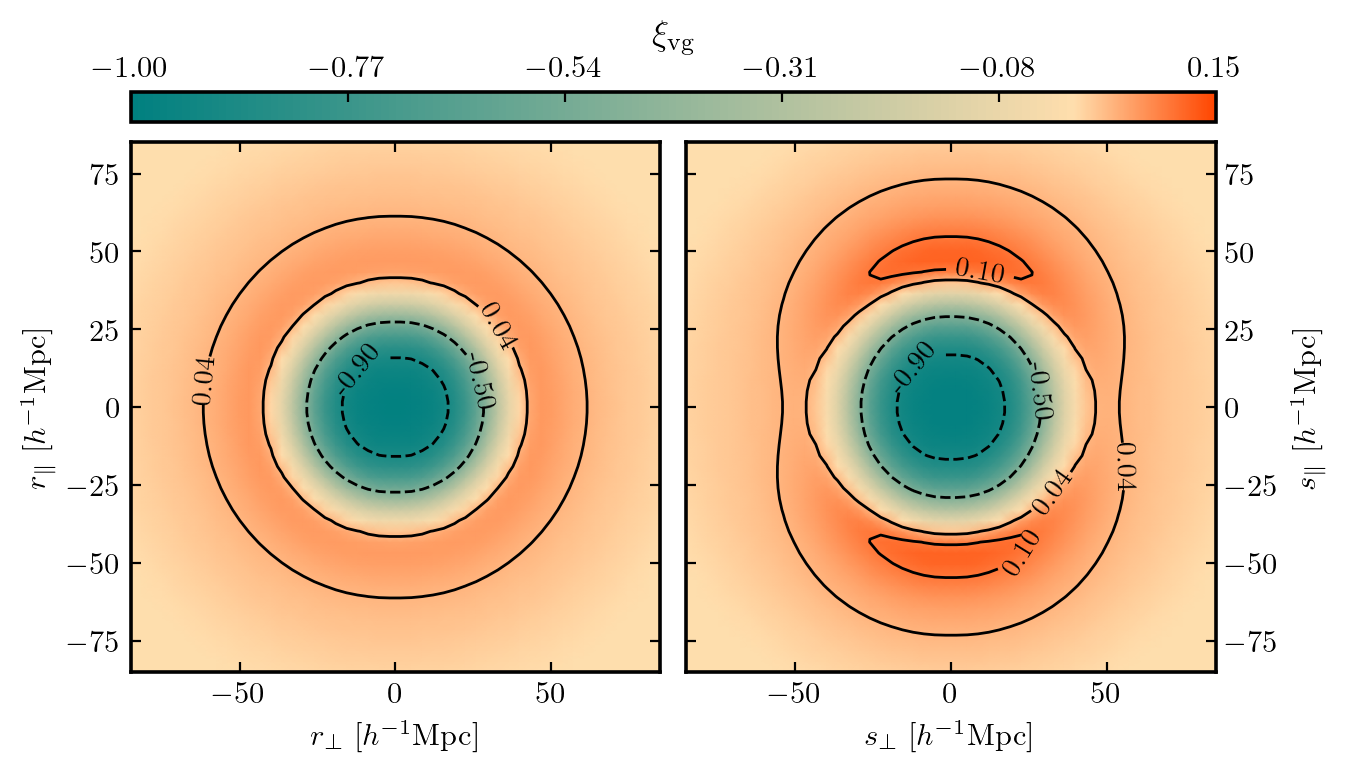
Though a young probe in a young field, cosmic voids are proving to be a promising way to study cosmology. Over the past one hundred years, cosmologists have been trying to explain the observed expansion of the Universe. Whether this expansion is driven by a new form of energy (called dark energy) or a modification to the laws of gravity is still an open question. By measuring the spatial relation of voids and the galaxies that surround them, we can explore both possibilities at the same time.
However, two observational effects complicate this measurement, creating geometrical and dynamical distortions in the observed cosmic web. Luckily, this is a feature, not a bug! Dynamical distortions, known as redshift-space distortions, arise due to the motion of galaxies under the effect of gravity and can help us study it. Geometrical distortions, on the other hand, arise from mistakes in our assumptions, and can relate the Universe as we see it to the way it really is. This effect, called the Alcock–Paczyński effect, can help us pin down the amount of dark energy in the Universe, as well as its evolution in time.