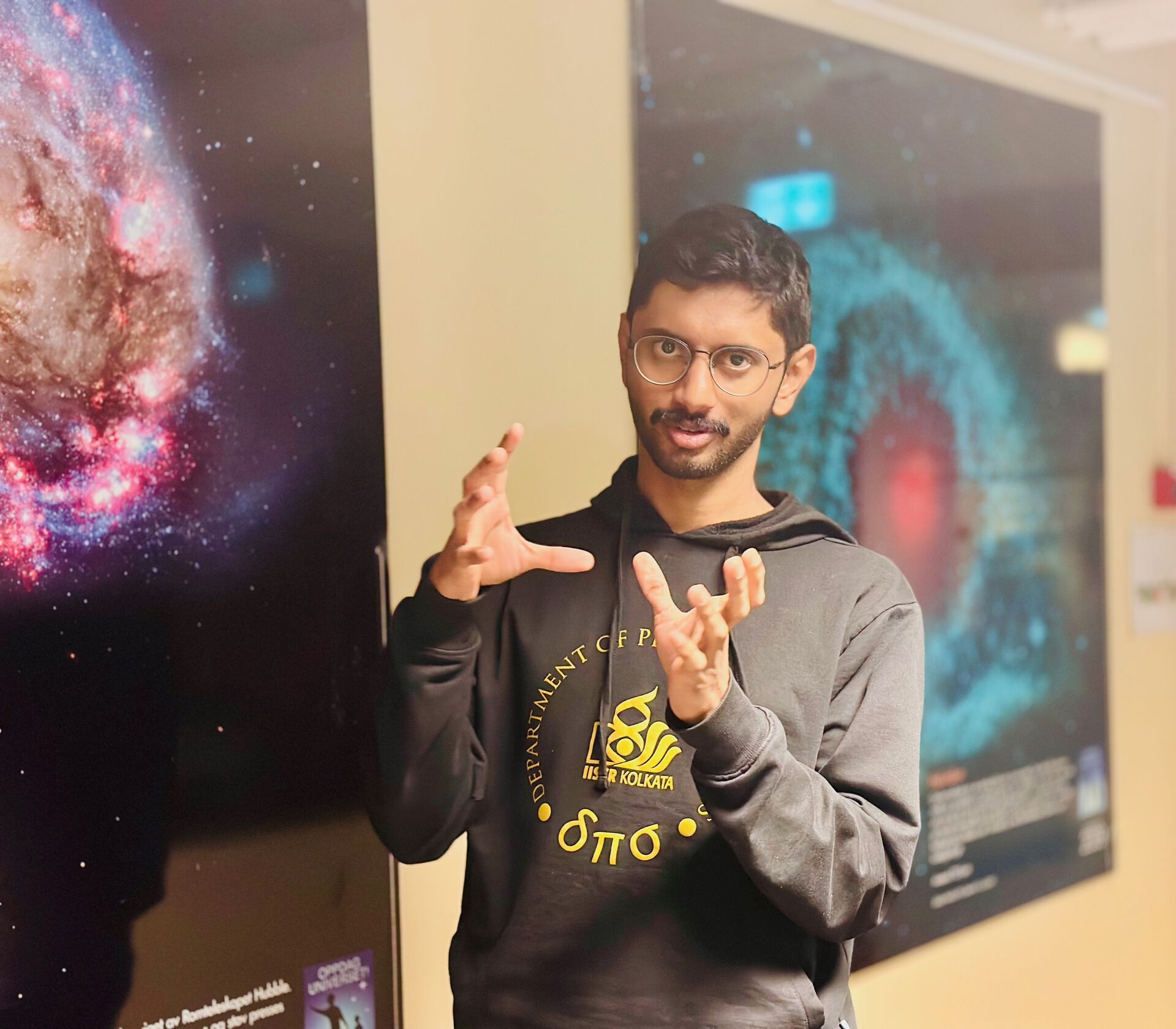
– My name is Akhil Lasrado and I'm from India.
Before arriving in Norway, Akhil did a 5 year Integrated Bachelors+Masters from the Indian Institute of Science Education and Research, Kolkata.
– Although my Master's degree is in Physics, my final year project was in astrophysics, specifically in observationally studying how massive stars form in molecular clouds inside the Milky Way galaxy, Akhil tells.
And that was Akhil's first encounter with astrophysics and sub-millimeter and spectroscopic observations with telescopes such as Herschel, Spitzer, and APEX.
Observing beyond the Milky Way galaxy
Akhil's Ph.D journey started a year ago, under the supervision of Professor Claudia Cicone.
– For my Ph.D I am continuing working on molecular gas clouds where star formation occurs with similar observing techniques except now at a much broader scale, in other galaxies, explains Akhil.
He will be studying various phenomena in extragalactic astrophysics with focus on galaxies in the local Universe.
– What's the main question of your research?
– I am broadly studying the baryon cycle of galaxies through multiple projects.


Molecular gas at the outermost fringes of galaxies holds the potential to unveil crucial evidence about distant past events that have shaped the galaxies we observe today. These events may include interactions with other galaxies, as well as the ejection of molecular gas through outflows.
By studying this molecular gas, astronomers can gain valuable insights into the evolutionary history of galaxies and the dynamic processes that have contributed to their current state.
– The goal of my current project is to use the APEX telescope to study molecular gas at the furthest extents seen yet for a bunch of very nearby galaxies, Circinus, NGC 1097, and the Antennae merger, he explains.
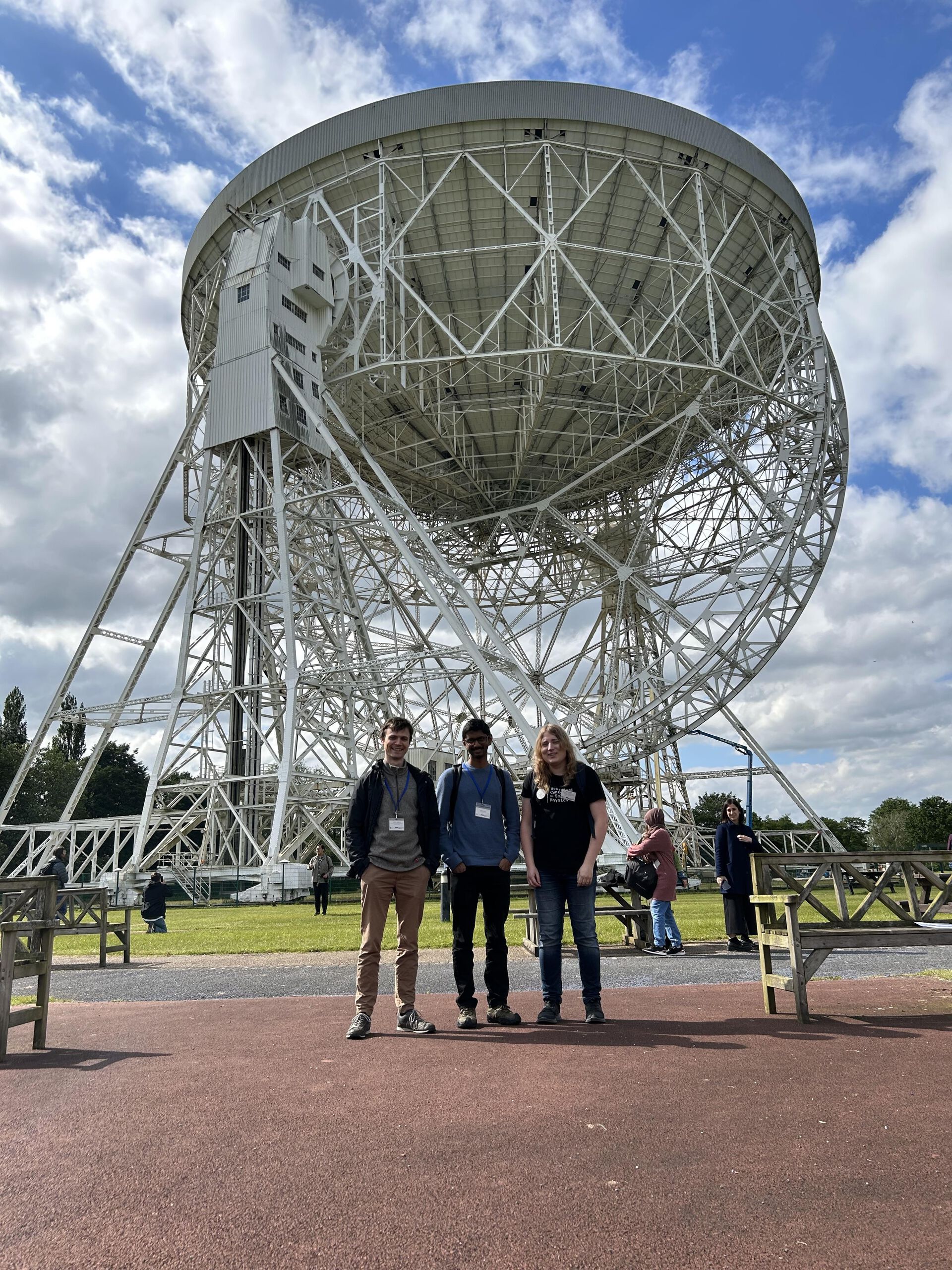
But that is not all.
– In addition to this I am also working in a couple of other projects involving radio continuum and far-infrared polarimetric observations, both of which involve techniques I haven't worked with before, he continues.
– What is your approach?
– I am primarily an observer. I use data I have applied for and obtained from sub-millimeter telescopes such as Atacama Pathfinder Experiment (APEX) and Atacama Large Millimeter Array (ALMA) in Chile, radio telescopes such as Giant Metrewave Radio Telescope in India, but I'll also be using archival data for my work, primarily from the far-infrared telescope SOFIA (which was a telescope on a Boeing 747!! Sadly its operations have now concluded).
Embracing the complexity of astrophysical phenomena
Akhil finds astronomy inherently fascinating, and he believes its intrigue deepens as he delves into the details.
– I find particularly interesting the diversity of physics involved in seemingly simple astrophysical processes, and the emergent phenomena seen at different scales from individual star forming clouds to galaxies, says Akhil excitedly.
– As an observer, applying the right observing techniques and tools to answer specific questions is also an interesting exercise.
– This diversity of physics is however also what makes astrophysics quite uniquely challenging, and having to account for and disentangle all sorts of ideas that can explain the observational data you have in hand is complicated and requires very careful analysis, he adds.
The appeal of coming to Norway
After working on sub-mm observations of star forming molecular clouds in the Milky Way, Akhil was interested in the prospect of using the same techniques to galaxies.
– What did bring you to Oslo?
– The project offered a lot of freedom in choosing a research topic, allowing me to work on sub-mm molecular line observations but also to venture into new topics such as observing magnetic fields in galaxies, he says happily.
Moreover, Norway is a very beautiful country and offers some amazing landscapes.
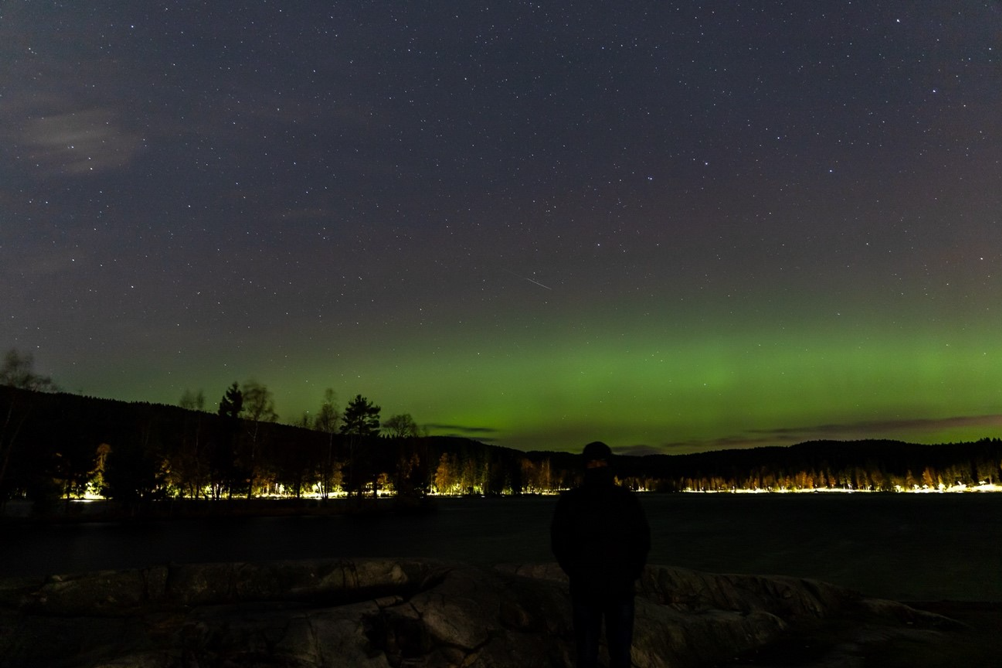
– I’ve been lucky enough to already see the Northern Lights a few times (sometimes right from my bedroom window), and the snow in the winter makes the city quite dreamy to walk around.
– Since this is the first time I’ve been outside India, I’m very excited to interact with such a different culture and explore the country!
The social and work environment at the Institute of Theoretical Astrophysics (ITA) has been promising for Akhil so far.
– All my interactions with the friendly people at ITA have been very positive and I’ve ended up participating in many activities with them that I couldn’t have anticipated, like sledding down the icy trail from Frognerseteren in the winter, going mushroom picking in the forest, taking part in the Holmenkollstafetten relay race around the city, and most excitingly, learning how to pay taxes!
– ITA has also given me the opportunity to participate in conferences and schools around Europe, which has been very exciting to explore, and I will also be visiting the US this year for a research visit which I am very much looking forward to!
– What is your experience at ITA so far?
– The academic freedom and opportunities I have had just in my first year here make me quite optimistic about my growth as an academic, but even overall I have seen myself learn and grow a lot as a person, and I look forward to spending more time with my friends here and exploring Norway!
More about:
Fysikk og Astronomi (Bachelor program)
Astronomy (Master program)