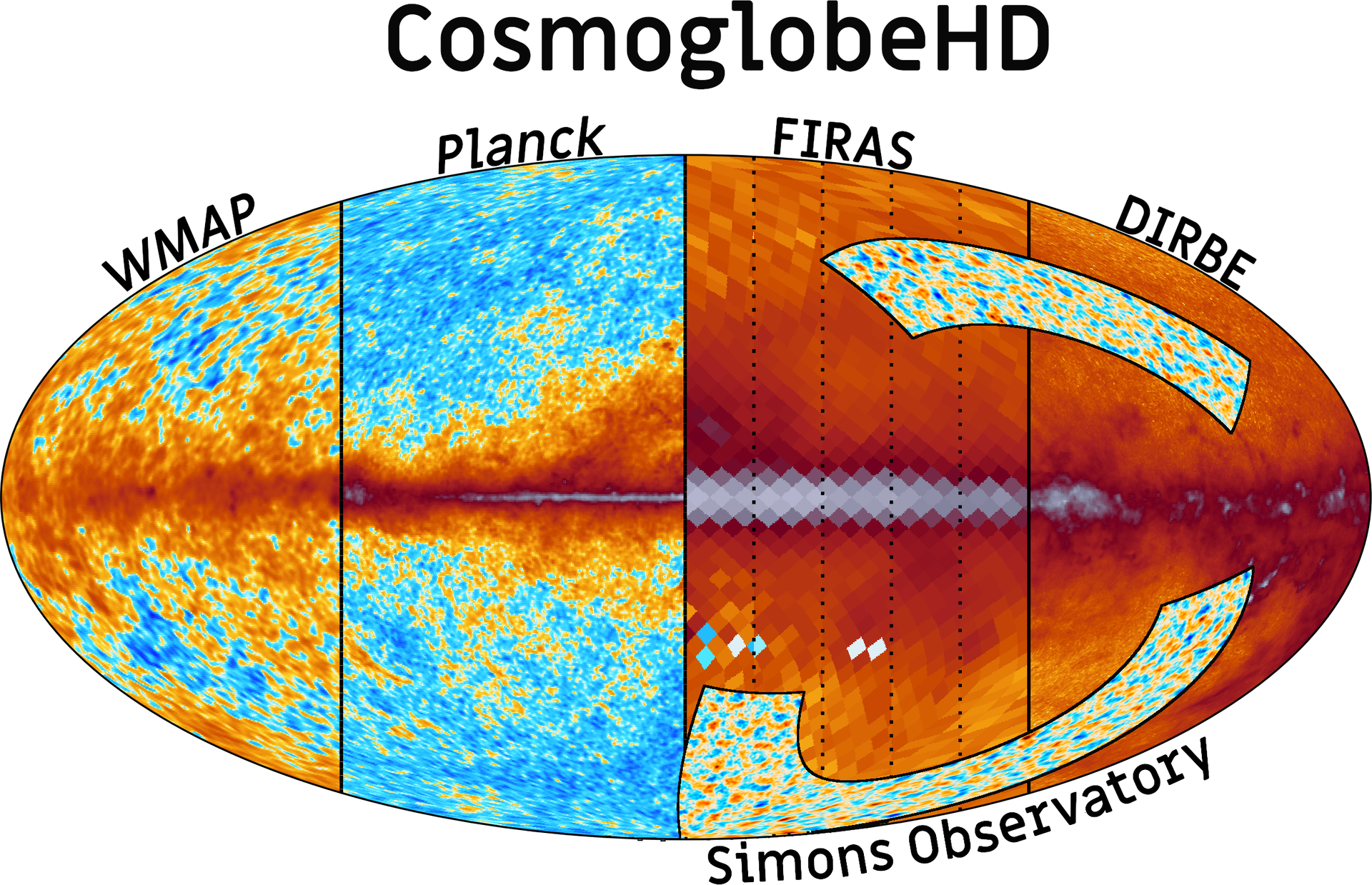

The Cosmic Microwave background (CMB) is the oldest source of light in existence, and our most precious resource for understanding the early history of the universe. Two vital targets for next-generation CMB experiments are B-mode polarization - a direct probe of cosmic inflation and primordial gravitational waves - and spectral distortions, which encode the energy history of the universe from redshift one million until today. In the CosmoglobeHD project, we will develop a joint integrated analysis framework for ground-based B-mode experiments with high spatial resolution and spectral distortion experiments with high spectral resolution, building on recent breakthroughs in the processing of CMB anisotropy satellite data. I will then use this framework to jointly analyze the upcoming state-of-the-art data from Simons Observatory (SO) with archival data from COBE/FIRAS, COBE/DIRBE, Planck, and WMAP.
The main product from this analysis will be CosmoglobeHD: an absolutely calibrated high-resolution model of the radio, microwave, and sub-mm sky. This will enable cutting edge science in both fundamental cosmology and Galactic physics.
The SO observations will constrain both primordial gravitational waves and cosmic birefringence to unprecedented levels, while the FIRAS analysis will reduce the frequency- domain uncertainties of the CMB spectrum by a factor of 2–5, potentially leading to the worldʼs first detection of large-scale non-blackbody CMB radiation. These signals probe independent aspects of ΛCDM and also share many observational challenges, justifying a synergistic analysis approach. This novel integrated and Open Science analysis framework will define a new paradigm for a wide range of next-generation B-mode and spectral distortion experiments, including CMB-S4, LiteBIRD, and ESAʼs Voyage 2050 spectral distortion concept.