The Universe has entered an accelerating expansion phase in the last few billion years of its evolution, a phenomenon that is caused by the mysterious entity known as dark energy. The NEVO project aims to provide key insights about the properties of dark energy, which includes its time evolution and spatial distribution in the Universe. This objective will be achieved by utilizing cutting-edge cosmological N-body simulations and novel techniques to study cosmic EVOlution accurately.
A comprehensive understanding of the nature of dark energy requires a thorough investigation of viable candidates and their impact on different stages of the Universe. However, the consistent and accurate modeling of dark energy candidates has been largely neglected so far. To address this gap, I propose the development of a novel, integrated framework that utilizes state-of-the-art relativistic N-body simulations along with the hi_class code, to accurately model dark energy candidates in both linear and non-linear scales.
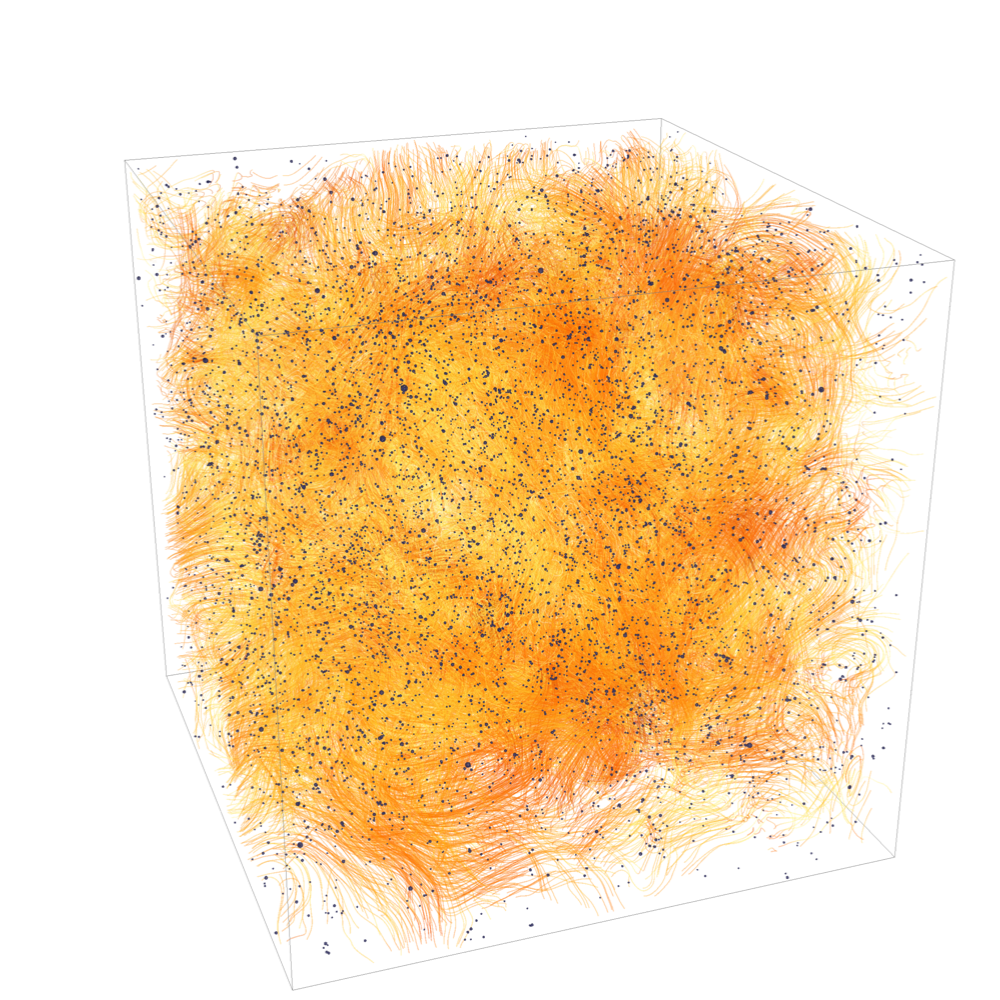
Main objective
The NEVO project aims to identify viable dark energy candidates and provide a comprehensive understanding of their behavior, including their time evolution and spatial distribution across a wide range of scales, with the precision required by future surveys, particularly Euclid.
Secondary objectives
(A) Conduct an in-depth exploration of the space of viable candidates for dark energy, taking into account current observational constraints.
(B) Gain a thorough understanding of the non-linear behavior of dark energy candidates using relativistic N-body simulations to ensure accurate modeling and interpretation of future observations.
(C) Identify potential "smoking gun" signatures of dark energy candidates by analyzing various observables, such as gravitational lensing, redshift space distortions, and the integrated Sachs-Wolfe effect, among others.
(D) Constrain the parameters of dark energy candidates by utilizing emulators and high-precision data.