Jupiter
Having made it safely through the asteroid belt, we have now arrived at Jupiter, 78 metres from the Sun.
The Planetfield is a unique light model of our solar system, at the correct relative scale, where both distances and planet sizes are reduced by a factor of ten billion. Read more about the model.
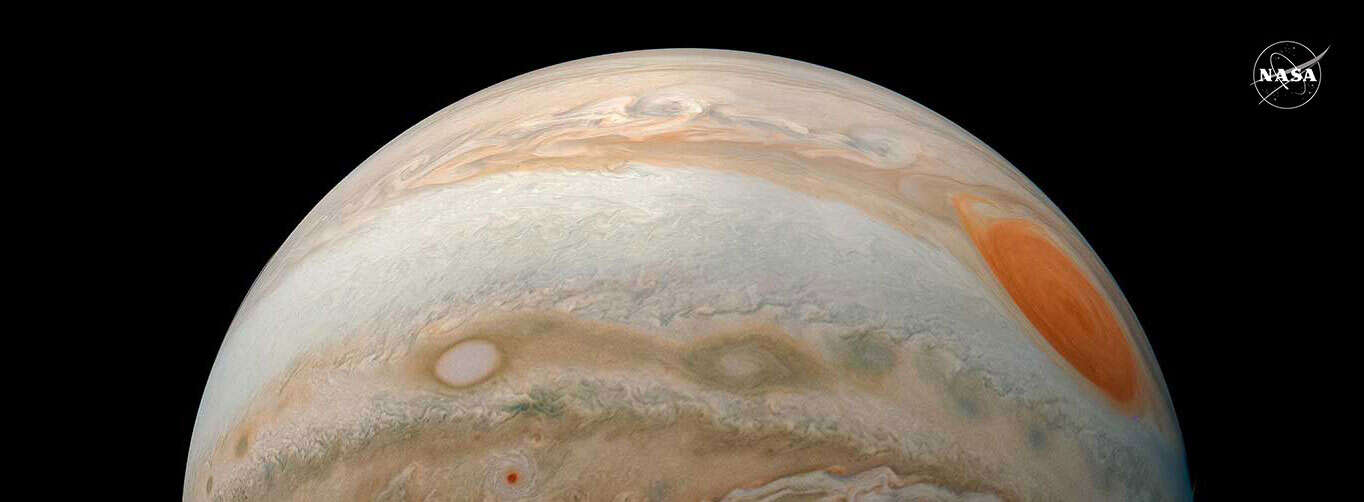
This gas giant is the largest planet in the Solar System, with a diameter more than ten times that of Earth. In the model, it is represented by a glowing sphere measuring 14 mm across. Jupiter consists mainly of hydrogen and helium, like the Sun, along with small amounts of methane and other gases. Methane is the simplest hydrocarbon, consisting of one carbon atom surrounded by four hydrogen atoms.
Although Jupiter is a planet, it has no solid surface. Instead, the gas becomes increasingly dense as we move deeper into its interior. Eventually, the hydrogen is compressed into a dense liquid that conducts electricity like a metal and acts as a giant dynamo. This dynamo produces an extremely powerful magnetic field, creating intense and permanent auroras at the planet’s poles. Data from NASA’s Juno spacecraft have revealed that Jupiter’s core is not a solid, concentrated lump, but an enormous, partly diluted and poorly defined core of rock and metals. This diffuse core gradually blends into the outer layers and contains heavy elements with a combined mass equivalent to several tens of Earths. The planet also has a powerful gravitational field: if it had a surface, you would weigh 2.5 times as much as on Earth.
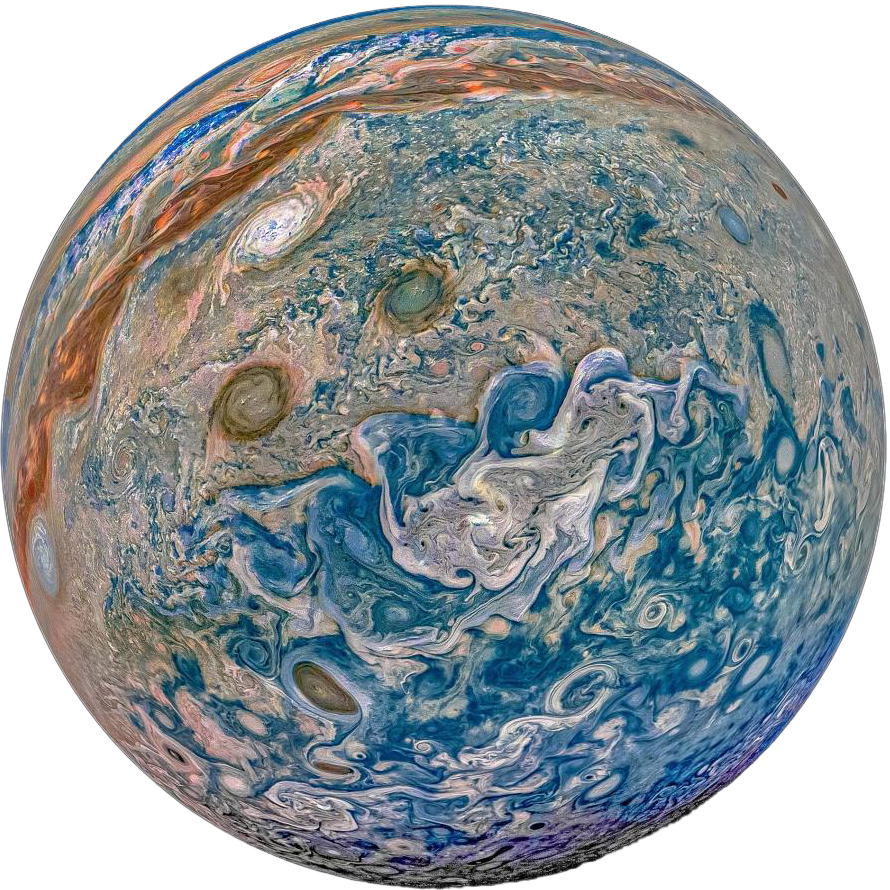
Jupiter’s appearance is dominated by its distinctive cloud bands and the Great Red Spot, a vast storm system. The storm has shrunk over time but is still wider than Earth. Measurements from the Juno spacecraft have shown that these storms extend unexpectedly deep, and that the Great Red Spot reaches more than 350 kilometres below the cloud tops. Powerful winds of more than 500 kilometres per hour, swirling storms, and frequent lightning strikes characterise the enormous cloud system.
At least 115 officially recognised moons orbit Jupiter. The four largest—Io, Europa, Ganymede, and Callisto—are known as the Galilean moons, after Galileo Galilei, who discovered them in 1610. These large moons are fascinating and fully fledged worlds in their own right. Ganymede is the largest moon in the Solar System, while volcanic Io is characterised by intense geological activity. The icy moon Europa is especially notable because it is covered by a thick, fractured layer of ice that conceals a vast subsurface ocean of liquid water—one of the most promising places in the Solar System in the search for extraterrestrial life.
Facts about Jupiter
| Diameter | 139 822 km |
|---|---|
| Distance from the Sun | About 484 millions of kms |
| Rotation period | 9 h 54 min |
| Orbital period around the Sun | 12 Earth days |
| Surface temperature | About -110 ºC |