Mars
Welcome to Mars, 23 meters away from the Sun, and only 0.7 mm in diameter.
The Planetfield is a unique light model of our solar system, at the correct relative scale, where both distances and planet sizes are reduced by a factor of ten billion. Read more about the model.
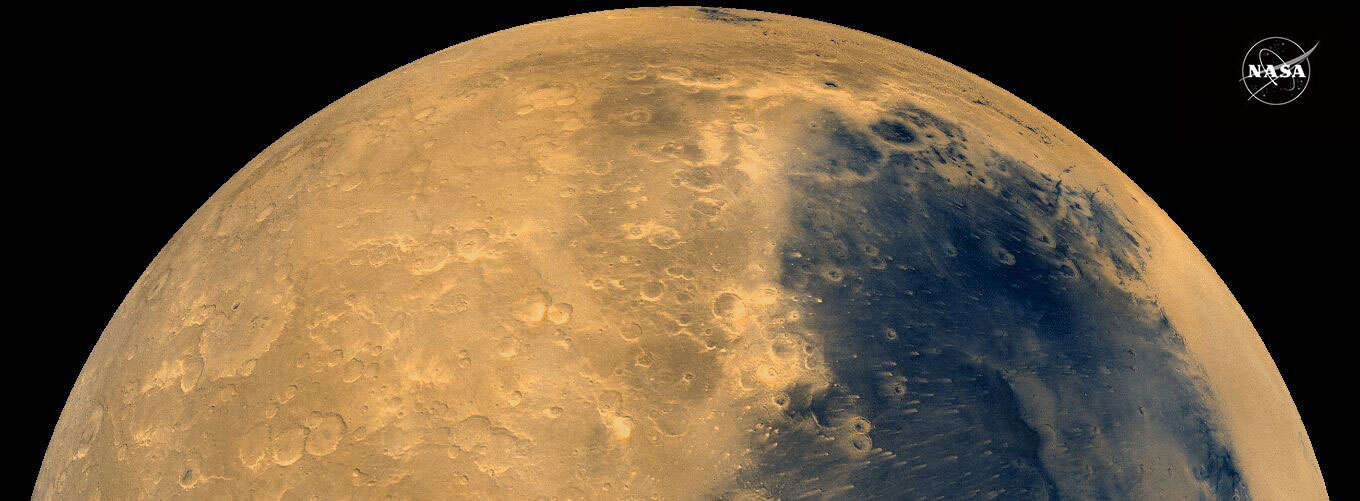
Mars has an orange-red hue. This familiar colour is caused by rust—iron oxides—in the planet’s soil, and the Red Planet is marked by deep craters and massive dust storms. Its most extreme landscape feature is Olympus Mons, the largest volcano in the Solar System. It rises as much as 22 kilometres above the surrounding terrain and has a diameter of about 600 kilometres. Another spectacular feature is the immense canyon system Valles Marineris, which extends for more than 4,000 kilometres and cuts as much as 7 kilometres into the surface.
Mars is one of the best candidates in the search for life in the Solar System, and it is the planet most similar to Earth, although there are major differences. The planet has a thin atmosphere, and space probes have revealed extensive areas of ancient riverbeds. A number of robotic rovers have also landed on Mars to investigate it—and continue to do so. It is now quite clear that frozen water exists in the soil, in the permanent polar ice caps, and beneath large parts of the surface. In the past, this water formed lakes and flowed across the planet’s surface, but because of today’s low atmospheric pressure, liquid water would either evaporate or freeze almost immediately.
Because the thin atmosphere cannot retain heat, the global average temperature is around −62 °C. Temperatures vary from +20 °C on a pleasant summer day near the equator to −140 °C at night, while winter temperatures at the poles can fall as low as −153°C.
In terms of time, a Martian day—known as a sol—is remarkably similar to an Earth day, lasting 24 hours and 40 minutes. However, because Mars has a longer orbit around the Sun, a Martian year lasts 687 Earth days. Mars has seasons that are somewhat like Earth’s because its axis is tilted by 25 degrees, but each season lasts nearly twice as long. Two small moons, Phobos and Deimos, orbit the planet. Compared with Mars, these moons would look like two small rocks: Phobos is approximately 22 kilometres in diameter, while Deimos is about 12 kilometres across.
If you would now like to continue to Jupiter, you must first pass through the asteroid belt.
Facts about Mars
| Diameter | About 6 800 km |
|---|---|
| Distance from the Sun | About 228 millions of kms |
| Rotation period | 24 h 40 min |
| Orbital period around the Sun | 687 Earth days |
| Surface temperature | -153 to 20 ºC |
