Mercury
Welcome to Mercury. A small luminous dot, six meters away from the luminous sun ball.
The Planetfield is a unique light model of our solar system, at the correct relative scale, where both distances and planet sizes are reduced by a factor of ten billion. Read more about the model.
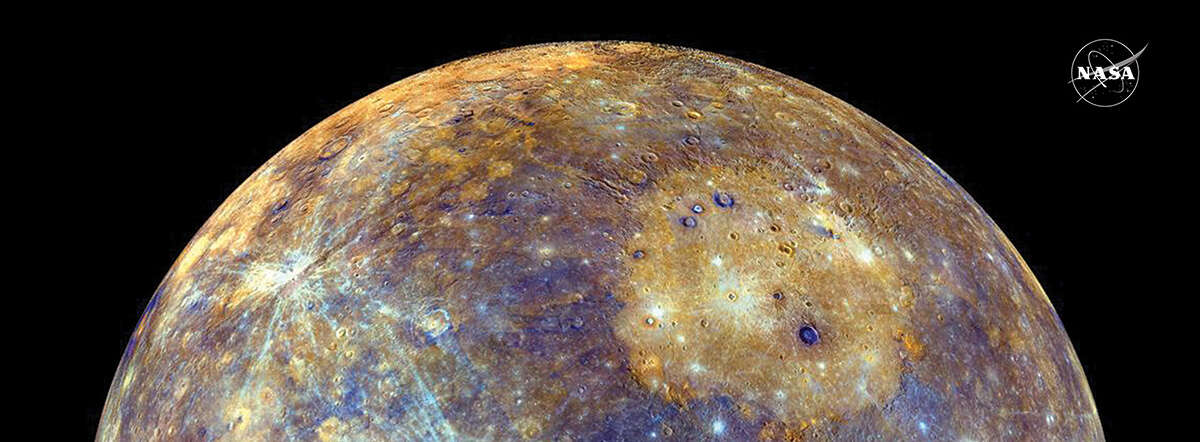
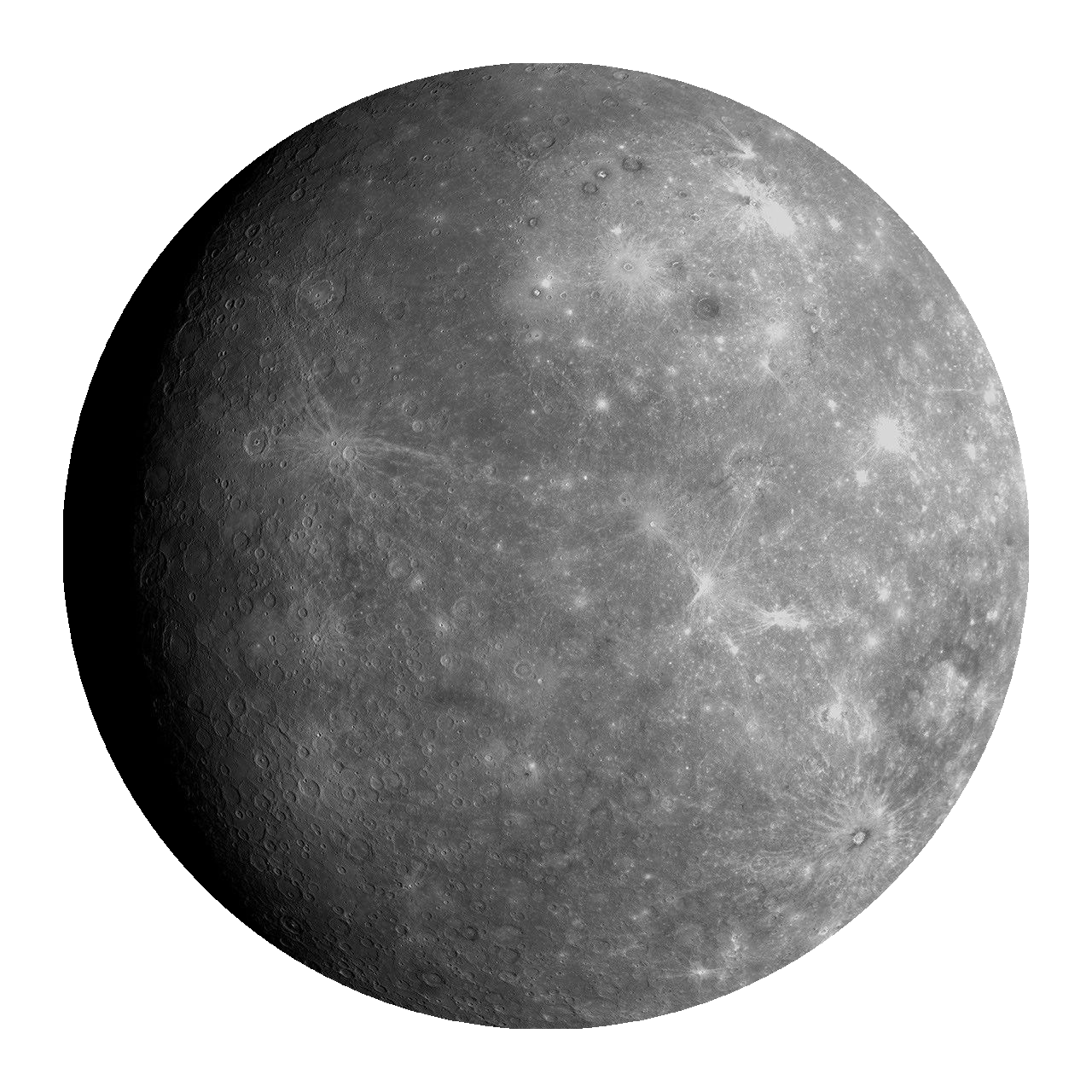
Mercury is the smallest planet in the solar system and is only half a millimeter in diameter here in the model. In appearance, it can be very reminiscent of the Moon, as both have surfaces marked by impact craters of various sizes. This is because Mercury lacks both an atmosphere and geological activity, so that traces of cosmic collisions are not erased by wind and natural forces.
Beneath the surface lies an enormous iron core that makes up 85% of the planet's volume. As this cooled over billions of years, the globe shrank violently, leaving kilometer-high mountain slopes on the otherwise flat plains. To the human eye, the landscape is ashen gray and brown, broken only by luminous ray patterns from asteroid strikes that pulverize the mountain bed into highly reflective dust.
Weather conditions are extreme due to a slow rotation and a fast, elongated orbit around the Sun. The planet takes 59 Earth days to spin around its own axis, and 88 Earth days to complete a full year. Because it moves so quickly in its orbit while spinning so slowly, it takes 176 Earth days from one sunrise to the next. A day on Mercury lasts exactly two Mercury years, meaning you can actually celebrate two birthdays in a single day.
The slow rotation means that one side of the planet bakes in relentless sunlight for 88 days straight, while the other side remains in pitch darkness for the same amount of time. Since Mercury lacks an atmosphere to distribute or retain heat, this creates the most extreme temperature differences in the solar system, with the day side reaching 430°C and the night side dropping to -170°C. Mercury has no moons.
Facts about Mercury
| Diameter | 2 440 km |
|---|---|
| Distance from the Sun | About 58 millions of kms |
| Rotation period | 59 Earth days |
| Orbital period around the Sun | 88 Earth days |
| Surface temperature | -170 to 430 ºC |