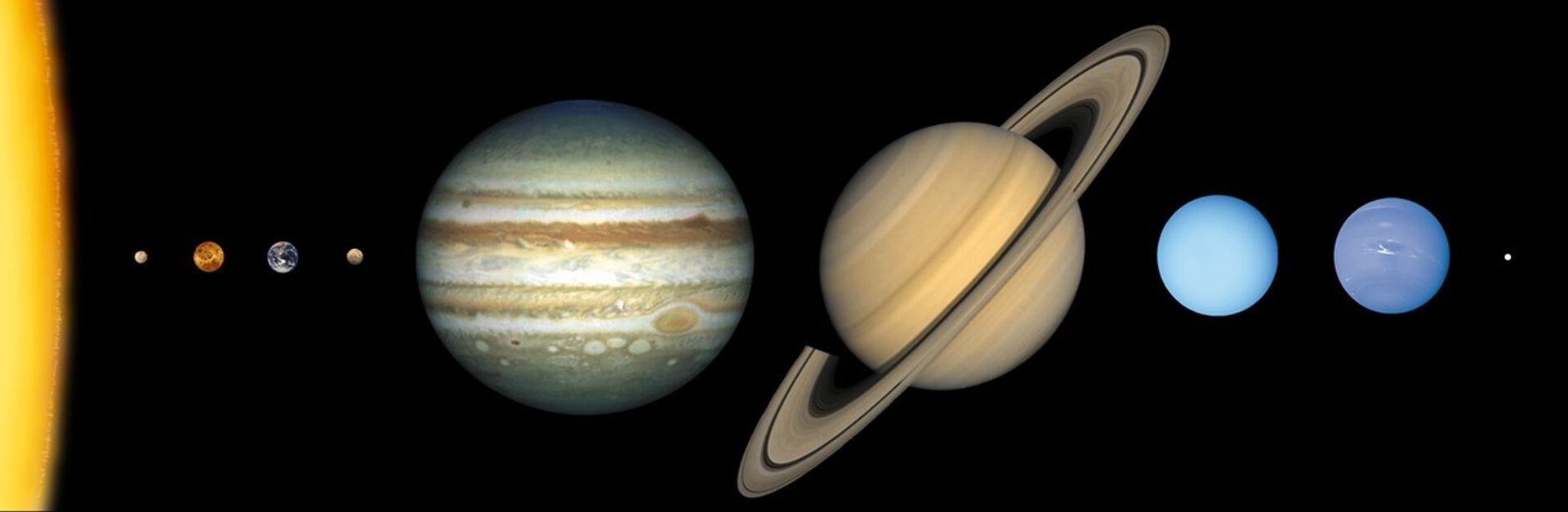
The illustration at the top is composed of real images of the different planets and shows their relative sizes. The Sun can be seen as the arc on the left side of the image, while the Earth is the third sphere in the row of planets. One important detail that necessarily has to be omitted is the relative distances between the planets.
Although such illustrations are great eye-catchers, they can be misleading. This also applies to many planet models found in science centres and museums, where the planets hang majestically from the ceiling, separated by a few meters. Even a large hall in a science centre will be far too small to give visitors a true sense of the enormous size of the solar system.
The actual distance relationships between the planets cannot be realised in indoor models. At best, one has to use an open field or a long street closed to traffic.
To create a better understanding of the solar system, it was decided that the system should be shrunk by a factor of ten billion, thereby breaking with the typical reduction factor of one billion. This resulted in planets that are ten times smaller than those used in several parks around the world. In these parks, small steel spheres are displayed on pillars, separated by correct relative distances over a stretch of nearly five kilometers.
The choice of an unconventional and bold scale was made to avoid the need for so much space. This naturally led to very modest planet sizes. In addition, the aim was to create a model that could be experienced in the dark, which would provide a unique experience.