Uranus
Welcome to Uranus. The planet is situated 287 meters away from the Sun.
The Planetfield is a unique light model of our solar system, at the correct relative scale, where both distances and planet sizes are reduced by a factor of ten billion. Read more about the model.
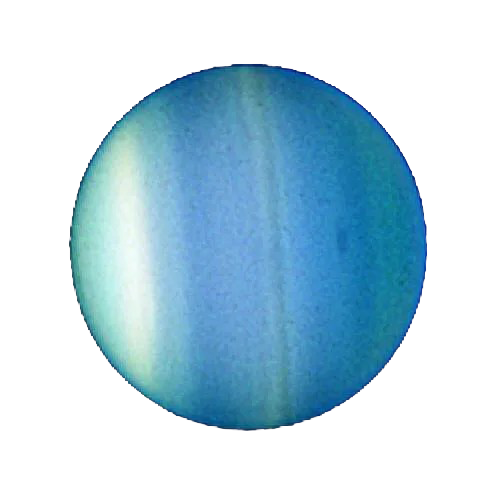
Uranus was discovered in 1781 by the astronomer William Herschel, making it the first planet ever found with the help of a telescope. Although it is often called a gas planet, it is much smaller than Jupiter and Saturn, and astronomers now classify it as an ice giant. Here in the model, it is only 5 mm across. The planet has a substantial core of rock and metal, covered by an enormous fluid layer that accounts for more than 80 per cent of its mass. This is an extremely hot and dense mixture of water, methane, and ammonia—substances that were frozen during the early history of the Solar System, hence the term ice giant. Uranus gets its characteristic blue-green colour from methane gas in its atmosphere, which absorbs red sunlight and reflects blue and green light into space.
A day on Uranus—the time it takes to rotate once on its axis—lasts about 17 hours. By contrast, the icy giant takes a full 84 Earth years to complete a single orbit around the Sun.
All planets rotate around their own axes, usually at a moderate angle relative to their orbit. Earth’s axial tilt is 23.5 degrees, while Jupiter’s is only 3 degrees. Uranus stands out with an extreme tilt of 98 degrees. The planet can be said to lie tipped over on its side, “rolling” along its path around the Sun. This is probably the result of a violent collision with an Earth-sized object long ago.
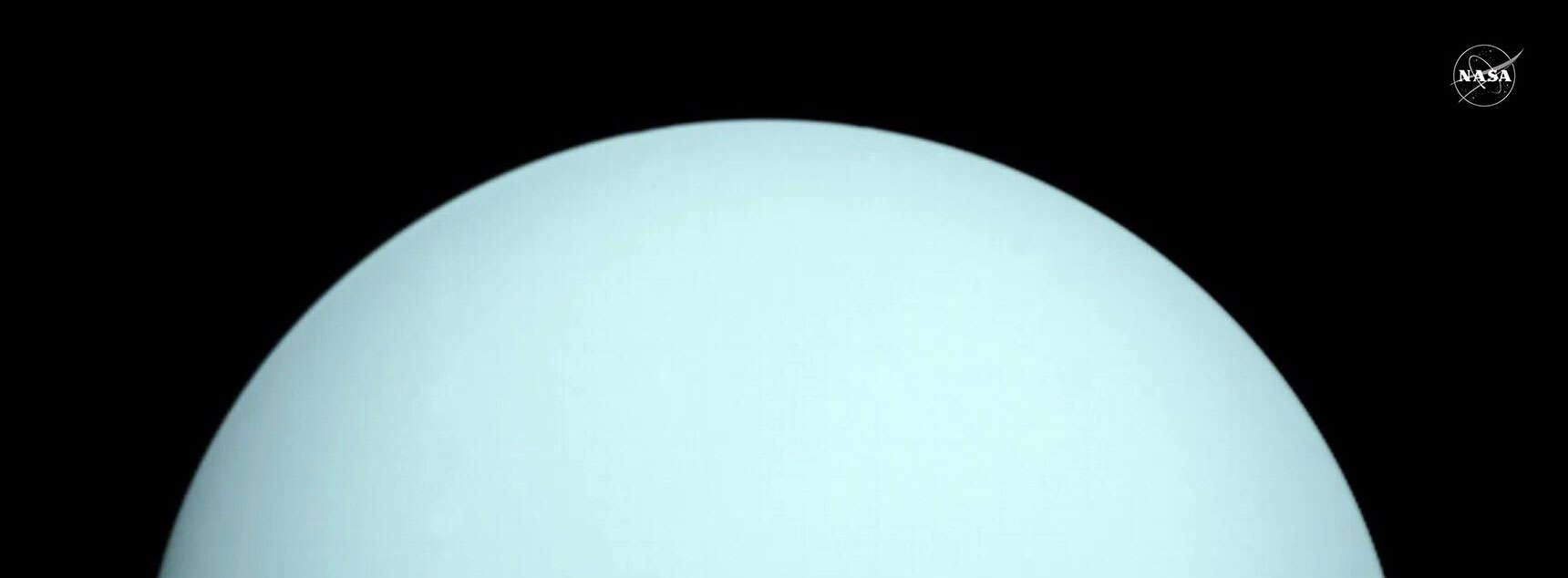
Up close, as the Voyager 2 spacecraft saw it during its flyby in 1986, Uranus appeared as an almost entirely uniform, greenish sphere with few distinctive features. More recent observations with large telescopes, however, have changed that impression. They show that Uranus has far more dynamic weather than was initially believed. As the planet approaches an equinox, vigorous cloud activity and bright features emerge and change frequently.
It is a rather harsh place. Temperatures range from a bone-chilling −210 to −224 ºC, while powerful winds can reach speeds of up to 900 km/h. Thin rings of dark material orbit the planet, along with 29 known moons.
Facts about Uranus
| Diameter | 51 118 km |
|---|---|
| Distance from the Sun | About 2.9 billions of kms |
| Rotation period | About 7 h |
| Orbital period around the Sun | 84 Earth years |
| Surface temperature | -224 to -210 ºC |