FishTech - The impact of new technologies on fisheries management (completed)

About the project

The advance of new technologies, the rapid expansion of big data, and the deep digitalization of society that allows consumers to trace products to their origin, or firms to live stream their trawl hauls online, opens hitherto unknown - and unassessed - potential for more effective resource control and increased value creation. In particular, there has been a surge in new technologies increasing the effectiveness of the enforcement activities, such as satellite monitoring of vessels and electronic logbooks. Compared to traditional fisheries enforcement, this allows for control of all operations of every vessel at all times, which significantly boosts enforcement efforts.


At the same time, such approaches may also raise serious concerns about privacy and data protection that may easily undermine compliance unless they are accompanied by conscious efforts to maintain maximum transparency. This implies that the management system carefully has to take into account the repercussions of monitoring and compliance, both in the short- and long-term, which will be at the heart of the research.


We also analyze how new technologies may enhance the value created from the oceans, for example by allowing for finer selectivity or increased seafood traceability and how management may contribute to harnessing the full potential of the oceans. Because the impact of new technologies on compliance is difficult to study, we approach it from different angles.


FishTech uses empirical, experimental, and theoretical economics as well as biological modelling and qualitative approaches from social science to understand what determines compliance behavior and generate the knowledge that informs management how to strengthen compliance behavior.

FishTech brings together the Norwegian social and economic marine research centers of Bergen, Oslo, and Tromsø to join forces and further strengthen Norway's world leading position in fisheries science.
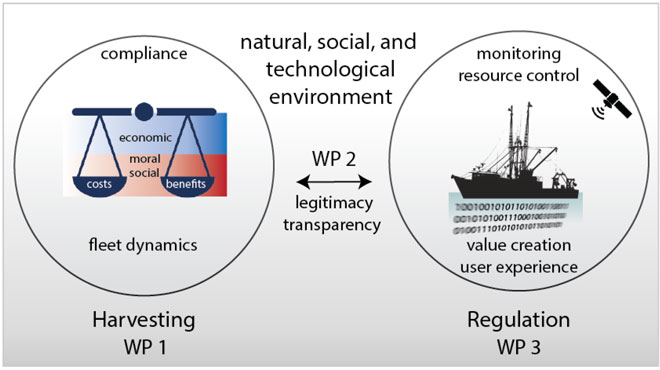
picture showing the schematic overview of the project

A schematic overview of the project. WP 1 analyzes short-run compliance and repercussions on long-run fleet dynamics. WP2 is looking at the contextual factors of compliance and links regulation to perception and actions of fishers. WP3 analyzes how new Technologies are affecting management, whether through monitoring and control, but also investigates how it may help to enhance value creation based on marine Resources.

Objectives

The aim of FishTech is to assess whether, and in which way, new technologies may be used to best strengthen fisheries management.

To achieve this objective, we will:
a) obtain a better understanding of what determines short- and long-term compliance and harvesting decisions and how this is affected by new technologies,
b) study the interactions between regulatory legitimacy, new ways of monitoring, and compliance,
c) analyze the effect of new technologies on effective resource control and improved value creation.


The relevance and timeliness of the topic, as well as the innovative combination of qualitative research, economic experiments, mathematical modeling, and statistical data analysis means that FishTech holds the clear promise to both push the international research frontier, and deliver robust advice to national policy makers.

Financing

This Project is funded by the Research Council of Norway (RCN) (MARINFORSK) 

RCN Project Number: 280541  (Project data bank at RCN)

UiO Project Number: 421260

Cooperation

Nøstbakken, Richter, and Diekert have collaborated successfully in the past under the HAVKYST program, most recently on NFR project no. 243892 (SeaSurf) and 224818/E40 (REPIN).


The current project directly extends the collaboration between Bergen and Oslo in terms of marine ecosystem related research, which holds the promise of yielding significant synergies. In this project, they join forces with Kathrine Tveiterås (head of department at the Norwegian College of Fishery Science; NCFS) and Petter Holm (professor at NCFS) from Tromsø. Tveiterås and Holm have successfully carried out research projects on the interface between policy, science, and society within resource management, resulting in several high-profile publications and policy advice.


Together, FishTech’s project team achieves an inclusive and holistic approach of doing marine research in Norway. Moreover, the team extends beyond Norway and with Chris Costello (Bren School at UCSB, USA), it includes a world-leading expert in fisheries economics. Finally, Bruno Nkuiya (University of Alberta, Canada) is an expert in bio-economic modelling that adds important skill and perspective to the team.

Period

01.01.2018 - 30.06.2022

Publications

  • Diekert, Florian Klaus; Li, Yuanhao; Nøstbakken, Linda & Richter, Andries Peter (2026). Compliance, environmental regulation, and quota markets. Journal of Environmental Economics and Management. ISSN 0095-0696. 138. doi: 10.1016/j.jeem.2026.103345. Full text in Research Archive
  • Gokhale, Sanmitra; Blomquist, Johan; Lindegren, Martin; Richter, Andries Peter & Waldo, Staffan (2024). The Role of Non-fishing and Partner Incomes in Managing Fishers' Economic Risk. Marine Resource Economics. ISSN 0738-1360. 39(4), p. 305–305. doi: 10.1086/731762. Full text in Research Archive
  • Abe, Keita; Nøstbakken, Linda & Wold, Mads Fjeld (2024). Quota Consolidation in Norwegian Coastal Fisheries. Environmental and Resource Economics. ISSN 0924-6460. 87(5), p. 1295–1326. doi: 10.1007/s10640-024-00866-x. Full text in Research Archive
  • Abe, Keita; Diekert, Florian Klaus; Melsom, Arne & Langangen, Øystein Ole Gahr (2024). Do fishers follow fish displaced by climate warming? npj Ocean Sustainability. 3(1), p. 1–7. doi: 10.1038/s44183-024-00063-9. Full text in Research Archive
  • Diekert, Florian Klaus & Schaap, Robbert-Jan (2024). Does nature shape risk preferences? Evidence from Chile, Norway, and Tanzania. Economic Inquiry. ISSN 0095-2583. p. 1–23. doi: 10.1111/ecin.13272. Full text in Research Archive
  • Diekert, Florian Klaus; Li, Yuanhao; Nøstbakken, Linda & Richter, Andries Peter (2023). Why do fishermen comply with regulations? The role of preferences. In Bucciol, Alessandro; Tavoni, Alessandro & Veronesi, Marcella (Ed.), Behavioural Economics and the Environment. A Research Companion. Routledge. ISSN 9781032003535. p. 83–106. doi: 10.4324/9781003172741-6. Full text in Research Archive
  • Nkuiya, Bruno & Diekert, Florian Klaus (2023). Stochastic growth and regime shift risk in renewable resource management. Ecological Economics. ISSN 0921-8009. 208, p. 1–11. doi: 10.1016/j.ecolecon.2023.107793. Full text in Research Archive
  • Kroetz, Kailin; Nøstbakken, Linda & Quaas, Martin (2022). The Future of Wild-Caught Fisheries: Expanding the Scope of Management. Review of Environmental Economics and Policy. ISSN 1750-6816. 16(2), p. 241–261. doi: 10.1086/721097. Full text in Research Archive
  • Ashrafi, Tannaz Alizadeh & Abe, Keita (2021). Intra- And inter-temporal effort allocation and profit-maximizing strategy of trawl fishery. ICES Journal of Marine Science. ISSN 1054-3139. 78(8), p. 2943–2957. doi: 10.1093/icesjms/fsab172. Full text in Research Archive
  • Diekert, Florian Klaus; Nøstbakken, Linda & Richter, Andries Peter (2021). Control activities and compliance behavior—Survey evidence from Norway. Marine Policy. ISSN 0308-597X. 125. doi: 10.1016/j.marpol.2020.104381. Full text in Research Archive
  • Wieczorek, Alina; Schadeberg, Amanda; Hallin, Julie Krogh; Putten, Ingrid van; Kraak, Sarah B. M. & Richter, Andries Peter [Show all 12 contributors for this article] (2021). Behavioural economics in fisheries: A systematic review protocol. PLOS ONE. 16(8). doi: 10.1371/journal.pone.0255333. Full text in Research Archive
  • Schuch, Esther; Gabbert, Silke & Richter, Andries Peter (2021). Institutional inertia in European fisheries – Insights from the Atlantic horse mackerel case. Marine Policy. ISSN 0308-597X. 128, p. 1–13. doi: 10.1016/j.marpol.2021.104464. Full text in Research Archive
  • Stoeven, Max T.; Diekert, Florian Klaus & Quaas, Martin (2021). Should fishing quotas be measured in terms of numbers? Marine Resource Economics. ISSN 0738-1360. 36(2), p. 133–153. doi: 10.1086/713437. Full text in Research Archive
  • Teh, Lydia C.L.; Teh, Louise S.L.; Abe, Keita; Ishimura, Gakushi & Roman, Raphael (2020). Small-scale fisheries in developed countries: Looking beyond developing country narratives through Japan’s perspective. Marine Policy. ISSN 0308-597X. 122. doi: 10.1016/j.marpol.2020.104274. Full text in Research Archive
  • Tokunaga, K; Ishimura, Gakushi; Iwata, Shigehide; Abe, Keita; Otsuka, Kazuhiko & Kleisner, Kristin [Show all 7 contributors for this article] (2019). Alternative outcomes under different fisheries management policies: A bioeconomic analysis of Japanese fisheries. Marine Policy. ISSN 0308-597X. 108. doi: 10.1016/j.marpol.2019.103646. Full text in Research Archive
  • Schaap, Robbert & Richter, Andries Peter (2019). Overcapitalization and social norms of cooperation in a small-scale fishery. Ecological Economics. ISSN 0921-8009. 166. doi: 10.1016/j.ecolecon.2019.106438. Full text in Research Archive
  • Winter, Anna-Marie; Richter, Andries Peter & Eikeset, Anne Maria (2019). Implications of Allee effects for fisheries management in a changing climate: evidence from Atlantic cod. Ecological Applications. ISSN 1051-0761. 30(1). doi: 10.1002/eap.1994. Full text in Research Archive

View all works in NVA

  • Wold, Mads Fjeld & Nøstbakken, Linda (2026). The Efficiency Costs of Transfer and Consolidation Constraints: Evidence from a Resource Market. Full text in Research Archive
  • Diekert, Florian Klaus; Li, Yuanhao; Nøstbakken, Linda & Richter, Andries Peter (2026). Compliance, environmental regulation, and quota markets. Full text in Research Archive
  • Nøstbakken, Linda & Wold, Mads Fjeld (2025). Fishing Vessel Markets and the Value of Fishing Quotas: A Hedonic Approach. Full text in Research Archive
  • Diekert, Florian Klaus; Li, Yuanhao; Nøstbakken, Linda & Richter, Andries Peter (2024). How non-compliance behavior affects investments in fishing quota and capital. Full text in Research Archive
  • Diekert, Florian Klaus; Nøstbakken, Linda & Richter, Andries Peter (2023). Behavior, compliance and attitudes to digital and traditional control methods. Full text in Research Archive
  • Diekert, Florian Klaus; Li, Yuanhao; Nøstbakken, Linda & Richter, Andries Peter (2023). Non-compliance behavior and use of extraction rights for natural resources. Full text in Research Archive
  • Nøstbakken, Linda; Diekert, Florian Klaus; Li, Yuanhao & Richter, Andries Peter (2023). Non-compliance behavior, investment and use of extraction rights for natural resources. Full text in Research Archive
  • Richter, Andries Peter; Diekert, Florian Klaus; Nøstbakken, Linda & Li, Yuanhao (2022). Behavioral motives of investments in catch-share managed fisheries. Full text in Research Archive
  • Richter, Andries Peter (2022). Framing effects in threshold public good games - The role of "warm glow" and beliefs. Full text in Research Archive
  • Diekert, Florian Klaus; Nesje, Frikk; Heyen, Daniel & Shayegh, Soheil (2022). Early warning of tipping points improves management but may encourage risk-taking. Full text in Research Archive
  • Diekert, Florian Klaus; Richter, Andries Peter & Nøstbakken, Linda (2022). Modern Compliance Policies in Fisheries. Full text in Research Archive
  • Diekert, Florian Klaus & Schaap, Robbert (2022). Does nature shape economic preferences? Evidence from Chile, Norway and Tanzania. Full text in Research Archive
  • Diekert, Florian Klaus; Li, Yuanhao; Nøstbakken, Linda & Richter, Andries Peter (2022). Non-compliance behavior and use of extraction rights for natural resources. Full text in Research Archive
  • Diekert, Florian Klaus & Schaap, Robbert-Jan (2021). Does nature shape risk- and social preferences? Evidence from Chile, Norway, and Tanzania. Full text in Research Archive
  • Richter, Andries Peter (2021). Moden compliance policies in fisheries. Full text in Research Archive
  • Abe, Keita (2020). A Dynamic Model of Endogenous Fishing Duration. Full text in Research Archive
  • Nøstbakken, Linda (2019). Why do fishers comply with regulations? Full text in Research Archive
  • Richter, Andries Peter (2019). Social justice in Fisheries. Full text in Research Archive
  • Abe, Keita & Nøstbakken, Linda (2019). Spatial competition and bargaining power in Norwegian pelagic fisheries. Full text in Research Archive
  • Abe, Keita & Nøstbakken, Linda (2019). Spatial Competition and Bargaining Power in Norwegian pelagic fisheries. Full text in Research Archive
  • Nøstbakken, Linda (2019). Klimatrusselen og fiskeri- og havbruksnæringa. Full text in Research Archive
  • Nøstbakken, Linda (2019). Fiskerinæringa om 10 år. Full text in Research Archive
  • Richter, Andries Peter; Diekert, Florian Klaus; Nøstbakken, Linda & Li, Yuanhao (2017). Why do fishermen comply with regulations? The role of preferences. Full text in Research Archive
  • Nøstbakken, Linda & Wold, Mads Fjeld (2025). The Efficiency Costs of Transfer and Consolidation Constraints: Evidence from a Resource Market. SNF - Centre for Applied Research at NHH. doi: https:/snf.no/publikasjoner/2025/the-efficiency-costs-of-transfer-and-consolidation-constraints-evidence-from-a-resource-market/. Full text in Research Archive
  • Diekert, Florian Klaus; Nøstbakken, Linda & Richter, Andries Peter (2020). Modern Compliance Policies in Fisheries. Samfunns- og næringslivsforskning. Full text in Research Archive

View all works in NVA

Published Feb. 22, 2021 1:48 PM - Last modified Nov. 3, 2025 2:17 PM

Participants

Detailed list of participants