Michaël Etienne Arlandoo
Period: Summer/fall 2018, July 2019 (100%), August 2019 - January 2020 (50%)
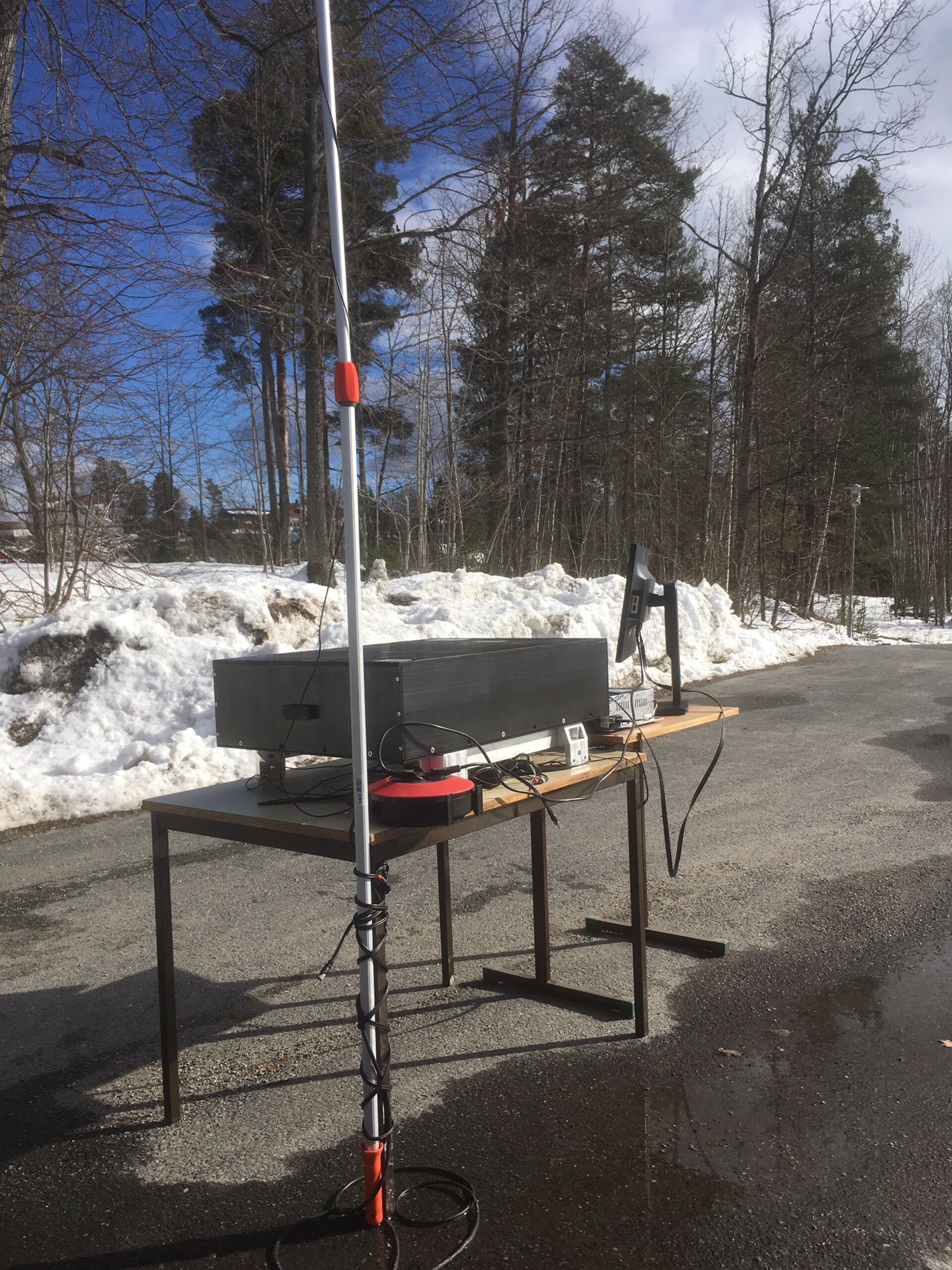
Work: Michaël participated in the coordination and installation of the polar telescopes at Nesodden VGS. He also participated in the monitoring of the detector after it had been installed reporting any issues.
Michaël developed, documented and gathered code to be used in the new course - Research-based Particle Physics (FYS5555) - in a GitHub repository.
Outcome: The successful installation and data taking of one of the three polar telescopes for which data was used in the publication New high precision measurements of the cosmic charged particle rate beyond the Arctic Circle with the PolarquEEEst experiment. The detector was shipped back to Italy in the spring of 2020 for maintenance.
The GitHub repository was extensively used during the spring-2020 edition of the course at the University of Oslo.
Even Simonsen Haaland
Period: Summer/fall 2018
Work: Even worked with Michaël and Simon on the polar telescope in Nesodden.
Even worked on developing jupyter notebooks for analysis of ATLAS Open Data to be used in a university course. His work was later migrated and updated to the new data format in the second release of ATLAS Open Data.
Outcome: Evens work has been migrated to the common GitHub repository used in the Research Based Particle Physics course at the University of Oslo
Simon Aas Millerjord
Period: Summer/fall 2018, August 2019 (100%)
Work: Simon worked with Michaël and Even on the polar telescope in Nesodden.
Simon also did a study of the OPloT source code to assess the possibilities of adding new variables and plots into the same framework.
Outcome: The conclusion from Simon's work was that within the current framework of OPloT it is difficult to have the flexibility to implement what is discussed above. One would need to develop a new code more or less from scratch. We therefore decided to choose another solution based on the histogram analyzer code used for the ATLAS Open Data.
Helén Persson
Period: September 2020 - current (time sheet based)
Work: Implement an instance of a modified version of the histogram analyzer to work with text files from a masterclass-type of analysis. This would allow students to look at more variables and distributions, quickly assess the impact of making cuts etc.
Outcome: -