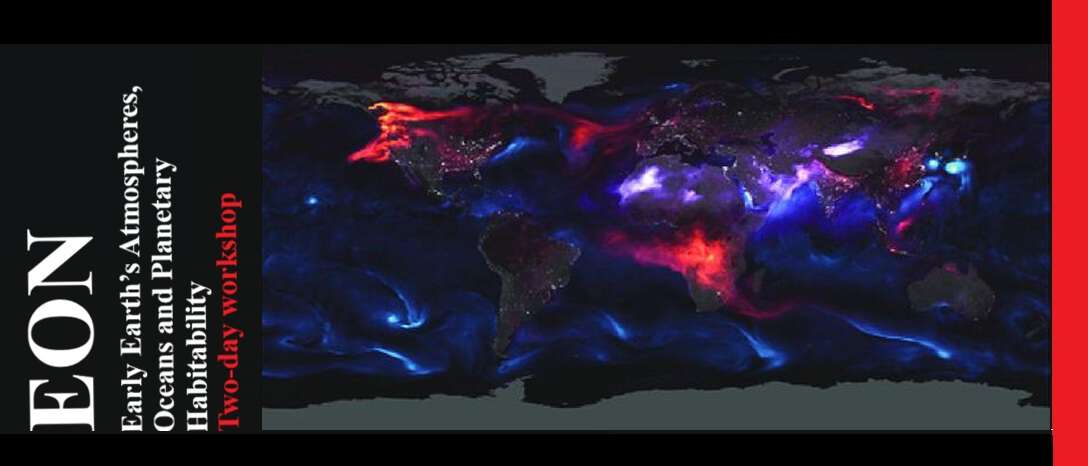
What is the EON workshop?
Understanding the physical and chemical evolution of the early Earth's atmosphere is fundamental to tracing the emergence and early evolution of life. A key constraint is the presence of liquid water in equilibrium with the early atmosphere – a condition that links atmospheric composition, surface temperature, and ocean chemistry. Processes such as volcanism, hydrothermal activity, and the sources and sinks of major atmospheric gases (CO₂, CH₄, N₂) shaped early planetary environments, yet their interactions remain poorly understood. Aerosols may provide a unifying link.
In the modern Earth system, aerosols influence atmospheric chemistry, cloud microphysics, radiative transfer, nutrient transport, and ocean-atmosphere coupling. Their role on early Earth, however, has received comparatively little attention. On the early Earth, aerosols likely acted as dynamic intermediaries between volcanic emissions, ocean chemistry, ice formation, and atmospheric processes – with direct implications for climate regulation and habitability.
The discussions will address the following main topics:
- What was the role of aerosols, volcanoes, oceans, and hydrothermal systems for the origin of early life?
- How do planetary habitability, atmospheric and climate processes couple together?
- How do aerosols control a planet’s surface temperature, cloud formation, and precipitation?
- What were the Early Earth’s hydrological and sedimentary processes in a CO₂-dominated atmosphere?
This is a GEO matchmaking event at UiO for researchers and students in geosciences. Researchers and students at the Department of Geosciences and the PHAB Centre are welcome to attend the workshop. Please register if you wish to participate, as food and lunch will be provided. You find the link for registration below!
Workshop programme:
Day 1: 23rd April 2026, Thursday
10:00 am Opening
10:15 am Introduction to EON by Joseph Henry Lacasce (Head of Geosciences, UiO, Norway)
10:30-11:00 am Trond H. Torsvik, UiO, Norway: Atmospheric CO2 and global mean surface temperatures in deep time: Reverse Engineering
11:00-11:30 am Kirstin Krüger, UiO, Norway: Modelling present-day volcanic aerosol climate responses
11:30-12:00 pm Breakout sessions/Discussion
12:00-1:00 pm Lunch
1:00-1:30 pm Tómas Zoega, UiO, Norway: Effusive volcanic eruptions and their impacts on Arctic climate
1:30-2:00 pm Desiree Lisette Roerdink, UiB, Norway: Early sulfur cycling, atmospheric interactions of volcanic sulfur and sulfate aerosols
2:00-2:30 pm Breakout sessions/Discussion
2:30-3:00 pm Eivind Olavson Straume, UiO, Norway: Early Earth Ocean Circulation: Implications for Climate and Habitability
3:00-3:30 pm Steffen Leth Jorgensen, UiB, norway: The Oceanic crust - an early habitat for life?
3:30-4:00 pm Breakout sessions/Discussion
6 pm EON dinner
Day 2: 24th of April 2026, Friday (updated)
10: 00 -10:30 am Joshua Krissansen-Totton, University of Washington, USA: The role of the geologic carbon cycle in maintaining planetary habitability
10:30-11:00 am Trude Storelvmo, UiO, Norway: Climate feedback caused by land-atmosphere interactions and their impacts on clouds
11:00-11:30 Breakout sessions/Discussion
12:00-1:00 pm Lunch
1:00-1:30 pm Eva E. Stüeken, University of St. Andrews, UK: Exploring lightning as a source of bioavailable nitrogen on the early Earth
1:30-2:00 pm Sara Blichner, University of Stockholm, Sweden: Modelling feedback with biogenic volatile organic compounds in the Earth System
2:30-3:00 pm Jaganmoy Jodder, UiO, PHAB, Norway: Raging Planet: Early Earth volcanism
3:00-3:30 pm Breakout sessions/Discussion
3:30-4:00 pm Fabian Klenner, UC Riverside, California: Sampling an Ocean Through Ice-Grain Aerosols: Lessons from Enceladus"?
Closing remarks (Jaganmoy, Robert and Alexander)
Workshop details:
- Dates: 23–24 april 2026
- Location: Helga Engs hus, Auditorium 1, University of Oslo
- Participation: In-person attendance is encouraged. Remote participation via Zoom will be available only for participants who are not in Oslo. ZOOM from here.
Programme: Information and full programme, print out this pdf!
Registration: As soon as possible using Nettskjema https://nettskjema.no/a/600883
Please register your attendance by April 22 at 12:00 PM. Places are limited and will be allocated on a first-come, first-served basis.
Workshop coordinators: Jaganmoy Jodder, Robert David and Alexander Minakov, Department of Geosciences, University of Oslo
Organisers: The PHAB-Centre and the Department of Geosciences, University of Oslo