
Is our planet's future melting before us?
This is a question that scientists around the world are racing to answer, and the new EU funded LIQUIDICE project is at the forefront of this research mission. The LIQUIDICE project brings together 18 leading institutions from Europe and India to investigate how glaciers, ice sheets, and permafrost shape the global climate and water supply.
From University of Oslo and Department of Geosciences, Thomas Vikhamar Schuler, Professor and Glasiologist is one of the key scientists in this ground-breaking international research initiative. Two glacier sites in Norway are part of the research as "supersites"; Jostedalsbreen and on Svalbard, the Spitzbergen and Hornsund regions.
Using cutting-edge technology—from satellite observations to advanced climate models—LIQUIDICE will analyze key glacial regions, known as supersites, that play a crucial role in both local ecosystems and global climate processes.
Why does this research matter?
Because melting ice isn’t just about shrinking glaciers—it’s about rising sea levels, disrupted water cycles, and real-world consequences for millions of people.
The data from LIQUIDICE will help improve predictions of future climate changes and guide decisions in water management, energy security, tourism, and adaptation strategies.
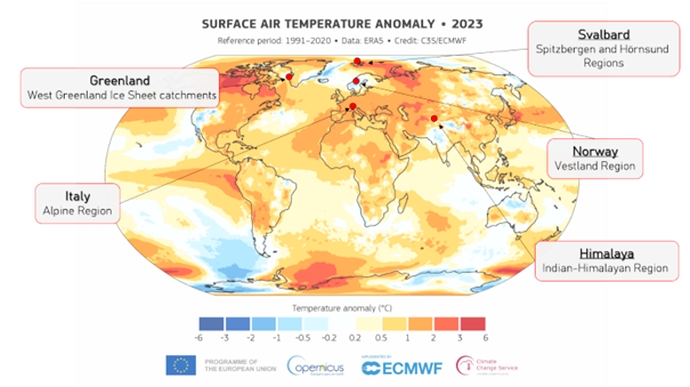
LIQUIDICE focuses on key glacial regions—so-called supersites—that play a crucial role in both local ecosystems and global climate processes:
- Monte Rosa, Italy – A crucial source of hydroelectric power and winter tourism, but shrinking snow cover threatens these industries.
- Jostedalsbreen, Norway – Provides up to 15% of Norway’s hydropower, making it a key element of energy security.
- Greenland Ice Sheet – The Ilulissat and Kangerlussuaq catchments show how melting ice sheets affect global sea levels and freshwater resources.
- Svalbard, Arctic – Permafrost is disappearing, destabilizing infrastructure and altering fjord ecosystems.
- Himalayas, Ladakh – Melting glaciers and shifting rainfall patterns threaten the water supply of 240 million people in the region and 1.65 billion people downstream.
LIQUIDICE is an urgent and compelling story—about science serving the climate, about global challenges, and about how researchers worldwide are joining forces to better understand the future of our planet.
This major EU_HORIZON- project is led by the Institute of Geophysics at the Polish Academy of Sciences, launched on February 1, 2025, and will run for four years. Stay tuned as we uncover the hidden impact of snow and ice on our planet’s future!
More details, please visit the Cordis portal:
Additional information about the project on EU CORDIS portal:
Project fact sheet: LinkIng and QUantifying the Impacts of climate change on inlanD ICE snow cover, and permafrost on water resources and society in vulnerable region (LIQUIDICE)
More about the support: HORIZON | CORDIS | European Commission