
The seminar «Teaching for students or with students?» was a half‑day event held on 30 January and comprised two workshops.
The event was led by Associate Professor Anders Mattias Lundmark from the Department of Geosciences, in collaboration with the iEarth Centre for Integrated Geoscience Education. Lundmark welcomed participants from the Department of Geosciences at UiO and from other institutions, including students from the universities of Tromsø, Bergen, Ås (NMBU) and NTNU.
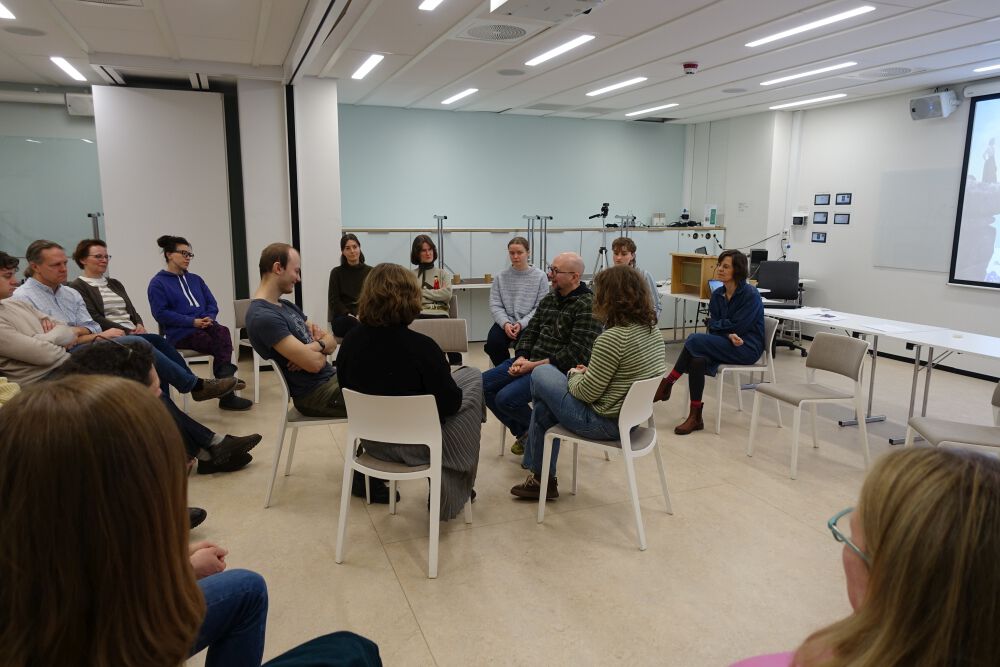
Around 30 people took part, and participants reported that they gained valuable insights into teaching as a collaboration between instructors and students. Here are some impressions and photos from the day.
Teaching as a democratic arena
Den første workshopen, «Teaching as a democratic arena», ble ledet av Ulrike Schnaas, pedagogisk utvikler ved Uppsala universitet.
The first workshop, “Teaching as a democratic arena,” was led by Ulrike Schnaas, a pedagogical developer at Uppsala University.
The session addressed a democratic approach to higher education and asked participants to split into four theme groups to discuss the roles higher education should play in a democracy. Should education prepare students to solve global challenges, create inclusive spaces where everyone participates on equal terms, foster students’ critical thinking, or give students greater influence over their own education? The groups’ conclusions were then shared in plenary.
Schnaas is also co‑author of An Active Student Participation Companion, which is freely available online as a PDF.

Building trust in teaching in the age of AI
The second workshop, “Trust, teaching and the age of AI,” was led by Rachel Forsyth and Mirjam Glessmer, educational developers at Lund University. The session addressed a timely theme: how to build trust between students and staff at a time when artificial intelligence is becoming increasingly influential in education.
They presented and discussed factors that affect trust between stakeholders in a world influenced by AI. On the cognition side, they emphasized that instructors must have subject‑matter expertise and pedagogical insight into how the subject should be taught. On the affective side, it is important to show care for students’ learning and motivation. Instructors should also work on “Trust me” factors, such as taking responsibility for their own professional development, being transparent about expectations of students, and being clear about assessment criteria.
The corresponding role for students—described as an “I trust you!” relationship—is that students show engagement in their own learning, participate actively in teaching activities, and reflect on their learning process and outcomes, among other things.


Summary
Participants were active throughout the two workshops, which consisted of academic presentations, group work and open discussions on student participation and inclusive teaching practices in the geosciences.
“Participants were very satisfied, and the seminar brought together valuable perspectives from both academic staff and students during the three hours we were gathered,” Lundmark summarizes. He is Associate Professor in Geodidactics at the Department of Geosciences.
Lundmark is also pleased with the seminar format, particularly that everyone had the opportunity to contribute — either in groups or in plenary — for example through a “fishbowl” exercise in which some sit in an inner circle and speak while others can swap in. This created dynamic discussions and good academic progress. Perhaps we will see more such sessions in geoscience teaching going forward?
About iEarth
iEarth is a national centre that brings together several Norwegian higher education institutions offering geoscience programmes. iEarth aims to promote a student‑centred and innovative learning environment that empowers tomorrow’s geoscience graduates to meet complex societal challenges.
Read more: iEarth | The Center for Integrated Earth Science Education