
The PhD defence and trial lecture will be held in Auditorium 1 in The Geology Building. In some cases, it will be possible to attend the trial lecture and dissertation digitally, in that case a link to Zoom will be posted.
Trial lecture
Monday 8 June, 10:15-11:00, Aud 1, The Geology Building:
The impact of climate warming on the Arctic ocean dynamics
Conferral summary
The ocean plays an important role for life and the climate on Earth. Ocean currents transport heat, salt, nutrients, and pollution and are therefore of great importance for the complex interactions on Earth. In her dissertation, Anna Lina P. Sjur has used both theoretical models and numerical simulations to investigate what drives the currents around the deep ocean basins in the Arctic Ocean. The study shows that variations in ocean currents can largely be explained by the influence of wind on the ocean surface, as well as friction against the seabed. However, this is not always sufficient; in energetic parts of the ocean, vortices interacting with the uneven seabed can contribute to driving the ocean current in a counterclockwise direction.
Main research findings
Popular scientific article about Sjur’s dissertation:
From Winds to Whirls: Dynamics that shape Arctic Ocean circulation
As the ocean moves, it transports heat, salt, nutrients, and pollution over vast distances. The ocean currents thus have the power to melt sea ice, support ecosystems, and shape both local and global climates. In her doctoral research, Anna Lina P. Sjur investigates how winds and rotating water masses, known as whirls or eddies, work together to shape the currents around the deep ocean basins of the Arctic Ocean.
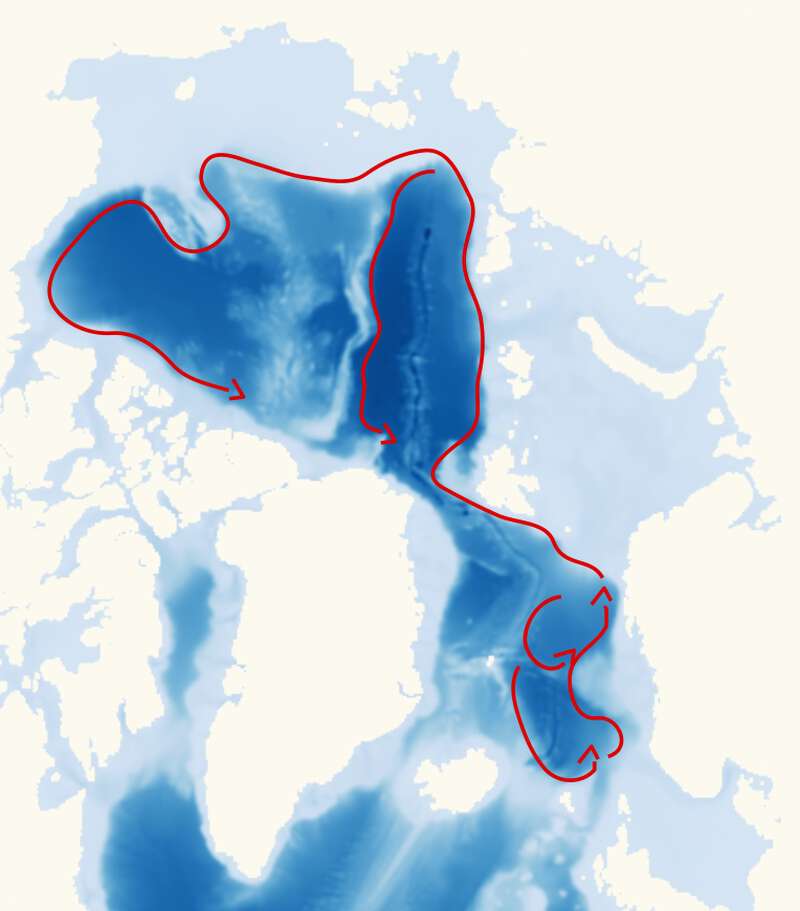
Currents at high latitudes, such as in the Arctic Ocean, are particularly influenced by the shape of the seafloor. Here, the current systems closely follow the continental slopes and underwater mountain ridges, forming closed loops around the basins. Existing theory predicts that as winds blowing over the ocean increase in strength, these currents speed up until bottom friction balances the wind's contribution. This doctoral work by Anna Lina P. Sjur highlights that while this theory often provide a good framework, it does not capture the full picture of the currents dynamics. Whirls interacting with the uneven seafloor can also play a significant role in shaping the currents according to findings in this doctoral work. The impact of the interaction is to drive the flow in an counterclockwise direction.
As sea ice is rapidly retreating in the Arctic, stronger wind influences and more whirls are expected to come in the future. This underscores the need to better understand how winds and whirls influence ocean currents. Such knowledge is crucial for monitoring the impacts of these currents on the climate system and ecosystems, as well as for improving ocean predictions.
Photo and other information:
Press photo: Anna Lina Petruseviciute Sjur, portrait; 850px. Photo: Private

Other photo material: Figure with description and credit as specified in the article above, size 800px.