
Disputas og prøveforelesning er i Auditorium 1 i Geologibygningen. I noen tilfeller vil prøveforelesning og disputas være mulig å delta på digitalt, i så fall blir det lagt ut en lenke til Zoom.
Prøveforelesning
Mandag 8 juni, 10:15-11:00, Aud 1, Geologibygningen:
The impact of climate warming on the Arctic ocean dynamics
Kreeringssammendrag
Havet spiller en viktig rolle for livet og klimaet på jorda. Havstrømmer transporterer varme, salt, næringsstoffer og forurensning, og er dermed av stor betydning for det komplekse samspillet på jorda. I sin avhandling har Anna Lina P. Sjur brukt både teoretiske modeller og numeriske simuleringer for å undersøke hva som driver strømmene rundt de dype havbassengene i Nordishavet. Studien viser at variasjoner i havstrømmen i stor grad kan forstås av påvirkning av vind på havoverflaten, samt friksjon mot havbunnen. Men dette er ikke alltid nok; i energetiske deler av havet vil i tillegg virvler som interagerer med ujevnheter i havbunnen ha nok energi til å være med på å drive havstrømmen mot klokkeretningen.
Hovedfunn
Populærvitenskapelig artikkel om Sjurs avhandling:
From Winds to Whirls: Dynamics that shape Arctic Ocean circulation
As the ocean moves, it transports heat, salt, nutrients, and pollution over vast distances. The ocean currents thus have the power to melt sea ice, support ecosystems, and shape both local and global climates. In her doctoral research, Anna Lina P. Sjur investigates how winds and rotating water masses, known as whirls or eddies, work together to shape the currents around the deep ocean basins of the Arctic Ocean.
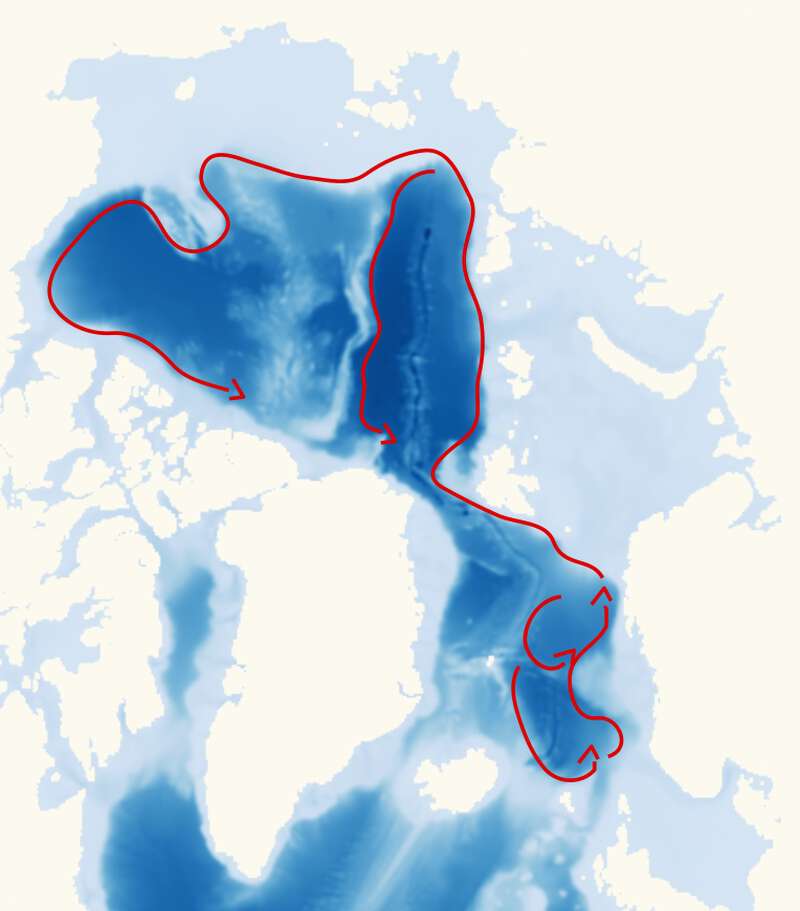
Currents at high latitudes, such as in the Arctic Ocean, are particularly influenced by the shape of the seafloor. Here, the current systems closely follow the continental slopes and underwater mountain ridges, forming closed loops around the basins. Existing theory predicts that as winds blowing over the ocean increase in strength, these currents speed up until bottom friction balances the wind's contribution. This doctoral work by Anna Lina P. Sjur highlights that while this theory often provide a good framework, it does not capture the full picture of the currents dynamics. Whirls interacting with the uneven seafloor can also play a significant role in shaping the currents according to findings in this doctoral work. The impact of the interaction is to drive the flow in an counterclockwise direction.
As sea ice is rapidly retreating in the Arctic, stronger wind influences and more whirls are expected to come in the future. This underscores the need to better understand how winds and whirls influence ocean currents. Such knowledge is crucial for monitoring the impacts of these currents on the climate system and ecosystems, as well as for improving ocean predictions.
Foto og annen informasjon:
Pressefoto: Anna Lina Petruseviciute Sjur, portrett; 850px. Foto: Privat

Annet bildemateriale: Figur med beskrivelse og kreditering som spesifisert i artikkelen over, størrelse 800px.