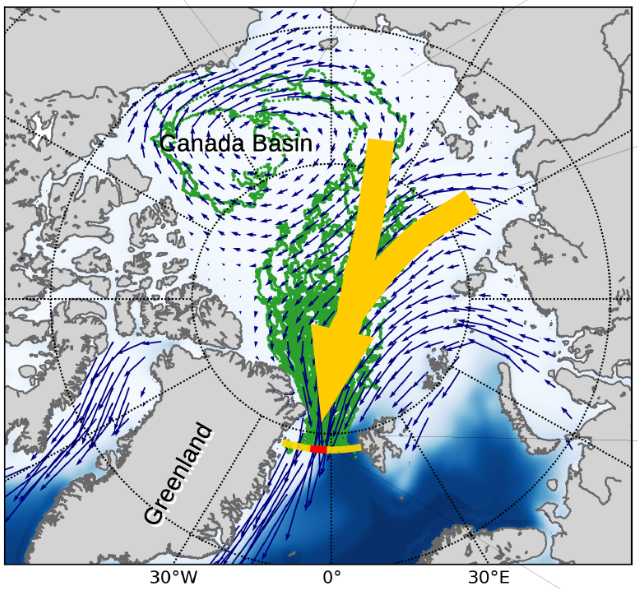
The Fram Strait between Greenland and Svalbard (Figure 1) is an important gateway between the Arctic Ocean and the North Atlantic. Here, warm and salty Atlantic water enters the Arctic via the West Spitsbergen Current (WSC) and cold and fresh water exits via the East Greenland Current (EGC), resulting in heat transport into the polar ocean and freshwater transport out of it. Understanding what controls this ocean transport is crucial to our overall understanding of the Arctic Ocean's role in the climate system.
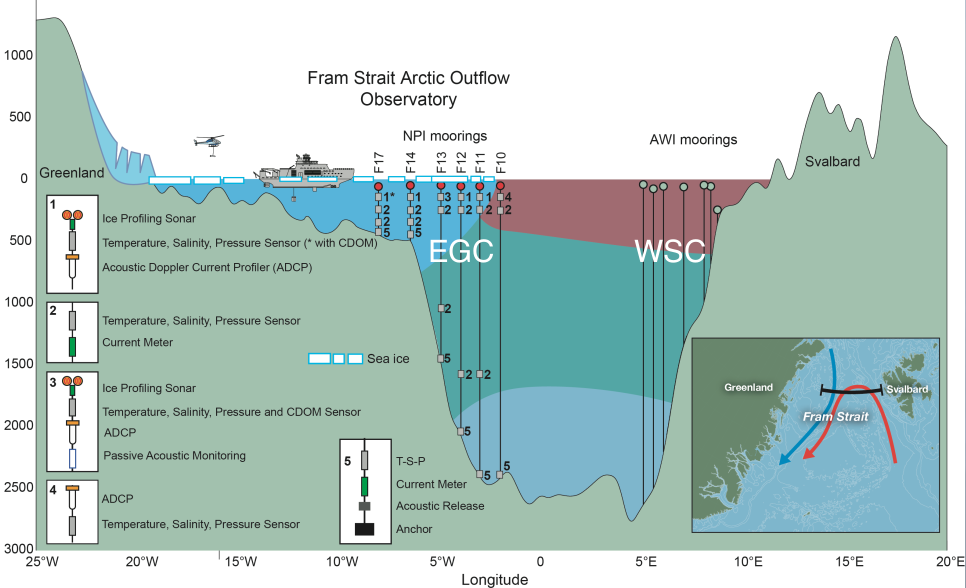
The Norwegian Polar Institute (NPI) and the Alfred Wegner Institute (AWI) have measured temperature, salinity, currents and sea ice thickness in the Fram Strait since the 1990s using moored instruments (Figure 2). The observations have given valuable quantitative estimates of the heat and freshwater transport—and their variability—in and out of the Arctic. But work still needs to be done on understanding the dynamical processes that govern the flow variability observed in this key gateway region.
We offer two master projects where the student will work with the NPI and AWI datasets:
- Study of co-variability between flows in the EGC and WSC: Current observations with monthly time resolution from both sides of the Fram Strait will be used to examine how the EGC and WSC co-vary. As the inset in Fig. 2 shows, there is a part of the WSC which recirculates locally in the Fram Strait. But another part which enters the Arctic Ocean also eventually returns to the Fram Strait and becomes part of the EGC. The student will relate the observed co-variability between the two sides in light of theories we have for the large-scale ocean circulation in the region.
The work will involve signal processing techniques, including the use of Fourier and filter methods. The student will also need to get familiar with and put the findings in relation to ‘closed f/H’ theory.
- Study of vertical structure of currents in the EGC: High-frequency observations from the EGC will be used to describe the vertical structure of flow variability here. The purpose is to see if we can understand this structure in terms of known ocean dynamics, such as i) the propagation of so-called topographic waves along continental slopes and ii) the generation of mesoscale eddies by instabilities in the large-scale currents.
The work will involve signal processing techniques, including the use of Fourier, filter methods and principal component analysis (PCA). To examine the relation of observed flow variability to hydrodynamical instability, linear stability analysis on the hydrography and large-scale currents will also be done.
The work will be a collaboration between MetOs/UiO, NPI and AWI.
The student(s) may have the opportunity to participate in an oceanographic cruise in the Fram Strait in Aug-Sep.