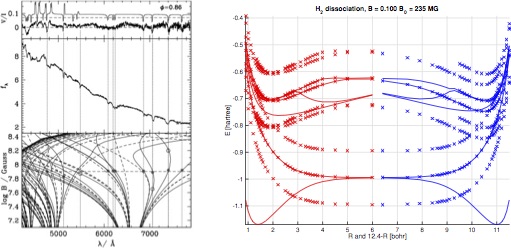
On Earth, chemistry is governed by Coulomb interactions, the effect of magnetism being weak and subtle. Elsewhere, the situation is different—on many white dwarf stars, for example, magnetic forces compete with electric forces, setting up an exotic chemistry of egg-shaped atoms that interact in unexpected ways [2, 3]. Apart from shedding light on a fascinating chemistry that cannot be experienced directly, the study of chemistry in ultrastrong magnetic fields thus has relevance in astrophysics. Following the serendipitous first observation of molecules on nonmagnetic white dwarf stars in 2013 [4], we will simulate spectra of H2 for their detection on magnetic white dwarfs, in collaboration with astrophysicist J. S. Heyl at the University of British Columbia, with whom an application for Hubble observation time will be made. If successful, it would be the first glimpse of chemistry in an environment where electric and magnetic forces compete. However, demands are high in terms of the accuracy required and the number of states, field strengths, and field orientations that must be addressed, see the figure above. For sufficient accuracy, (anisotropic) basis sets must be designed, benchmarked against the basis-set limit established with the MRCHEM multiwavelet code of RT1.
Responding to our work on the magnetic bond, Murdin et al. [5] noted that, in semiconductor impurities, the dielectric constant of the material and effective mass of the electron combine to enhance the effective strength of the magnetic field for the impurity relative to that experienced by a free molecule. The effects of ultrastrong fields may therefore be studied inside impurities, at laboratory field strengths, prompting speculation that magnetic bonding may be observed under laboratory conditions, with far-reaching implications. This observation provides compelling motivation for extending our study to large systems. Combining LONDON with multiscale methods, we will study magnetic enhancement effects in large systems and its effect on bonding. Moreover, for a broader picture of chemistry, molecular dynamics in a magnetic field will be developed. Although the Born– Oppenheimer approximation is still valid for fields up to 105 T as considered here, a non-adiabatic Lorentz correction [6] to the forces must be calculated. LONDON is the only code capable of performing gauge-invariant FCI [7], CCSD(T) [8], and CDFT [9, 10] calculations in magnetic fields; its extension to large systems, multiscaling and dynamics goes well beyond the state of the art, allowing new phenomena to be studied.
There is an intriguing connection between ultrastrong magnetic fields and ultrahigh pressure: both squeeze matter, creating highly complicated, electronic systems, challenging our understanding of chemistry and our computational models. For instance, under high pressure, helium has an hcp crystal phase; in ultrastrong magnetic fields, it forms magnetically bonded structures suggestive of a hexagonal 2D crystal lattice. Recently, materials have been studied at pressures up to 400 GPa, revealing a chemistry with novel structural, electronic, and magnetic properties, challenging our intuition [11]. Noting that ultrahigh pressure poses challenges similar to those of an ultrastrong magnetic field, in both cases related to electron confinement, we will develop and adapt the methods of electronic-structure theory to explore both phenomena.
[1] F. Euchner et al. “Zeeman tomography of magnetic white dwarfs III. The 70–80 Megagauss magnetic field of PG 1015+014”. Astron. Astrophys. 451 (2006), 671. [2] D. Lai. “Matter in strong magnetic fields”. Rev. Mod. Phys. 73 (2001), 629. [3] A. Thirumalai et al. “Energy Levels of Light Atoms in Strong Magnetic Fields”. Adv. At., Mol., Opt. Phys. 63 (2014), 323. [4] S. Xu et al. “Discovery of molecular hydrogen in white dwarf atmospheres”. Astrophys. J. Lett. 766 (2013), L18. [5] B. N. Murdin et al. “Si:P as a laboratory analogue for hydrogen on high magnetic field white dwarf stars”. Nat. Commun. 4 (2012), 1469. [6] P. Schmelcher et al. “On the validity of the Born–Oppenheimer approximation in magnetic fields”. J. Phys. B 21 (1988), L445. [7] K. K. Lange et al. “A paramagnetic bonding mechanism for diatomics in strong magnetic fields”. Science 337 (2012), 327. [8] S. Stopkowicz et al. “Coupled-cluster theory for atoms and molecules in strong magnetic fields”. J. Chem. Phys. 143 (2015), 074110. [9] J. W. Furness et al. “Current density-functional theory using meta-generalized gradient exchange–correlation functionals”. J. Chem. Theory Comput. 11 (2015), 4169. [10] E. I. Tellgren et al. “Non-perturbative calculation of molecular magnetic properties within current-density functional theory”. J. Chem. Phys. 140 (2014), 034101. [11] W. Grochala et al. “The chemical imagination at work in very tight places”. Angew. Chem. Int. Ed. 46 (2007), 3620.