Citation
Vrålstad, Anders Emil and Fosodeder, Peter and Deibele, Karin Ulrike and Nyrnes, Siri Ann and Rindal, Ole Marius Hoel and Skoura-Torvik, Vibeke and Mienkina, Martin and Måsøy, Svein-Erik, "Coherence-Based Sound Speed Aberration Correction–With Clinical Validation in Fetal Ultrasound," in IEEE Transactions on Medical Imaging, vol. 45, no. 7, pp. 4047–4057, July 2026, doi: 10.1109/TMI.2026.3691415
About the paper
Standard clinical ultrasound scanners reconstruct ultrasound images under the assumption that sound waves propagate through human tissue at a constant speed of 1540 m/s. However, human tissue is highly heterogeneous. In obstetric imaging, sound waves travel significantly slower through maternal fat layers, averaging approximately 1440 m/s. This velocity mismatch creates acoustic aberrations that defocus the ultrasound beam, blur structural details, and introduce physical measurement uncertainty into the millimetric fetal measurements used by obstetricians to assess growth and estimate delivery dates. While many babies naturally miss their estimated delivery dates due to biological variation, physical measurement uncertainty shouldn't add to that error.
The proposed method calculates a coherence-based estimation of the aberration directly from the raw received channel data, adjusting the beamforming delays dynamically. To evaluate its clinical utility, a validation study was performed on 172 fetal ultrasound images. Three expert clinicians compared the corrected reconstructions against standard delay-and-sum (DAS) images, rating the corrected images as superior or equivalent in 72.5% of the cases.
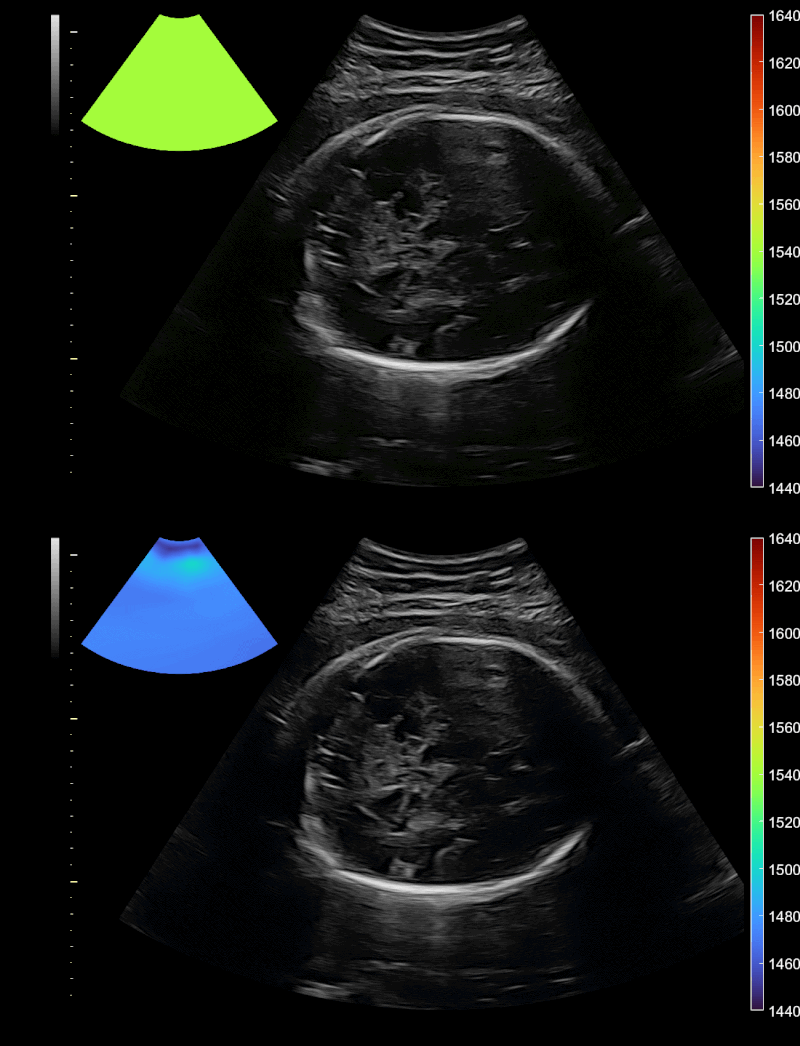
This publication represents the final chapter of Anders Vrålstad's PhD research at NTNU as a part of Centre for Innovative Ultrasound Solutions (CIUS), conducted in close collaboration with:
- GE HealthCare Voluson Ultrasound
- St. Olavs Hospital (Trondheim University Hospital)
- The Norwegian University of Science and Technology (NTNU)
- The Digital Signal Processing and Image Analysis (DSB) group at the University of Oslo (UiO)
Early development and modeling of these algorithms were supported by the open-source UltraSound ToolBox (USTB), which is actively maintained by the DSB group.
- Direct to the paper: https://ieeexplore.ieee.org/document/11513579
- Project page (with example images): https://andersvra.github.io/research/coherenceaberration/
- Preprint (openly available): https://arxiv.org/pdf/2411.16551
Bibtex record
@article{vralstad2026,
  author={Vrålstad, Anders Emil and Fosodeder, Peter and Deibele, Karin Ulrike and Nyrnes, Siri Ann and Rindal, Ole Marius Hoel and Skoura-Torvik, Vibeke and Mienkina, Martin and Måsøy, Svein-Erik},
  journal={IEEE Transactions on Medical Imaging},
  title={Coherence-Based Sound Speed Aberration Correction---With Clinical Validation in Fetal Ultrasound},
  year={2026},
  volume={45},
  number={7},
  pages={4047--4057},
  doi={10.1109/TMI.2026.3691415}
}