- Citation: Sufayan Mulani, Mahsa Sotoodeh Ziksari, Andreas Austeng, Sven Peter Näsholm (2026). Rectified wavenumber algorithms for efficient ultrasound imaging, Ultrasonics, p. 108227.
- Read the full paper: https://doi.org/10.1016/j.ultras.2026.108227 (currently in author-typeset pre-proof version. Will also become openly available in the journal.)
Highlights
- Remarkably more efficient ultrasound image formation for common transmit schemes.
- Produces the same image output as traditional processing.
- Builds on existing and efficient wavenumber-domain algorithms.
- Significantly reduced computational cost compared to conventional methods.
- Future cost-reduction impacts in terms of reduced hardware and software requirements.
Abstract
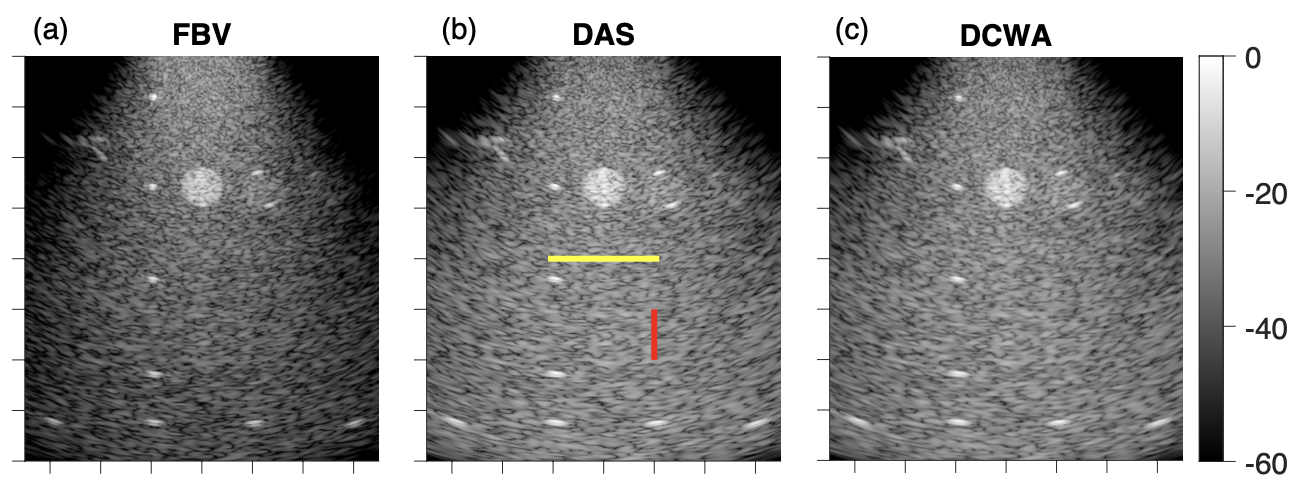
Wavenumber-domain beamforming offers substantial computational advantage over conventional time-domain algorithms in ultrasound image formation. However, these methods are found to introduce distortions at large angles and greater depths, making it nontrivial to replace conventional processing pipelines with wavenumber-domain approaches. This paper presents a wavenumber-domain framework that produces images consistent with conventional delay-and-sum (DAS) beamforming, while retaining the computational efficiency of Fourier-domain processing. Building on recent work on DAS-consistent imaging for multistatic acquisition data, the key utility of this novel algorithm is its applicability in plane-wave, focused-transmit, and diverging-wave imaging. The approach compensates for the implicit spatial-frequency filtering of earlier wavenumber-domain formulations through a modified Fourier-domain weighting and an axial scaling to the reconstructed image. Using data from simulations, phantom experiments, and in-vivo liver imaging, we demonstrate that the proposed method preserves DAS-equivalent amplitude, speckle statistics, resolution, and contrast. Quantitative image comparison confirms a close agreement between DAS and the proposed method with Structural Similarity (SSIM) values exceeding 0.99, whereas SSIM between earlier wavenumber-domain beamformers and DAS is lower, ranging from 0.67 to 0.92 depending on the transmit scheme. The proposed method yields approximately one order-of-magnitude reduction in computational cost compared to conventional DAS, making it well-suited for real-time and resource-constrained ultrasound systems.
BibTeX record
@article{mulani2026rectified,
title = {Rectified wavenumber algorithms for efficient ultrasound imaging},
journal = {Ultrasonics},
pages = {108227},
year = {2026},
issn = {0041-624X},
doi = {10.1016/j.ultras.2026.108227},
author = {Mulani, Sufayan and Ziksari, Mahsa Sotoodeh and Austeng, Andreas and Näsholm, Sven Peter}
}