|
We are happy to announce that our work is set to appear in the IEEE Open Journal of Ultrasonics, Ferroelectrics, and Frequency Control, and is currently available in early access! H. K. Arnestad, O. M. H. Rindal, A. Austeng and S. P. Näsholm, "Robust non-parametric estimation of speckle probability densities and gCNR," in IEEE Open Journal of Ultrasonics, Ferroelectrics, and Frequency Control, doi: 10.1109/OJUFFC.2024.3445868. |
|---|
Link to article
Link to code
Abstract:
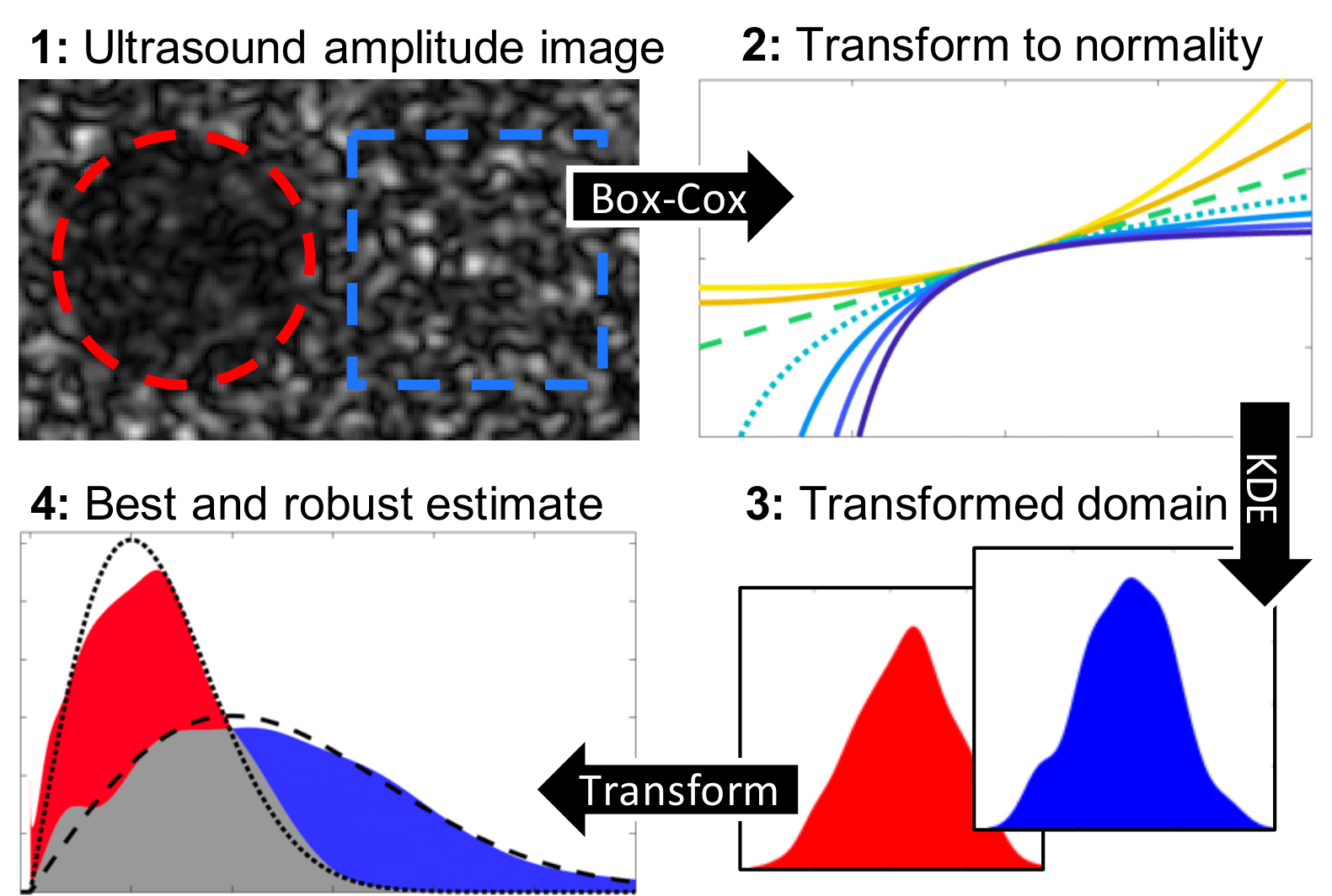
In ultrasound imaging, speckle originates from a large amount of sub-resolution scatterers within the medium. In idealized cases, the speckle envelope statistics follow a Rayleigh distribution, but in practical pulse-echo imaging, the distribution depends on both the imaging system and the underlying tissue structure. Estimating envelope statistics is part of quantitative ultrasound workflows and is also important for image quality assessment as it relates to lesion and tissue detectability. A concrete example is the generalized contrast-to-noise ratio (gCNR), which is a functional of two pixel-value probability density functions (PDFs) from different speckle regions. Such speckle PDFs have, by convention, been estimated from data using histograms, but the accuracy of these estimates can be affected by the nontrivial selection and tuning of the binning parameters. However, the statistics literature widely advocates kernel density estimation (KDE) as a better alternative to histogram-based approaches. In this article, we propose applying a KDE-based method to estimate speckle PDFs in medical ultrasound imaging. The method is practically tuning-free and leverages the Box-Cox transformation to achieve best-in-class performance across a wide range of test cases, and is also robust in cases where gCNR estimation may otherwise fail, such as for skewed distributions that may arise with adaptive beamformers. Furthermore, this work highlights theoretical aspects related to the estimation of PDFs and derived quantities, including the gCNR.
Highlights:
- The use of histograms to estimate envelope statistics and gCNR is associated with pitfalls and limitations. We propose a robust tuning-free method that performs well in all cases analyzed.
- The method leverages kernel density estimation (KDE). This can be combined with a Box-Cox power transform, yielding a globally near-optimal bandwidth selection, among other benefits.
- Previous research on envelope statistics is placed in a context of statistical density estimation, and implications for derived quantities such as gCNR (a density functional) are highlighted.
Published in: IEEE Open Journal of Ultrasonics, Ferroelectrics, and Frequency Control ( Early Access )
Date of Publication: 19 August 2024
DOI: 10.1109/OJUFFC.2024.3445868
@ARTICLE{10638550,
  author={Arnestad, Håvard Kjellmo and Rindal, Ole Marius Hoel and Austeng, Andreas and Näsholm, Sven Peter},
  journal={IEEE Open Journal of Ultrasonics, Ferroelectrics, and Frequency Control},
  title={Robust non-parametric estimation of speckle probability densities and gCNR},
  year={2024},
  volume={},
  number={},
  pages={1-1},
  keywords={Estimation;Speckle;Probability density function;Kernel;Histograms;Ultrasonic imaging;Bandwidth;Beamforming;envelope statistics;speckle PDF;gCNR;histogram;kernel density estimation;Box-Cox},
  doi={10.1109/OJUFFC.2024.3445868}}