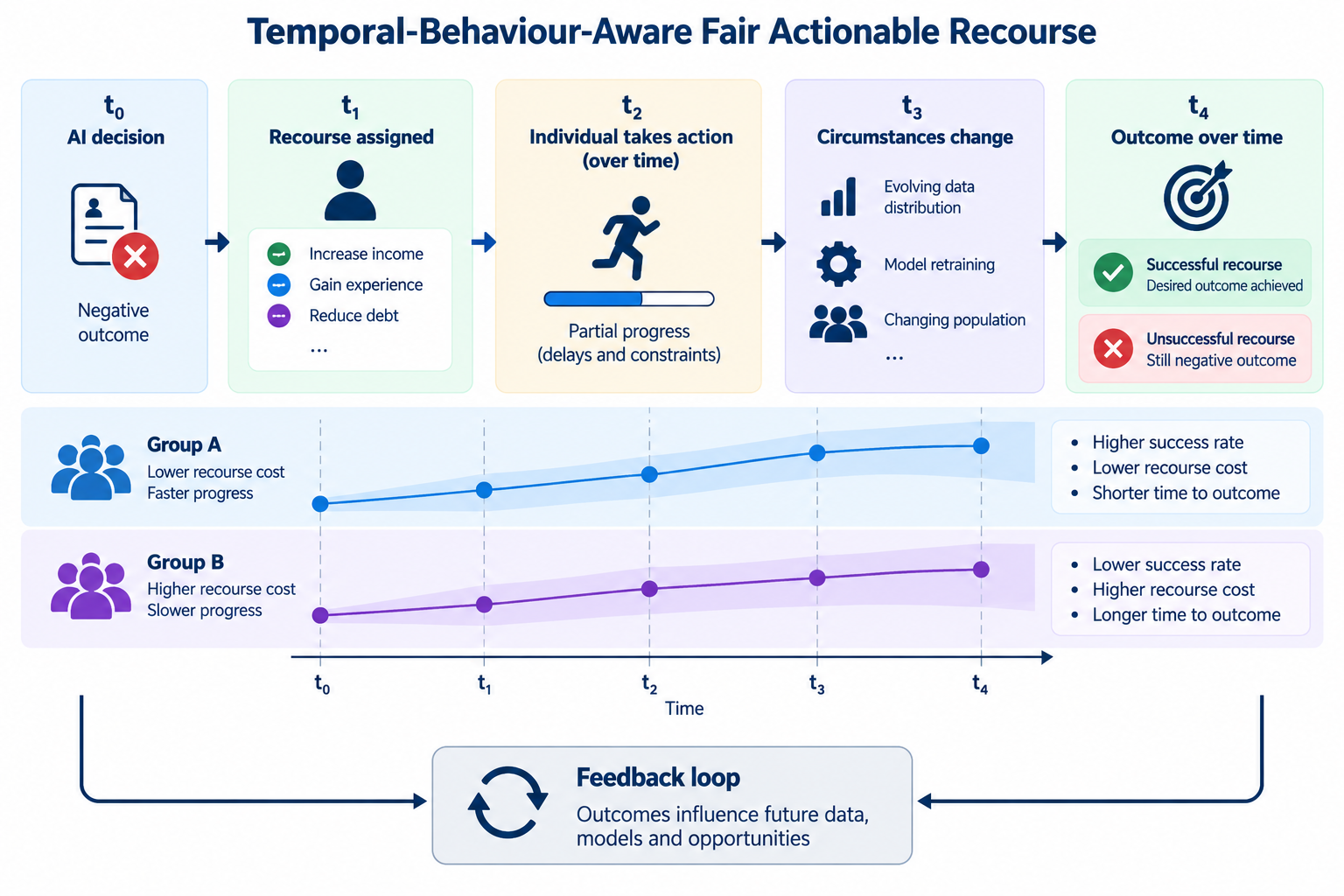
In this master's thesis, we will investigate actionable recourse and fairness as a dynamic process evolving over time, rather than evaluating recourse only at a single point in time.
A central part of the project will be the development of a simulation framework in which individuals follow behavioural trajectories after receiving recourse. Actions may occur gradually or with delays, while individual attributes, population distributions, resource constraints, and decision models evolve. This will make it possible to study both individual recourse success and longer-term group-level consequences.
The student may investigate when recourse becomes outdated, whether recommendations should be updated as circumstances change, and how repeated model retraining and feedback loops affect different groups. Another direction is to develop adaptive recourse, where recommendations are periodically reconsidered instead of being treated as one-time interventions.
Depending on the student's interests, the thesis may investigate questions such as:
- How does delayed implementation affect the success of actionable recourse?
- When does a previously valid recommendation become outdated?
- How do behavioural changes and evolving circumstances affect recourse feasibility and cost?
- Do different groups experience systematically different recourse costs, delays, or success rates?
- How do repeated model retraining and recourse interventions influence fairness over time?
- Can adaptive recourse maintain comparable opportunities and success rates across groups?
- How can a simulator capture interactions among individuals, recourse strategies, resource constraints, feedback loops, and evolving data distributions?
The project combines machine learning, responsible AI, algorithmic fairness, actionable recourse, temporal modelling, and simulation, with a particular focus on understanding the long-term consequences of AI-assisted decisions.