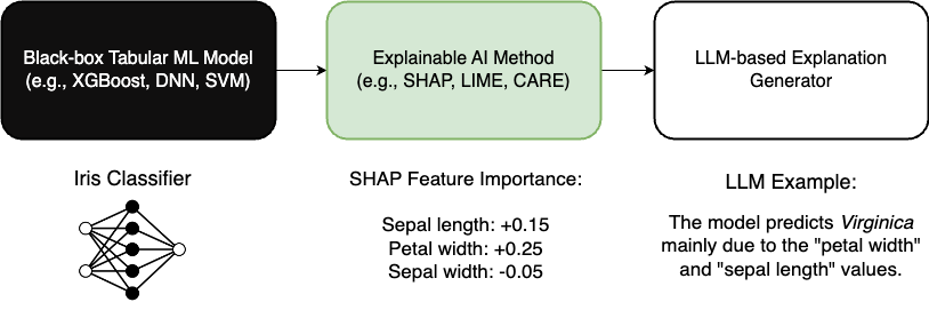
Explainable AI (XAI) aims to bridge this gap by developing techniques that shed light on the decision-making processes of complex models. While existing XAI methods such as SHAP, LIME, and Counterfactual Explanations have proven useful, they often fail to communicate explanations effectively to non-technical stakeholders. Recent advancements in Large Language Models (LLMs) offer a promising opportunity to generate human-readable explanations that are more comprehensive and accessible.
This Master’s thesis will explore the potential of combining LLMs with XAI techniques to enhance the interpretability of black-box models, making their predictions more understandable across various domains. The goal is to develop a model-agnostic explanation framework that leverages LLMs to translate traditional XAI outputs into coherent narratives, allowing stakeholders to gain a clearer understanding of model predictions. The project will integrate LLMs with widely used XAI techniques to achieve consistency in the generated explanations and ensure their applicability to a wide range of black-box models.
The healthcare domain will be a primary focus of this project, specifically through a use case provided by a biotech company called NEC OncoImmunity (https://www.oncoimmunity.com/). The framework will be applied to a healthcare model to demonstrate its effectiveness in enhancing interpretability and trust in critical, real-world scenarios.
The project has several objectives:
- Developing a generalizable pipeline for generating LLM-based explanations applicable to any black-box model trained on tabular datasets.
- Comparing the effectiveness of traditional XAI techniques (e.g., SHAP, LIME) with LLM-generated explanations regarding clarity, user comprehension, and trustworthiness.
- Designing evaluation metrics to assess the quality of LLM-generated explanations and conducting user studies to gauge their impact on stakeholders' understanding and trust.
This master’s project aims to contribute to the field of Explainable AI by introducing a scalable approach that utilizes the capabilities of LLMs to enhance the interpretability of black-box models, improving transparency and fostering trust in AI-driven decision-making processes. Experience in Python programming and machine learning is a benefit.